Lattice
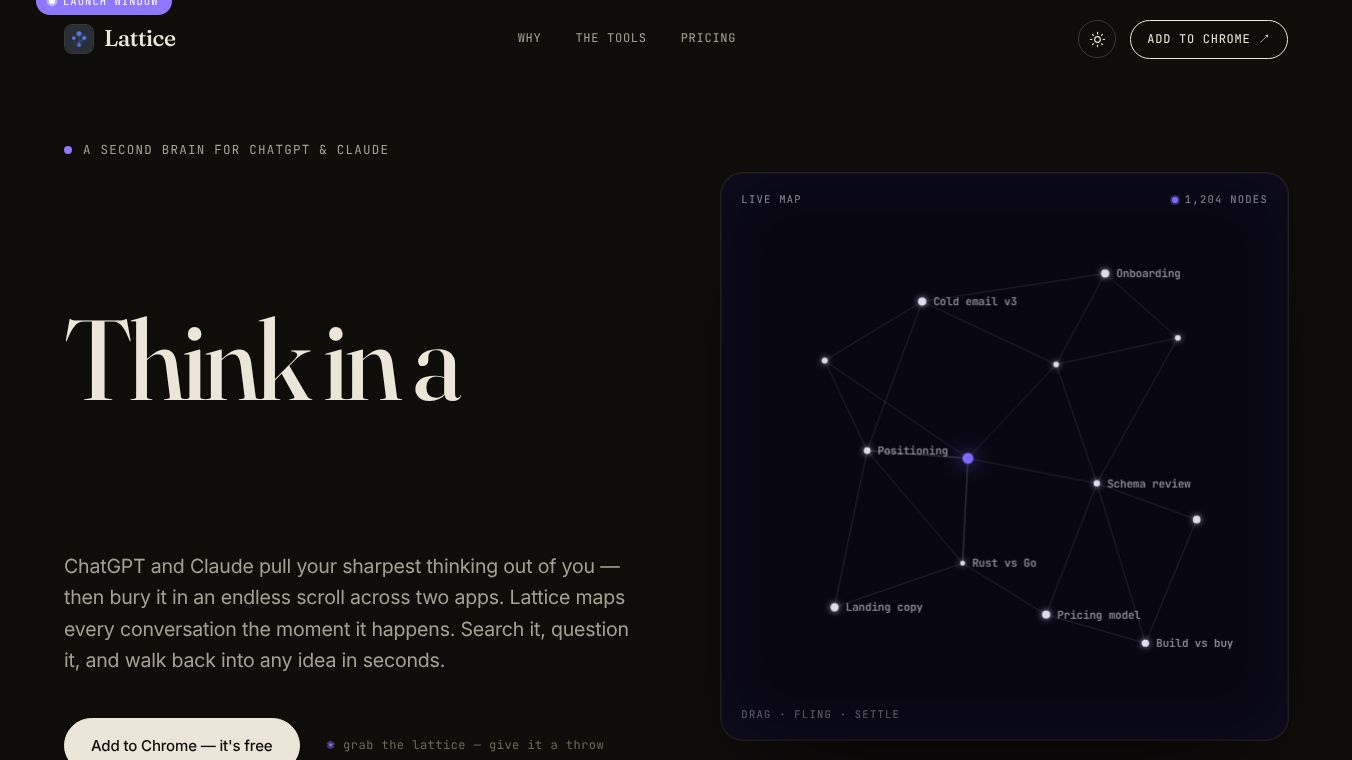





Lattice: Map Your Thinking, Not Just Scroll
Introduction
Lattice is a browser tool designed to help people organize their thoughts using artificial intelligence. While most AI chat apps force users to scroll through endless lists of conversations, Lattice turns those chats into a visual map. This map lets users see all their ideas at once instead of searching through a long history. It works by capturing conversations from popular AI tools like ChatGPT and Claude automatically in the background.
Benefits
Lattice solves several common problems that users face when using AI assistants. First, it prevents the loss of context. In standard apps, every new chat starts from zero, meaning users must re-explain old ideas. Lattice stores everything in one place so users never have to start over. Second, it removes the scroll burden. Breakthrough ideas often get buried deep in a list of chats. With Lattice, users can jump instantly to any specific idea or turn in a conversation without endless scrolling. Third, it preserves every version of a reply and every prompt iteration. This means users can revisit paths they abandoned if they turn out to be correct later. Finally, the tool groups related conversations into themes, helping users spot patterns in their own thinking that they might otherwise miss.
Use Cases
Lattice is ideal for anyone who uses AI for deep work, research, or creative projects. It is perfect for students who need to track complex research topics over weeks or months. Professionals who brainstorm product ideas or solve difficult problems will find the spatial navigation helpful for connecting different thoughts. Writers and strategists can use the thinking clusters feature to organize their drafts or plan their next moves. The tool is also great for teams or individuals who switch between different AI platforms, as it unifies their history into a single searchable shelf. Users simply install the Chrome extension, chat naturally as usual, and then press a keyboard shortcut to view their entire history as a connected map.
Pricing
Lattice offers a flexible pricing model to suit different needs. Currently, the tool is completely free to use while the team finalizes the product. This free tier includes mapping up to 50 conversations, full access to the map and library, and a daily allowance of queries. For users who need more, there is a Pro tier priced at $8 per month. This plan unlocks unlimited conversation mapping, unlimited queries, and weekly reports on thinking progress. There is also a Founding Tier available for $79.99 as a one-time payment. This limited edition seat provides everything in the Pro tier forever, including all future updates and a badge for founding members. Only 50 of these seats are available.
Vibes
Public reception for Lattice has been very positive since its launch. Users appreciate the "local-first" architecture, which means all data stays on their own device and never leaves their computer. This has built strong trust among privacy-conscious users. Reviews highlight how the tool changes the way people interact with AI by giving their thoughts a physical place to live. Many users feel relieved that they no longer lose half-formed ideas when switching tabs or starting new sessions. The ability to ask questions about their own past conversations and get cited answers has been called a game-changer for research and learning.
Additional Information
Lattice prioritizes privacy through a local-first design. All conversations live entirely on the user's machine within the browser storage. The tool does not send data to servers or track which threads are opened. For the "Ask" feature, users provide their own AI keys for providers like OpenAI or Claude. These keys stay on the device and communicate directly with the chosen provider. Users have full control and can delete any conversation or their entire history with a single click. Since data is never stored remotely, deletion is immediate and permanent. The tool is currently available as a Chrome extension with no complex setup required.
This content is either user submitted or generated using AI technology (including, but not limited to, Google Gemini API, Llama, Grok, and Mistral), based on automated research and analysis of public data sources from search engines like DuckDuckGo, Google Search, and SearXNG, and directly from the tool's own website and with minimal to no human editing/review. THEJO AI is not affiliated with or endorsed by the AI tools or services mentioned. This is provided for informational and reference purposes only, is not an endorsement or official advice, and may contain inaccuracies or biases. Please verify details with original sources.


Comments
Please log in to post a comment.