RESVRL
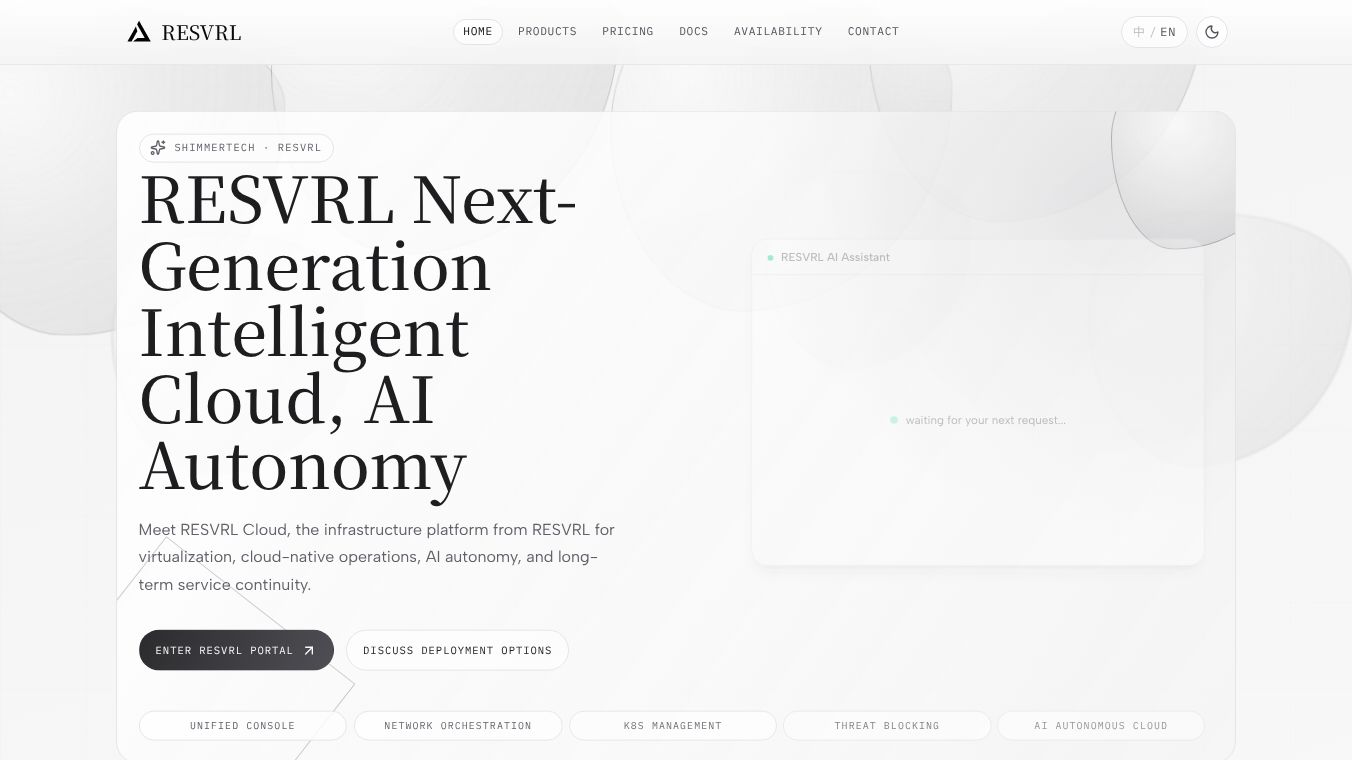





RESVRL: Next-Generation Intelligent Cloud & AI Autonomy Platform
Overview
RESVRL Cloud is an infrastructure platform designed for virtualization, cloud-native operations, AI autonomy, and long-term service continuity. Unlike traditional tools that sit on top of infrastructure, RESVRL is built around a platform-level centralized AI that spans the entire stack from the execution layer to the control plane. This architecture enables self-healing, self-management, self-optimization, and self-defense capabilities.
Core Philosophy: AI Autonomy vs. AIOps
RESVRL distinguishes itself by defining "AI Autonomy" as a distinct product model from standard AIOps.
| Dimension | AIOps | AI Autonomy (RESVRL) |
|---|---|---|
| Action | AI explains incidents and recommends fixes; humans must execute. | AI executes fixes within policy boundaries and verifies outcomes. |
| Architecture | Multiple stitched tools and dashboards. | Unified system integrating control plane, execution layer, and memory. |
| Memory | Event-based, session-limited recommendations. | Persistent memory storing events, context, and history for continuous learning. |
| Outcome | Alerting and analysis; closure depends on manual execution. | Closed-loop operations from sensing to verification. |
Platform-Level Centralized AI
RESVRL embeds sensing, decision-making, execution, and verification directly into the cloud control plane. This approach contrasts with "Tool-level AI," which operates in isolated sandboxes with limited visibility and restricted API scopes. RESVRL's Platform AI offers:
- Global Visibility:Access to every resource across the stack.
- Full-Stack Control:Management from virtualization and OS through Kubernetes, applications, security, and billing.
- Closed-Loop Autonomy:A seamless Detect ->Decide ->Execute ->Verify cycle within policy boundaries.
- Durable Memory:The system persists events, experiences, and timelines to improve future decisions.
The Autonomy Loop
The platform operates through a six-step AI-driven cycle:1.Monitor:Continuous 24/7 monitoring of cloud resources.2.Detect:Identification of anomalies, failures, or degradation.3.Analyze:Contextual analysis using stored facts and experience.4.Act:Automated execution of repairs or policy adjustments.5.Verify:Confirmation that the action resolved the issue.6.Report:Documentation of the timeline and outcome for future learning.
Key Capabilities
1. Natural Language Operations
RESVRL AI allows users to operate any visible resource using natural language, providing full-stack control without needing to navigate complex CLI commands or dashboards.
2. Intelligent Operations & Self-Healing
The AI monitors IaaS, KaaS, and PaaS layers continuously. It detects service degradation, instance failures, and dependency drift, then automatically launches repairs to restore service.
3. Active Defense & Security Coupling
The platform recognizes anomalous traffic, attacks, and risky actions in real-time. It can automatically modify security groups bound to network interfaces to block malicious traffic and generate defensive policies.
4. Network Orchestration
RESVRL provides a unified network control plane for building flexible virtual networks. Features include:* Isolation and address planning.* Resource connectivity management.* Support for different networking modes to create clear, reliable topologies.* Unified scheduling for NAT, gateways, and policies.
5. Kubernetes & Container Management
The platform offers full container orchestration capabilities for production-oriented cluster operations. It includes:* Creation and management of Kubernetes clusters.* A ready-to-use application template marketplace.* Managed deployment, scaling, and runtime operations that hide underlying orchestration details.
6. Continuous Optimization
The system continuously converges capacity, cost, images, and resource scheduling toward better runtime outcomes, ensuring efficiency over time.
Strategic Advantages
Unified Capability Model
Public cloud, private cloud, Kubernetes services, and appliance offerings follow a consistent capability model, ensuring deployment choices do not fragment the platform experience.
One Coordinated Control Plane
Resource management, network governance, and cluster operations converge into a single control plane, reducing switching overhead and complexity.
Scalable Evolution
The platform supports current delivery needs while leaving room for future capabilities. It allows for a "Single-Node Start, Multi-Node Scale" approach, enabling organizations to start with a minimal single-node deployment and scale smoothly to multiple nodes without changing platforms.
Use Cases
- Replacement Upgrade:Transitioning from existing virtualization stacks to a private cloud model with lower long-term costs.
- Cloud-Native Infrastructure:Running virtualization and Kubernetes under one governance model to improve delivery efficiency.
- Multi-Region Hybrid Deployment:Coordinating private cloud, public cloud, and edge nodes under a single architecture strategy.
Conclusion
RESVRL positions itself as an infrastructure platform where AI is the operating system of the cloud. By integrating deeply into the execution and control planes with persistent memory and closed-loop automation, it aims to provide enterprises with a robust solution for long-term service continuity, complex network governance, and intelligent operations that go beyond mere alerting to actual autonomous resolution.
This content is either user submitted or generated using AI technology (including, but not limited to, Google Gemini API, Llama, Grok, and Mistral), based on automated research and analysis of public data sources from search engines like DuckDuckGo, Google Search, and SearXNG, and directly from the tool's own website and with minimal to no human editing/review. THEJO AI is not affiliated with or endorsed by the AI tools or services mentioned. This is provided for informational and reference purposes only, is not an endorsement or official advice, and may contain inaccuracies or biases. Please verify details with original sources.




Comments
Please log in to post a comment.