Remote Agent Collaboration Lite
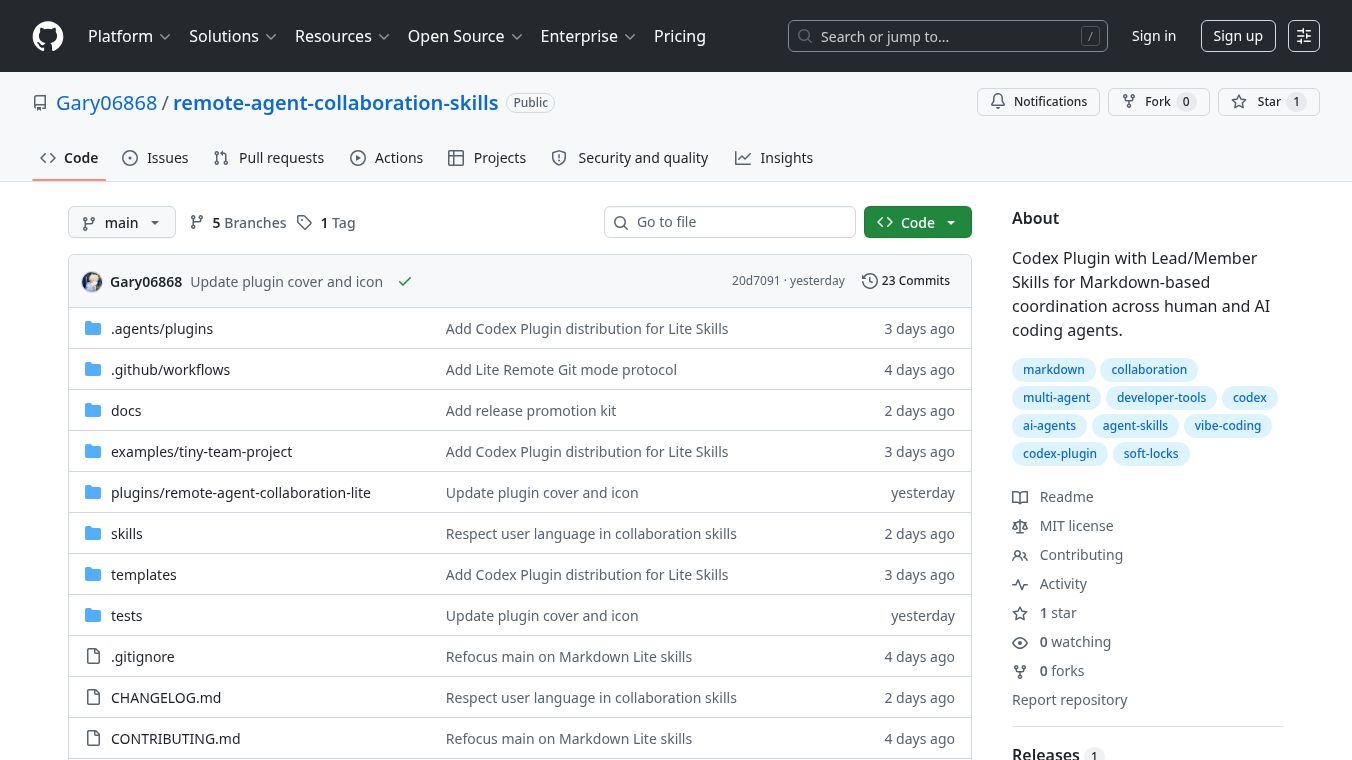





Remote Agent Collaboration Lite: A Markdown-Based Coordination Workflow
Overview
Remote Agent Collaboration Lite is a lightweight tool designed to help small teams, co-founders, contractors, or groups of AI agents work together smoothly within a single project. It acts as a coordination layer that prevents scattered chats and duplicate edits by using a structured system based on standard Markdown files. The tool requires no database, custom server, or complex infrastructure. It relies on simple text files and optional Git for synchronization, making it easy to set up and use.
Benefits
The main advantage of Remote Agent Collaboration Lite is its simplicity. It keeps everyone on the same page without needing heavy software. Key benefits include:
- No Server Needed: The system works with standard Markdown files and does not require a database or custom server infrastructure.
- Clear Roles: It defines specific roles for project leads and team members. Leads set rules and manage identity, while members register their identity and check for active work locks.
- Prevents Conflicts: The tool uses a locking system to ensure that multiple agents do not edit the same files at the same time. This reduces errors and duplicate work.
- Flexible Modes: Users can choose between casual coordination for simple projects or more structured modes like Task Assignment and Module Ownership for complex workflows.
- Easy Integration: The tool works with Codex via a plugin and can also be used with other AI agents like Claude by simply reading the skill files as project instructions.
Use Cases
Remote Agent Collaboration Lite is ideal for small groups that need to coordinate their work without the overhead of enterprise software. Common use cases include:
- Small Teams and Co-Founders: Startups or small groups can use it to manage tasks and avoid stepping on each other’s toes during development.
- Contractor Groups: Freelancers working on the same repository can use the tool to track who is working on what and when.
- AI Agent Swarms: Groups of AI agents working within a single repository can use the system to coordinate their actions and share information through Markdown logs.
- Remote Work: The tool supports both shared workspaces where everyone works in the same directory and remote Git modes where agents work on different machines.
Pricing
Remote Agent Collaboration Lite is available as an open-source project on GitHub. There are no known subscription fees or licensing costs mentioned in the available information. Users can install it via the Codex Plugin marketplace or by manually copying the skill folders to their local environment.
Vibes
As an open-source project hosted on GitHub, the tool has not yet received widespread public reviews or testimonials. However, the project description highlights its practical approach to solving coordination problems. The focus on simplicity and the lack of required infrastructure suggest it is well-received by developers looking for lightweight solutions. The project aims to provide a clear and reliable way for humans and AI agents to collaborate without the complexity of traditional permission systems.
Additional Information
The project was created by Gary06868 and is hosted on GitHub. It is currently available as a plugin for the Codex environment, with the latest plugin version being 0.5.0. The system is designed to be compatible with various AI agent platforms, not just Codex, as long as they can read standard Markdown files. The project emphasizes that it is a soft coordination workflow, meaning it relies on agents following the rules set in the Markdown files rather than enforcing strict OS-level permissions.
This content is either user submitted or generated using AI technology (including, but not limited to, Google Gemini API, Llama, Grok, and Mistral), based on automated research and analysis of public data sources from search engines like DuckDuckGo, Google Search, and SearXNG, and directly from the tool's own website and with minimal to no human editing/review. THEJO AI is not affiliated with or endorsed by the AI tools or services mentioned. This is provided for informational and reference purposes only, is not an endorsement or official advice, and may contain inaccuracies or biases. Please verify details with original sources.


Comments
Please log in to post a comment.