TaskFlow-OS
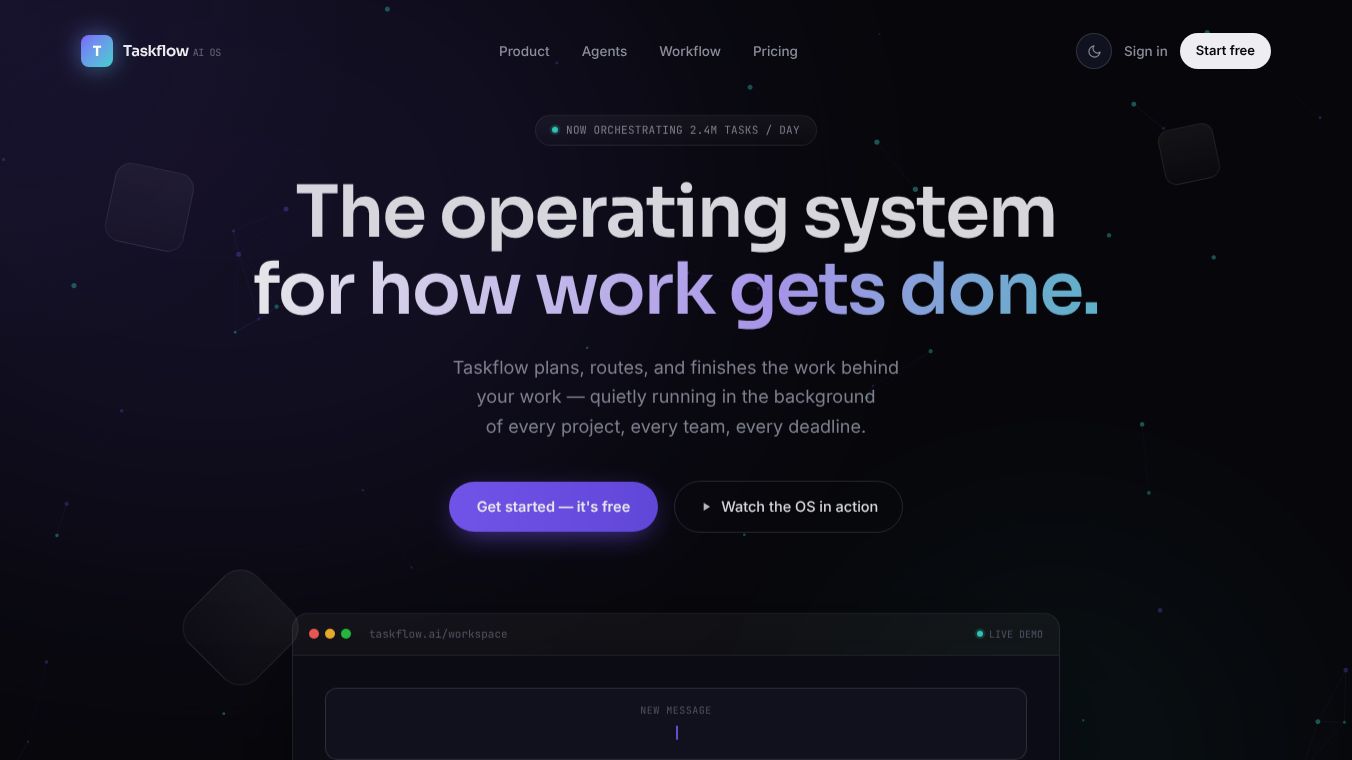





TaskFlow-OS: An AI-Powered Operating System for Autonomous Work Orchestration
Overview
TaskFlow-OS is an AI-powered operating system developed by Taskflow. It is designed to autonomously plan, route, and complete work for teams. Unlike traditional task management tools that only track what needs to be done, TaskFlow-OS operates as an underlying layer that orchestrates tasks and uses AI agents to execute real work quietly in the background. The system captures incoming requests from various communication channels like email, Slack, and voice notes. It then transforms these requests into structured tasks and intelligently routes them to the most suitable person or specialized AI agent based on skill, capacity, and historical context. Shipped in August 2026, the platform aims to reduce manual effort and context switching by integrating directly into existing workflows.
Benefits
TaskFlow-OS offers several key advantages for teams looking to improve efficiency. The system features autonomous routing, which means it automatically reads, understands, and dispatches incoming tasks to the most appropriate human or AI agent. It deploys a specialized agent workforce capable of handling specific tasks such as drafting content, conducting research, performing quality assurance, managing follow-ups, and handling billing. A unique feature called the Living Priority Map provides real-time prioritization and re-ranking of tasks based on shifting deadlines and blockers. The platform also utilizes context memory to pull relevant information from past projects and communications to inform current task execution. Additionally, it offers native integrations with popular platforms like Slack, Linear, Notion, and email without requiring data migration. Users have reported reductions in workflow absorption up to 40% within the first month of use.
Use Cases
TaskFlow-OS is primarily designed for organizations seeking to enhance operational efficiency and automate repetitive tasks within structured team environments. Operations teams can use it to streamline workflows and automate repetitive duties. Agencies can leverage the platform to manage client work, process unstructured client communications into structured Kanban workflows, and automate tasks like creating campaign banners or creative briefs. General teams can use it to reduce context switching and ensure task completion rather than just tracking. It is also ideal for teams requiring autonomous planning, as it automatically structures incoming communications from email, Slack, and voice notes into actionable tasks. Organizations deploying specialized AI agents can use the system for tasks such as drafting, research, quality assurance, and follow-ups, with human oversight for critical approvals.
Pricing
TaskFlow-OS operates on a Subscription SaaS model with three distinct pricing tiers. All plans include a 14-day free trial and are billed annually. No credit card is required to start the trial.
The Studio Plan costs $240 per workspace per month when billed annually at $2,880 per year. This plan includes up to 3 client workspaces, an AI inbox cascade for email and Slack, smart task routing, 10 automation workflows, 7-day AI memory retrieval, and email support.
The Agency Plan costs $600 per workspace per month when billed annually at $7,200 per year. This tier offers unlimited client workspaces, a full AI agent workforce including router, drafting, QA, and billing agents, unlimited automation workflows, unlimited AI memory and semantic search, client billing and invoicing sync, priority Slack support, custom approval workflows, and advanced reporting and forecasting.
The Enterprise Plan features custom pricing available by contacting sales. This plan includes all features of the Agency plan plus dedicated agent infrastructure and GPU pool, SSO, SAML, and full audit logs, a 99.95% uptime SLA, a dedicated success engineer, and custom data residency and retention options.
Vibes
TaskFlow-OS positions itself as an AI Operating System for Work, differentiating from traditional task management tools by focusing on autonomous execution and intelligent routing. It compares favorably to tools like CrewAI, which requires coding knowledge, and n8n, which focuses on broader workflow automation. While Gumloop allows building AI agents using natural language, TaskFlow-OS provides deeper autonomous agent planning and background task orchestration. Compared to Dify, which focuses on agent creation and management, TaskFlow-OS emphasizes continuous background task orchestration for project work. Unlike Goose, which runs locally on a user's machine, TaskFlow-OS offers a cloud-based, team-oriented background orchestration service. The platform is SOC 2 Type II and GDPR ready with data encrypted at rest, ensuring security and compliance for its users.
Additional Information
TaskFlow-OS includes an available API for developers. It supports multimodality, meaning it can process and understand both text and audio inputs for task generation and context gathering. The system uses a proprietary mechanism for function calling, enabling AI agents to interact with external tools and systems. The Enterprise plan guarantees a 99.95% uptime SLA. All plans are SOC 2 Type II and GDPR ready, with data encrypted at rest to ensure security and compliance.
This content is either user submitted or generated using AI technology (including, but not limited to, Google Gemini API, Llama, Grok, and Mistral), based on automated research and analysis of public data sources from search engines like DuckDuckGo, Google Search, and SearXNG, and directly from the tool's own website and with minimal to no human editing/review. THEJO AI is not affiliated with or endorsed by the AI tools or services mentioned. This is provided for informational and reference purposes only, is not an endorsement or official advice, and may contain inaccuracies or biases. Please verify details with original sources.

Comments
Please log in to post a comment.