OpenClaw LLM Proxy





OpenClaw LLM Proxy: A Comprehensive Guide
Overview
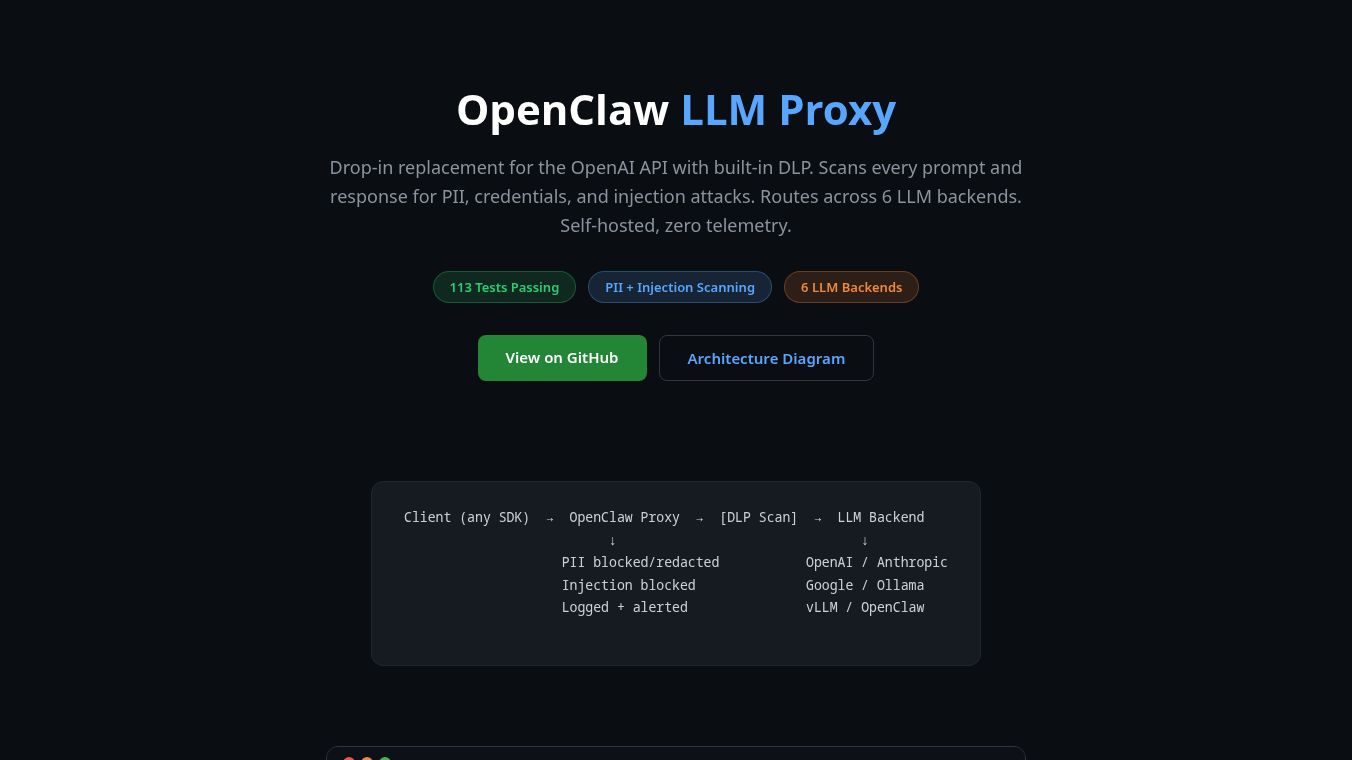
OpenClaw is a self-hosted, zero-telemetry LLM proxy designed as a drop-in replacement for the OpenAI API. It acts as a centralized security and routing layer, scanning every prompt and response for PII (Personally Identifiable Information), credentials, and injection attacks before they reach the provider. Unlike other proxies like LiteLLM, Portkey, or OpenRouter, OpenClaw uniquely integrates deep security scanning with multi-provider routing.
Key Differentiators
While tools like LiteLLM and Portkey handle multi-provider routing and API translation, they lack built-in security scanning. OpenClaw fills this gap by:-Scanning for PII & Credentials:Detects SSNs, credit cards, and API keys in both inbound prompts and outbound responses.-Injection Detection:Identifies and blocks prompt injection attacks.-Security Alerts:Sends real-time webhooks to Slack or PagerDuty for security events.-Self-Hosted:Runs entirely on your infrastructure with no external telemetry.
Benefits
OpenClaw provides several key advantages for organizations managing large language model deployments. First, it offers robust security by scanning for sensitive data like social security numbers and credit card numbers. It also detects and blocks attempts to inject malicious code into prompts. Second, it simplifies management by acting as a single point of contact for multiple AI providers. Users can route requests to different models based on their needs without changing their application code. Third, it includes built-in cost management. The tool tracks spending per backend and can enforce monthly budgets to prevent unexpected charges. Finally, it is designed for privacy. Since it is self-hosted, no data is sent to external servers for telemetry, ensuring full control over user information.
Use Cases
OpenClaw is suitable for various scenarios where security and flexibility are paramount. Developers can use it to create a unified interface for multiple AI models. For example, a system can route requests to OpenAI for general tasks and to Ollama for local processing. Enterprises can deploy it to manage multi-tenant environments where different teams have their own API keys, rate limits, and budgets. Security teams can use it to monitor all AI traffic in real time and receive instant alerts on potential threats. It is also ideal for organizations that need to comply with strict data privacy regulations. By running the proxy on their own infrastructure, companies can ensure that no sensitive data leaves their network. The tool supports different scales, from small development setups to large production environments handling thousands of requests per second.
Pricing
OpenClaw is an open-source project, so there is no licensing fee to use the software itself. However, users must cover the costs of their own infrastructure. This includes servers, databases like PostgreSQL, and caching systems like Redis. The tool also supports tracking the costs of the AI models it connects to. Users can configure pricing rules for each backend to monitor their spending on services like OpenAI or Anthropic. The project provides a dashboard to view cumulative spending and per-backend costs. This helps teams manage their AI budgets effectively without needing a separate billing system.
Vibes
The OpenClaw project has received positive feedback from the developer community for its focus on security and ease of use. Users appreciate the ability to self-host the solution without sending data to third parties. The comprehensive documentation and clear architecture diagrams have helped many teams understand how to deploy the tool quickly. Developers note that the fallback chain feature is particularly useful for maintaining uptime. If one AI provider goes down, the system automatically tries the next one in the list. The inclusion of unit tests and CI/CD pipelines has also built trust in the reliability of the software. Community members value the active development and the clear roadmap for scaling to extreme levels of traffic.
Additional Information
OpenClaw is developed by ParthaMehtaOrg and is available on GitHub. The project is designed to scale across different infrastructure needs. It supports configurations for development, production, high scale, and extreme scale environments. For example, a production setup can handle around 5,000 to 15,000 requests per second using Redis and PostgreSQL. High-scale setups can reach 50,000 to 100,000 requests per second using Kubernetes. The project includes deployment options for Docker Compose, Kubernetes Helm charts, and a one-command VPS setup script. It also features a Python SDK for easy client interaction and supports integration with monitoring tools like Prometheus and Grafana. The codebase includes over 97 unit tests to ensure core functionality works correctly.
This content is either user submitted or generated using AI technology (including, but not limited to, Google Gemini API, Llama, Grok, and Mistral), based on automated research and analysis of public data sources from search engines like DuckDuckGo, Google Search, and SearXNG, and directly from the tool's own website and with minimal to no human editing/review. THEJO AI is not affiliated with or endorsed by the AI tools or services mentioned. This is provided for informational and reference purposes only, is not an endorsement or official advice, and may contain inaccuracies or biases. Please verify details with original sources.



Comments
Please log in to post a comment.