GitHits beta 0.9
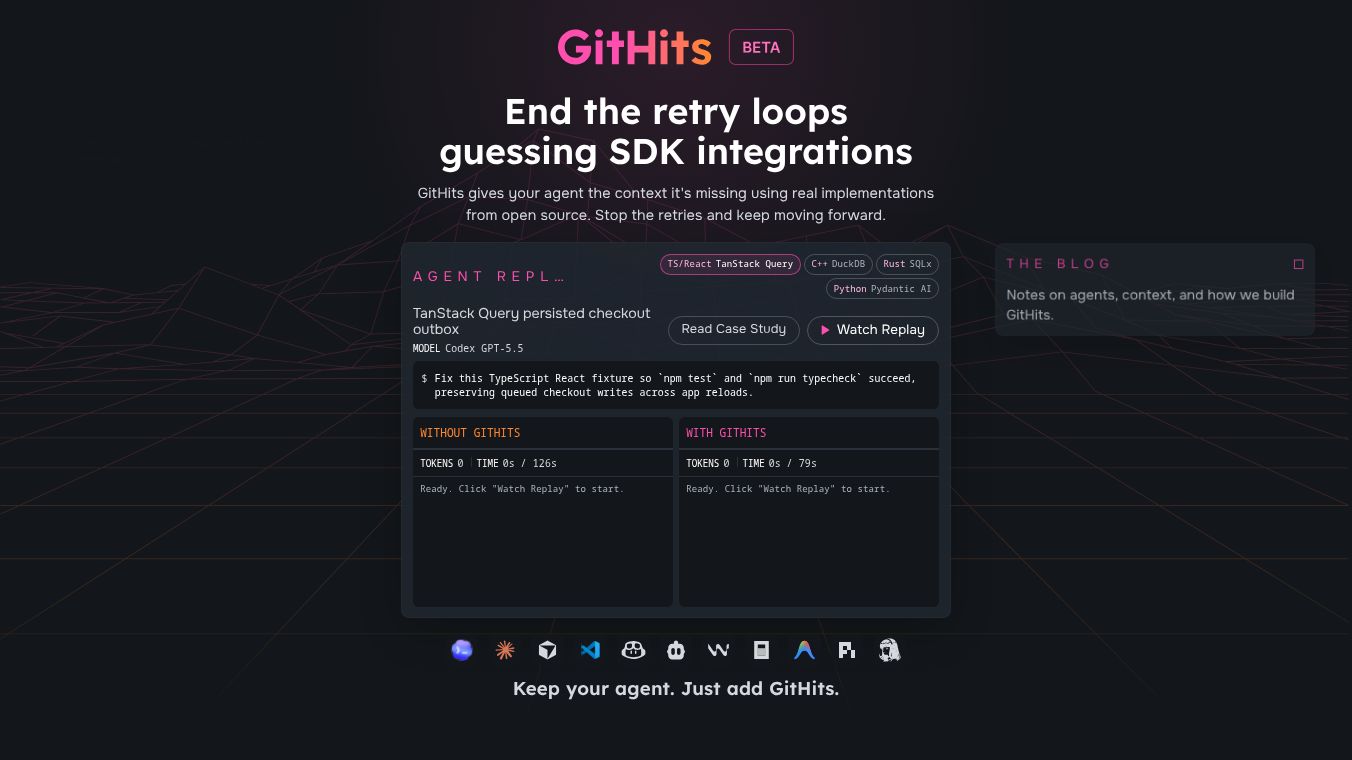





GitHits Beta 0.9: Grounding AI Agents in Real Open-Source Context
Introduction
GitHits is a new tool designed to help AI coding agents work more effectively. Modern AI tools can read your local code, but they often struggle with the vast world of open-source libraries and frameworks that power modern software. GitHits acts as a discovery engine that gives these AI agents access to real, working examples from public repositories. Instead of guessing or hallucinating code, the AI can inspect actual implementations to find solutions. This helps developers avoid common pitfalls like broken code or wasted time on trial and error.
Benefits
GitHits offers several key advantages for developers using AI tools:
- Reduces Guessing:AI agents stop making up APIs or guessing how libraries work. They can search real code to find the correct way to use a package.
- Saves Time and Money:By finding working solutions faster, developers spend fewer tokens and less time retrying failed code generations. This cuts down the cycle of error and correction.
- Improves Code Quality:Code generated with GitHits tends to be more reliable. Users report that solutions pass tests on the first try, whereas other tools often produce code that does not compile.
- Handles Low-Documentation Ecosystems:It is especially helpful for languages like Go, Rust, or C++ where official documentation might be thin. The tool finds real examples even when docs are missing.
- Deep Code Inspection:Users can search for specific symbols, trace how code is used, and inspect dependencies across different versions.
Use Cases
GitHits is useful in many situations where an AI coding assistant hits a wall:
- Fixing Integration Issues:When an AI agent cannot figure out how to connect two different libraries, GitHits can show real examples of that integration from public projects.
- Debugging Undocumented Features:If a library has a feature that is not mentioned in the official docs, developers can use GitHits to search the actual source code to find how it works.
- Working with Complex Dependencies:The tool helps map out relationships between packages and versions, making it easier to understand what a dependency actually does.
- Supporting Multiple Languages:Developers working with JavaScript, Python, Rust, Go, Swift, and other languages can use GitHits to find context-specific examples.
- Enhancing Existing AI Tools:It works as an add-on for tools like Claude Code, Cursor, or Copilot. Developers can trigger GitHits when their AI assistant gets stuck on a problem.
Pricing
Pricing details for GitHits Beta 0.9 are not available in the provided information. The tool is currently in a beta phase, and specific costs or subscription plans have not been disclosed.
Vibes
Early users and developers have responded very positively to GitHits. Here is what some of them have said:
- Atharv Singh (SDE):"GitHits changed my workflow because it's not a search engine, it's a discovery engine... It helps you find solutions you didn't even know existed."
- Onni Hakala (Senior Software Engineer):"Claude Code is amazing but sometimes confidently says things are impossible when they're not. GitHits MCP server helped Claude find undocumented DuckDB C++ APIs by searching actual code instead of docs."
- Peter Warnock (Full-Stack Developer):"The MCP is great! Whenever I don't like a solution, or my agent is stuck, I say use GitHits and it synthesizes a better solution based on real projects."
- Nathan Burg (CPO):"Every other AI tool produced code that wouldn't compile. GitHits passed my tests on the first try."
Additional Information
GitHits was created by Olli-Pekka Heinisuo, the CTO and creator of the popular opencv-python package. He noticed that developers often had to dig deep into GitHub to find the right code examples when documentation was unclear. He and his team built GitHits to automate this process for AI agents.
The tool indexes code from many popular package managers including npm, PyPI, crates.io, and Maven Central. It supports languages like Go, Swift, Zig, and more. GitHits focuses on security and privacy by only accessing public open-source repositories. It does not store user private code or use customer data to train AI models. The index is pinned to specific commits to ensure that the code examples remain stable and reproducible over time.
This content is either user submitted or generated using AI technology (including, but not limited to, Google Gemini API, Llama, Grok, and Mistral), based on automated research and analysis of public data sources from search engines like DuckDuckGo, Google Search, and SearXNG, and directly from the tool's own website and with minimal to no human editing/review. THEJO AI is not affiliated with or endorsed by the AI tools or services mentioned. This is provided for informational and reference purposes only, is not an endorsement or official advice, and may contain inaccuracies or biases. Please verify details with original sources.

Comments
Please log in to post a comment.