AgentCN
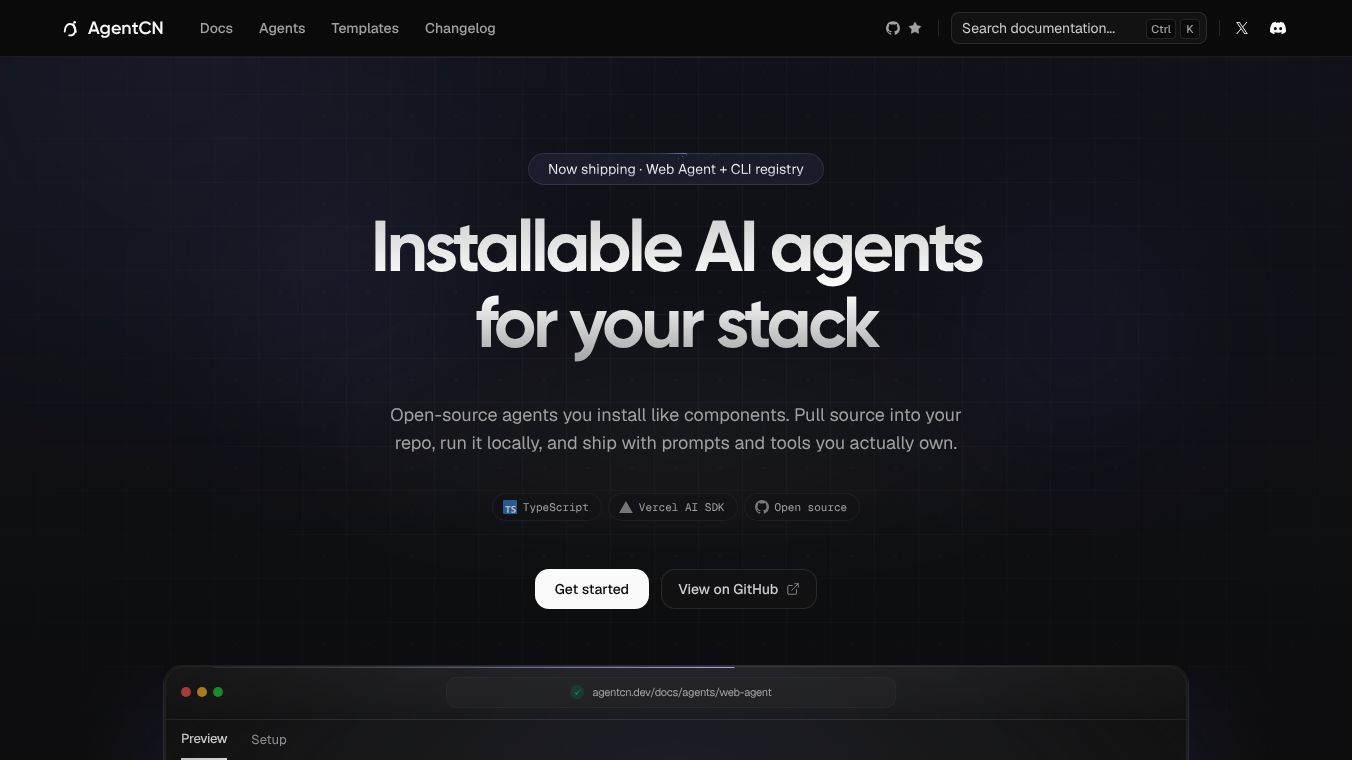





AgentCN: Installable AI Agents for Your Stack
Overview
AgentCN is an open-source kit designed to integrate AI agents directly into your codebase. Unlike traditional solutions that hide logic behind hosted APIs, AgentCN allows developers to pull source code into their repositories, run agents locally, and ship applications with full ownership of prompts, tools, and configurations.
Core Philosophy
The primary goal of AgentCN is to provide installable AI agents that function like standard software components. By copying source code into your repository rather than relying on external services, developers gain complete control over the agent's behavior, data, and dependencies.
Benefits
AgentCN offers several key advantages for developers who want full control over their AI applications. First, it packages agents as source code that you can inspect and modify. This means you can change prompts, tools, and wiring before deployment to ensure transparency and full ownership of the agent's logic. Second, installation is streamlined via a command line interface. Developers can add agents to their projects with a single command, such as npx agentcn@latest add web-agent. This process automatically fetches the agent from the registry, writes necessary source files, and sets up environment keys. Third, agents are built using editable TypeScript files. This enables developers to customize behavior by modifying standard code files rather than flipping switches in a dashboard. Key components include agent.ts for defining logic, prompt.ts for system and user prompts, tools for custom functions, and schema.ts for data structures. Fourth, you bring your own API keys. AgentCN does not require a hosted runtime. Users are responsible for providing their own provider API keys, ensuring that sensitive data remains within their own infrastructure. Finally, the solution operates locally within your environment. This eliminates the need for managed runtimes and reduces dependency on third-party infrastructure for agent execution.
Use Cases
AgentCN is ideal for developers who want to build robust AI applications without relying on external black boxes. The registry currently includes several specialized agents, including a Web Agent capable of web browsing and interaction, a Search and Cite agent that performs search tasks with citation capabilities, a Deep Research agent for in-depth research tasks, and a Browser agent that manages browser sessions and interactions. To install an agent, use the CLI to add it to your project. This command fetches the agent from the registry and installs dependencies such as ai, zod, and exa-js. It also scaffolds necessary .env keys for configuration. Once installed, agents are treated as plain files within your project. Developers can edit prompts, tools, environment configurations, and providers using the same methods they use for the rest of their application. For example, modifying a browser usage prompt involves editing the prompt.ts file directly. For users requiring a complete application setup beyond just the agent module, AgentKit is available as an open-source starter. It includes authentication, a chat user interface, and PostgreSQL database integration. AgentCN is fully open source. The registry, CLI, documentation, and agent source code are hosted in a single public repository on GitHub. This allows the community to file issues and report bugs, open discussions on features, and submit pull requests to help shape the future of the project. AgentCN empowers developers to build robust AI applications by providing a transparent, customizable, and locally run environment for AI agents. By integrating agents as standard code components, it bridges the gap between AI capabilities and traditional software development workflows.
This content is either user submitted or generated using AI technology (including, but not limited to, Google Gemini API, Llama, Grok, and Mistral), based on automated research and analysis of public data sources from search engines like DuckDuckGo, Google Search, and SearXNG, and directly from the tool's own website and with minimal to no human editing/review. THEJO AI is not affiliated with or endorsed by the AI tools or services mentioned. This is provided for informational and reference purposes only, is not an endorsement or official advice, and may contain inaccuracies or biases. Please verify details with original sources.

Comments
Please log in to post a comment.