CITAQ
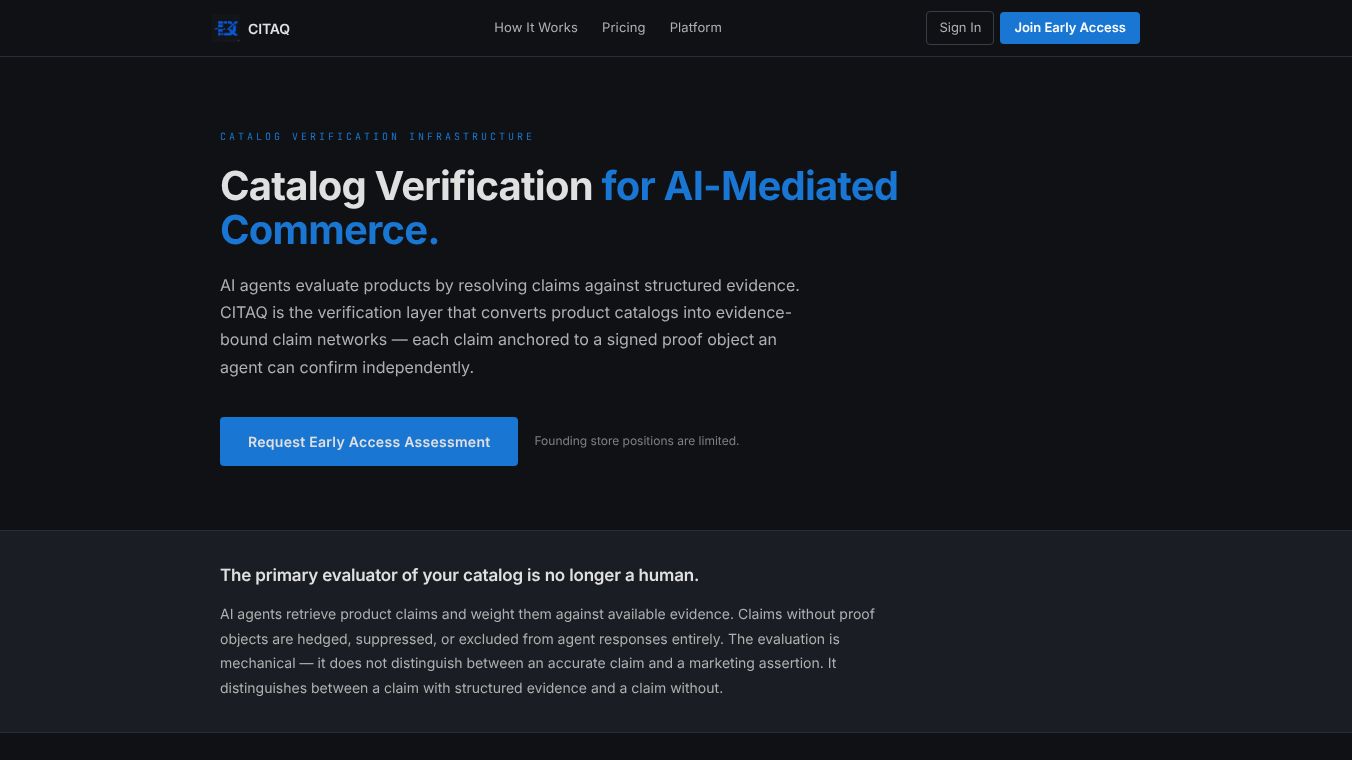





The way people shop is changing. AI agents are starting to help decide what products to buy. This means product information needs to be more than just words. It needs to be facts that AI can check. CITAQ is a service that helps make product information verifiable for these AI agents. It turns product lists into networks of claims that are backed by proof.
AI agents look at products by checking claims against solid evidence. To be seen by AI agents, product data must connect to things that can be proven. This is different from how websites are found now, which focuses on keywords. AI agents ignore claims that don't have proof. They can only tell if a claim has evidence or not.
Product lists are already like connected networks of claims. Each product has claims about what it's made of, how well it works, its safety, and what rules it follows. If one claim about a product is not proven, it can affect other related claims. The whole product list works as a system, not just separate items.
CITAQ checks claims in seven ways: Identity, Specification, Performance, Safety, Compliance, Origin, and Compatibility. Each check needs proof like signed lab reports or official certificates. Claims with proof are called hard claims, which AI agents can confirm. Claims without proof are soft claims, which cannot be verified. AI agents trust hard claims and ignore unverified ones.
For example, if a product is claimed to be waterproof to a certain level, it needs a signed test report from a lab. Without this report, an AI agent might say people have mixed opinions. With the report, the AI agent can confidently say the product is waterproof and mention the lab that tested it.
It's important for verification to be consistent, especially for large product lists. A list of 3,000 verified products is more useful than one with 10,000 products that are only partly verified. If there are gaps in verification, it makes the whole list less trustworthy. CITAQ works with existing systems to organize claims, link evidence, and keep proof records that AI agents can use.
CITAQ provides a score showing how many product claims can be proven by machines. It also shows which claims need evidence and which ones have the biggest impact if not verified. This helps businesses understand what proof they need to provide.
CITAQ's system uses proof objects to make sure claims are true. It processes product claims, creates proof hashes, checks digital signatures, and matches evidence. Verified claims get a permanent proof hash that is linked to their evidence.
As more product information is verified, a network of verifiable knowledge grows. AI shopping agents can directly ask CITAQ for information, getting verifiable data with proof references.
CITAQ uses a credit system where credits are used for analyzing products and verifying evidence. The company does not create product descriptions or try to influence search results. It focuses only on making existing product information verifiable for AI agents.
CITAQ is useful for product lists with many detailed claims, a large number of items, or strict rules to follow. The verification process is the same for any size of product list. CITAQ is currently bringing in a limited number of users through a careful rollout process.
This content is either user submitted or generated using AI technology (including, but not limited to, Google Gemini API, Llama, Grok, and Mistral), based on automated research and analysis of public data sources from search engines like DuckDuckGo, Google Search, and SearXNG, and directly from the tool's own website and with minimal to no human editing/review. THEJO AI is not affiliated with or endorsed by the AI tools or services mentioned. This is provided for informational and reference purposes only, is not an endorsement or official advice, and may contain inaccuracies or biases. Please verify details with original sources.
 No Info

Comments
Please log in to post a comment.