Cache-Pot
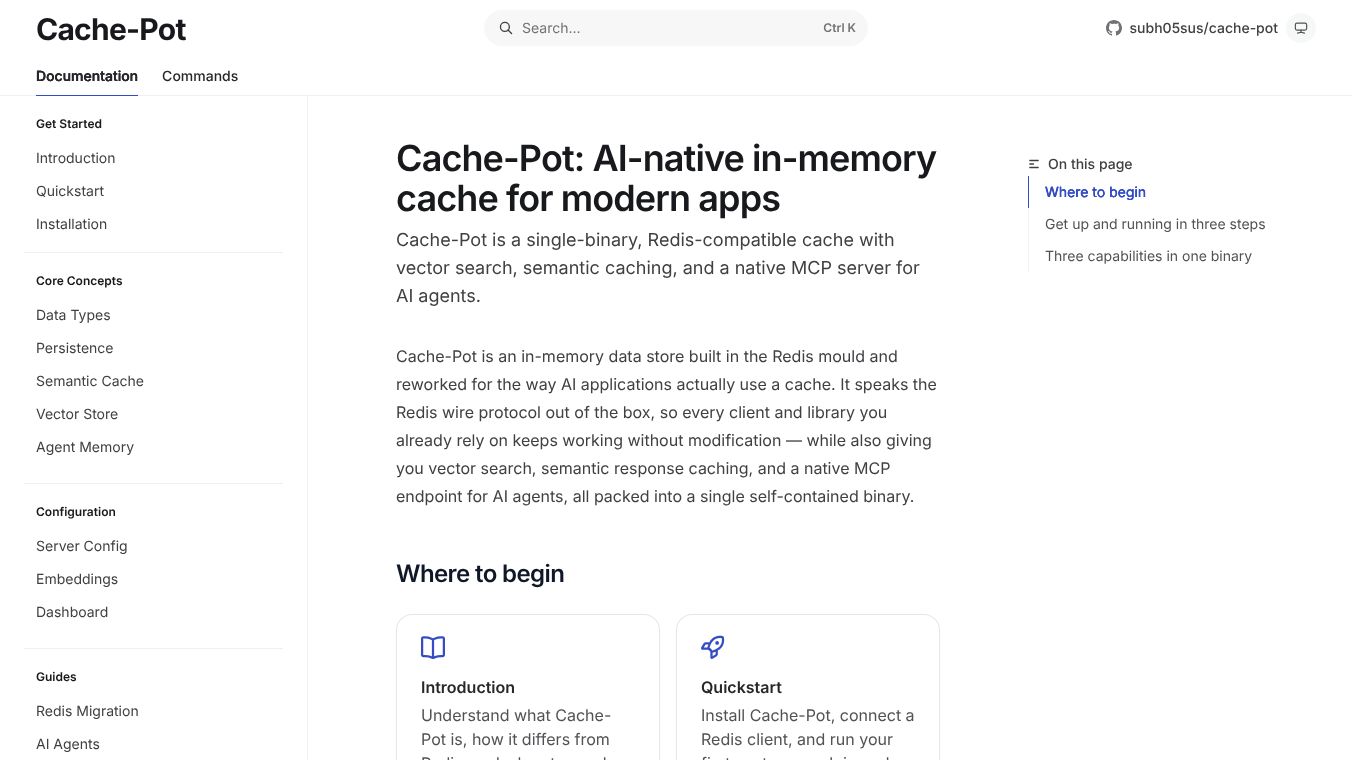





Cache-Pot: An In-Memory, Redis-Compatible Data Store Built for AI Agents
Overview
Cache-Pot is an in-memory data store designed in the mold of Redis but reworked specifically for the needs of AI applications and agents. It functions as a single, self-contained binary that eliminates the need for complex installation or external dependencies. While it speaks the standard Redis protocol (RESP2), ensuring compatibility with existing Redis clients, it distinguishes itself by integrating advanced AI features directly into the core.
Benefits
Cache-Pot offers several key advantages for developers building AI applications. First, it acts as a Redis-compatible cache, implementing the RESP2 protocol so existing Redis clients and applications can connect without code changes. It supports standard data structures including strings, hashes, lists, sets, sorted sets, and pub/sub. Unlike traditional caches, Cache-Pot includes built-in vector search capabilities. Users can store vectors and perform nearest-neighbor searches without external modules. It also features a semantic cache that stores model answers and retrieves them based on meaning, helping to reduce costs by avoiding redundant model calls for similar queries. Another major benefit is the native MCP endpoint. Cache-Pot includes a built-in Model Context Protocol server. This allows AI agents to interact with the data store as a first-class tool for reading, writing, searching, and remembering context, requiring no adapter layers. The software is designed for ease of use, running as a single binary. There are three primary ways to get started, including via Go, Docker, or from source. Upon startup, the server listens on port 6379, and a live dashboard is available at port 8080. The dashboard provides real-time statistics, key management, a browser for inspecting data, a workbench CLI, a profiler, slow log monitoring, pub/sub management, and client analysis. The software is free and open-source under the BSD-3-Clause license.
Use Cases
Developers building AI applications can use Cache-Pot to manage data efficiently. Users can interact with Cache-Pot using standard redis-cli tools by pointing them to port 6379. Existing applications can be redirected by simply updating the environment variable. For environments without redis-cli, Cache-Pot provides its own interactive RESP shell. It supports one-shot commands and piped scripts. TLS connections are supported via the tls flag along with certificate paths. Users can store vectors and retrieve nearest matches directly. They can cache model responses and retrieve them based on semantic similarity. Developers can provide agents with persistent memory between turns using remember and recall commands. The software is currently optimized for single-machine use. It does not yet support clustering, replication, or failover, making it unsuitable as a direct replacement for large production Redis clusters requiring high availability. The project welcomes contributions, ranging from bug reports and documentation improvements to implementing missing Redis commands. Users are encouraged to test the software with their preferred Redis clients and provide feedback.
Pricing
Cache-Pot is free and open-source software under the BSD-3-Clause license.
Vibes
There are no public reviews or testimonials available for Cache-Pot at this time.
Additional Information
Cache-Pot is currently optimized for single-machine use. It does not yet support clustering, replication, or failover, making it unsuitable as a direct replacement for large production Redis clusters requiring high availability. Shipped features include core Redis commands, snapshot saving, vector store, semantic cache, agent memory, and MCP server. It also includes an interactive CLI and benchmark tool, TLS encryption, and Append-Only File durability. On the roadmap, faster vector index, transactions, and incremental iteration are planned. Later plans include replication and clustering. The project welcomes contributions, ranging from bug reports and documentation improvements to implementing missing Redis commands. Users are encouraged to test the software with their preferred Redis clients and provide feedback.
This content is either user submitted or generated using AI technology (including, but not limited to, Google Gemini API, Llama, Grok, and Mistral), based on automated research and analysis of public data sources from search engines like DuckDuckGo, Google Search, and SearXNG, and directly from the tool's own website and with minimal to no human editing/review. THEJO AI is not affiliated with or endorsed by the AI tools or services mentioned. This is provided for informational and reference purposes only, is not an endorsement or official advice, and may contain inaccuracies or biases. Please verify details with original sources.



Comments
Please log in to post a comment.