ACE Sidecar
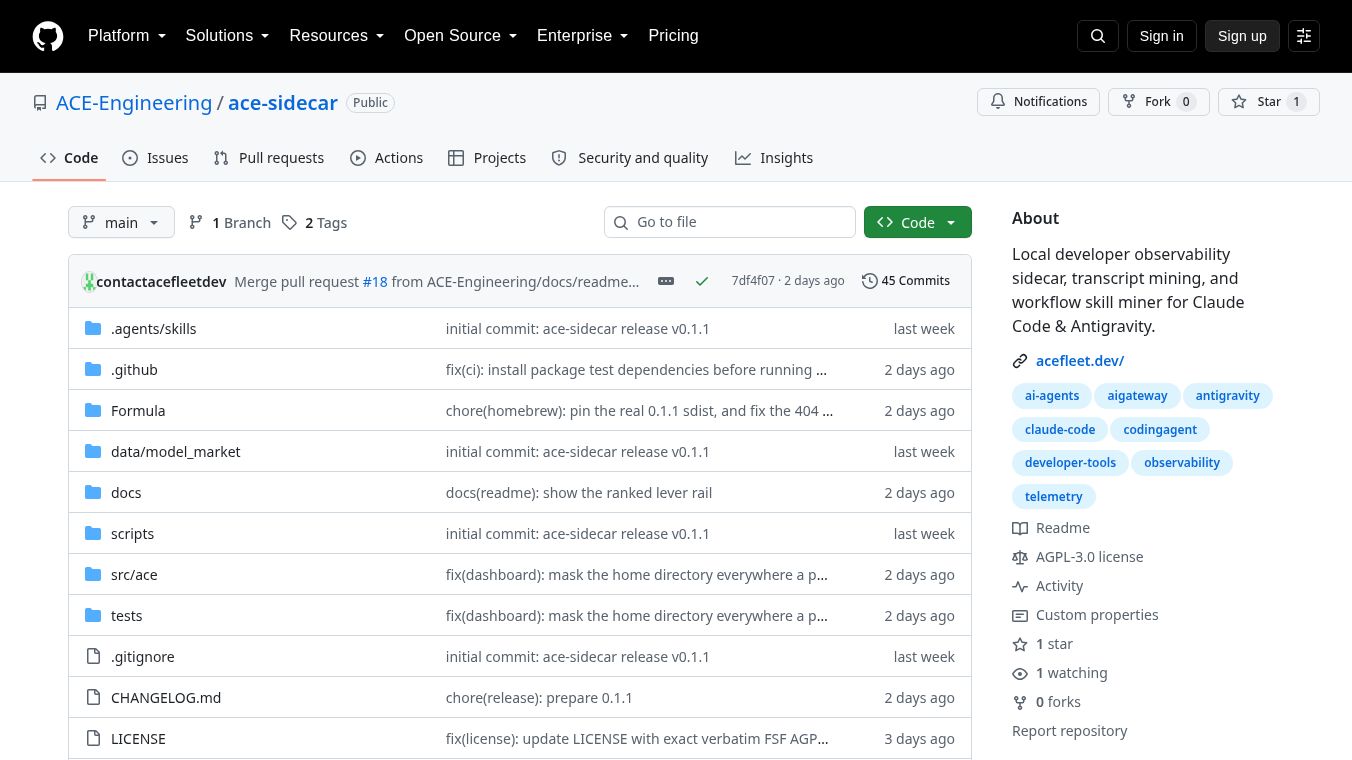





ACE Sidecar: Real-Time Observability and Telemetry for AI Coding Agents
Overview
The ACE Sidecar is a local reverse proxy designed to provide real-time observability and telemetry for AI coding agents, specifically targeting workflows like Claude Code. It operates as a local intermediary between the coding agent and the model provider, relaying traffic unchanged while offering deep insights into usage patterns, costs, and session dynamics.
Benefits
The ACE Sidecar offers several key advantages for developers using AI coding tools. First, it prioritizes privacy by running entirely on the user's machine. It does not upload prompts, code, session identifiers, or any telemetry data to external servers. All data processing happens locally. Second, it provides detailed insights into how AI agents are being used. Users can see metrics like context usage, token distribution, and session time. This helps them understand their spending habits and identify inefficiencies. Third, it helps manage costs. By analyzing session data, the tool can show how much money is being spent and where savings might be found, such as through cache efficiency. Finally, it acts as a security measure by binding to the loopback interface and rejecting requests from outside the local machine, ensuring it cannot be used as an open relay.
Use Cases
Developers who use AI coding agents can benefit from the ACE Sidecar in several ways. It is useful for anyone who wants to monitor their AI usage without worrying about data privacy. Users can install the tool and point their agent to the sidecar by setting a simple environment variable. Once running, the sidecar provides a local dashboard where users can view health checks and API reports. These reports show aggregated data like total token usage and cost summaries without revealing sensitive details like specific prompts or file paths. The tool is also helpful for teams that want to understand the volatility of their AI usage over time. It can detect when an agent is stuck waiting for a tool call, which helps in troubleshooting slow workflows. As the tool evolves, it aims to offer features that can automatically optimize token usage to reduce costs further.
Pricing
The ACE Sidecar is currently in beta and is available to users who request access in batches. Specific pricing details are not publicly listed in the available information. The tool itself runs locally and does not appear to charge a subscription fee for its core functionality, but users should check the official repository for the latest details on access and any future pricing models.
Vibes
The ACE Sidecar has received positive attention from the developer community for its focus on privacy and transparency. Users appreciate that it does not store API keys or upload their code to external servers. The tool is described as a robust solution for monitoring AI coding workflows. Early users have found the insights into token usage and session dynamics to be valuable for understanding their AI habits. The project is open source, which allows the community to inspect the code and contribute to its development. The beta access process encourages users to share their data to help improve the tool's accuracy for a wider audience.
Additional Information
The ACE Sidecar is an open-source project hosted on GitHub under the ACE-Engineering organization. It is currently in the beta phase, with access granted in batches to ensure stability. The project is actively seeking contributions from users who can provide additional data to help generalize the findings. The development team has a clear roadmap for future features, including per-turn risk coloring, shell segment parsing, and context-exhaustion forecasting. Some features, like collapsing duplicate file reads, were dropped after analysis showed they did not provide significant savings. The project maintains a strict privacy-first architecture and relies on loopback trust for credential management.
This content is either user submitted or generated using AI technology (including, but not limited to, Google Gemini API, Llama, Grok, and Mistral), based on automated research and analysis of public data sources from search engines like DuckDuckGo, Google Search, and SearXNG, and directly from the tool's own website and with minimal to no human editing/review. THEJO AI is not affiliated with or endorsed by the AI tools or services mentioned. This is provided for informational and reference purposes only, is not an endorsement or official advice, and may contain inaccuracies or biases. Please verify details with original sources.
Comments
Please log in to post a comment.