




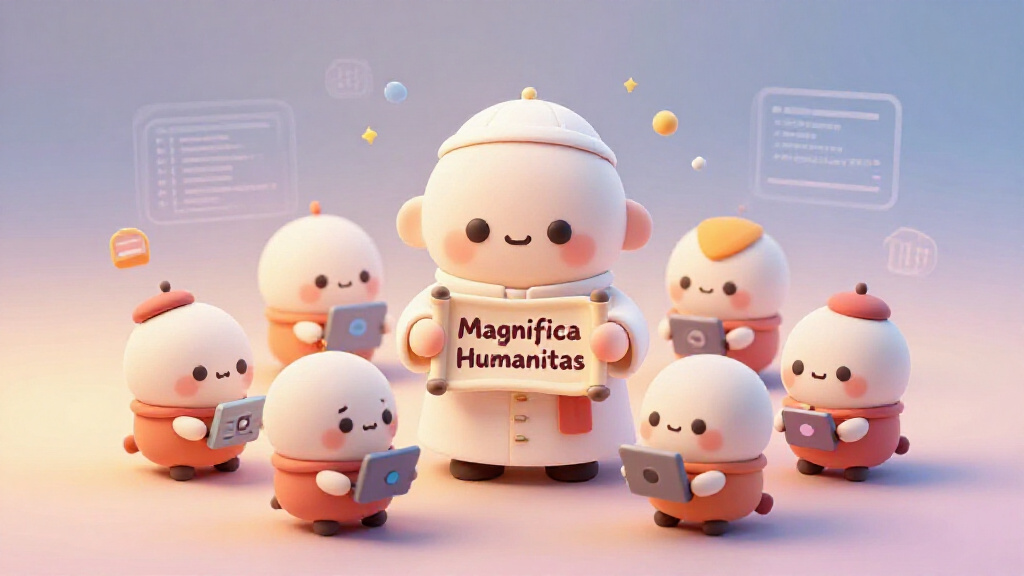
Pope Leo XIV has released a landmark encyclical titled 'Magnifica Humanitas,' focusing on preserving human dignity in the age of AI. The document, signed on May 15 and presented on May 25, 2026, aims to tackle global ethical and social dilemmas posed by rapid AI development.
The encyclical has been welcomed by Catholic bishops as 'crystal' clear guidance for the AI era, emphasizing the need for 'digital literacy' to understand how algorithms shape our perception of reality. The document is considered a significant one that could have a substantial impact on the development of AI and its applications.
In the tech world, AI is transforming software engineering, with AI-native development redefining the industry. However, experts stress that AI still requires human oversight to ensure accuracy and safety, as AI tools can produce buggy or potentially dangerous software at an industrial scale.
Michael Richman, founder of Cmd+Ctrl, has introduced a platform to manage AI agent workflows, addressing the growing concern of FOMAT (Fear of Missing Agent Time). The platform provides centralized management and visibility over AI agent sessions.
Meanwhile, research shows that large language models like ChatGPT or Claude can successfully change people's minds when instructed to debunk conspiracy theories. Google Cloud Security has also used Instruqt's hands-on platform to train over 150 practitioners on Agentic AI capabilities.
Key Takeaways
["Pope Leo XIV releases landmark encyclical 'Magnifica Humanitas' on AI and human dignity.", "Catholic bishops welcome the encyclical as 'crystal' clear guidance for the AI era.", 'AI-native development redefines software engineering, but human oversight is still necessary.', 'Michael Richman introduces a platform to manage AI agent workflows.', 'Large language models like ChatGPT or Claude can help debunk conspiracy theories.', "Google Cloud Security uses Instruqt's platform to train practitioners on Agentic AI capabilities.", 'The encyclical aims to tackle global ethical and social dilemmas posed by rapid AI development.', 'AI tools can produce buggy or potentially dangerous software at an industrial scale.', 'The platform by Cmd+Ctrl provides centralized management and visibility over AI agent sessions.', "Research shows that large language models can successfully change people's minds when instructed to debunk conspiracy theories."]Pope Leo issues landmark encyclical on AI and human dignity
Pope Leo XIV released a landmark encyclical titled 'Magnifica Humanitas' focusing on preserving human dignity in the age of AI. The document was signed on May 15 and presented on May 25, 2026. The encyclical aims to tackle global ethical and social dilemmas posed by rapid AI development. Pope Leo emphasized the need for 'digital literacy' to understand how algorithms shape our perception of reality. The encyclical is considered a significant document that could prove as influential as Pope Francis's 'Laudato Si,' a 2015 climate manifesto.
Bishops welcome Pope Leo's AI guidance
Catholic bishops are welcoming Pope Leo's encyclical as 'crystal' clear guidance for the AI era. The encyclical, titled 'Magnifica Humanitas,' invokes the wisdom of the Church's social teachings on protecting people in the AI era. Archbishop Pérez emphasized that the sanctity of human life must remain paramount as AI systems continue to develop and become more closely integrated into nearly every aspect of life.
Why Pope Leo's AI encyclical matters
Pope Leo XIV presented his vision for preserving human dignity in the era of artificial intelligence through an encyclical. This document lays the groundwork for Church teaching and long-term debate on AI. The encyclical is considered a significant document that could have a substantial impact on the development of AI and its applications.
Vatican launches first papal manifesto on AI
Pope Leo XIV personally presented his highly anticipated encyclical on artificial intelligence, 'Magnifica Humanitas,' at the Vatican. The manifesto aims to tackle global ethical and social dilemmas posed by rapid AI development. The encyclical was signed on May 15, the 135th anniversary of a 1891 encyclical by Leo XIII, which laid the foundations of the Church's social doctrine during the Industrial Revolution.
AI-native development redefines software engineering
The software industry is experiencing a fundamental change with the rise of AI-native software development. AI is no longer just a feature inside products but part of the engineering process itself. This shift enables smaller teams to handle larger product scopes and compresses development cycles.
AI still needs human oversight
While AI can generate code, it still requires human oversight to ensure accuracy and safety. AI tools can produce buggy or potentially dangerous software at an industrial scale. Experienced engineers are needed to supervise AI-generated code and ensure it meets standards.
Managing AI agent workflows
Michael Richman, founder of Cmd+Ctrl, discussed the growing concern of FOMAT (Fear of Missing Agent Time) and introduced a platform to manage AI agent workflows. The platform provides centralized management and visibility over AI agent sessions.
The impact of AI on human connection
AI is making professionals faster but may also be making them worse at their jobs. While AI tools increase productivity, they can erode genuine competence, relatedness, and autonomy. Young professionals who thrive treat AI as a sparring partner rather than a ghostwriter.
Young writers on AI
The Young Writers Project published a piece titled 'AI: The Worst Part' by Sophia Brooks, 15, Westford. The article discusses the drawbacks of relying on AI and how it affects creativity and authenticity.
AI can help debunk conspiracy theories
Research shows that large language models, like ChatGPT or Claude, can successfully change people's minds when instructed to debunk conspiracy theories. The key is to clearly explain relevant facts.
Google Cloud Security uses Instruqt for Agentic AI training
Google Cloud Security used Instruqt's hands-on platform to train over 150 practitioners on Agentic AI capabilities at Google Next 2026. The session demonstrated a new operational model for closing the AI-adoption gap at conference scale.
Sources
- Pope Leo to address human dignity in the age of AI
- Bishops welcome Pope Leo's encyclical as 'crystal' clear guidance for the AI era
- Pope Leo Is Set to Release an Encyclical About A.I. Why Is That Important?
- Vatican to launch first-ever papal manifesto on artificial intelligence
- How AI-Native Development Is Rewriting the Rules of Software Engineering
- AI still needs humans
- Michael Richman on FOMAT: Fear of Missing Agent Time
- AI Is Making You Faster. It May Also Be Making You Worse At Your Job
- Young Writers Project: ‘AI: The Worst Part’
- AI Can Help Debunk Conspiracy Theories and Pull People From the Brink
- Google Cloud Security Uses Instruqt Platform to Train 150+ Practitioners on Agentic AI at Google Next 2026
Comments
Please log in to post a comment.