Verity
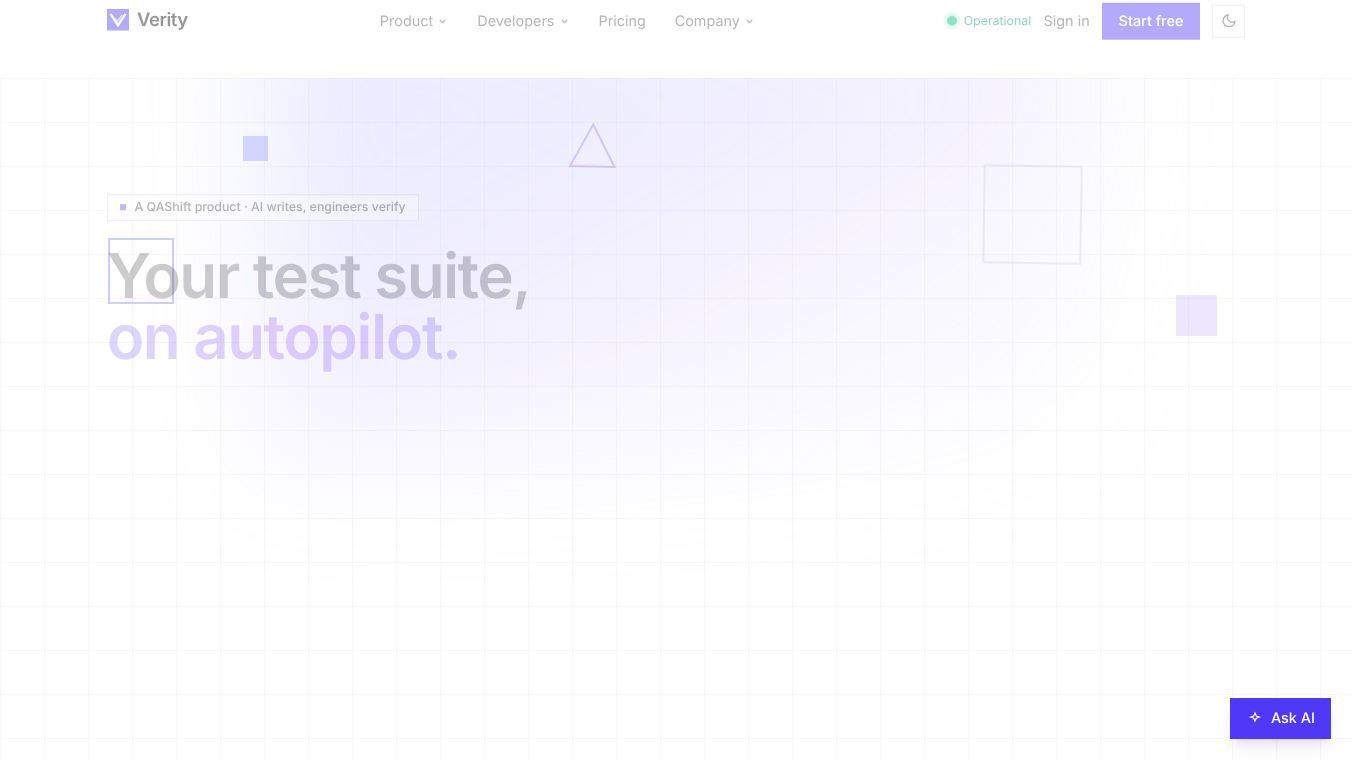





Verity: Your Test Suite, on Autopilot
Verity is an end-to-end testing platform that uses artificial intelligence to create, maintain, and predict the health of your test suite. It works directly within your existing continuous integration and deployment pipeline. Unlike traditional tools that only record actions or sit outside your workflow, Verity offers a complete solution. It generates Playwright tests, fixes broken links when your user interface changes, tells the difference between a glitchy test and a real bug, and warns you about potential failures before you release new code. Every paid plan includes a Forward-Deployed Engineer who takes ownership of the test suite and turns AI scripts into a clean, maintainable structure.
Benefits
Verity offers several key advantages for development teams. First, it automates the entire testing lifecycle. You can describe a user flow or simply drop a URL, and Verity writes a runnable test in TypeScript. Second, it handles maintenance automatically. When your website or app changes, Verity suggests fixes for broken test links instead of letting them fail. Third, it separates noise from real problems. The system re-runs suspect failures to distinguish between flaky tests and genuine bugs, ensuring that false alarms do not block your team from merging code. Finally, it provides predictive insights. Verity analyzes your codebase to identify files that are likely to break during a deployment and gives you a confidence score for every release.
Use Cases
Verity is designed for teams that want to integrate testing seamlessly into their workflow. Developers can use it to generate tests quickly from a sentence or a product requirement document. QA engineers can rely on it to run unlimited tests in their own infrastructure without hosting browsers themselves. The platform supports various triggers, such as running quick checks on every code commit or performing full regression tests before a merge. It is particularly useful for teams that need a safety net for their deployments. The system can flag high-risk files in pull requests and provide a deploy confidence score to help leaders decide when to push changes to production.
Pricing
Verity offers a self-serve model that starts for free. The Cloud Sandbox plan is free and includes 15 AI UI tests per month. The Self-Serve Pro plan costs $49 per month and provides 200 AI UI and API tests per month along with self-healing locators and flake detection. The Team plan is priced at $149 per month and supports up to 10 projects with 750 AI tests per month. For teams that want human support, there are FDE-backed tiers starting at $499 per month. These plans include all self-serve features plus a dedicated Forward-Deployed Engineer who manages the suite and adds advanced capabilities like visual regression and security scanning.
Vibes
Users appreciate Verity for its ability to reduce the manual burden of maintaining test suites. The platform is praised for its unique combination of AI generation, self-healing features, and predictive analytics. Reviewers note that the inclusion of a human engineer on paid plans ensures that generated tests are converted into a maintainable format rather than being left as disposable scripts. The open-source core of the execution engine is also a point of trust for teams concerned about data privacy, as it allows them to inspect the code and ensures that secrets never leave their own infrastructure.
Additional Information
Verity is built with security and data privacy in mind. Tests run entirely within the customer's own infrastructure, meaning browsers and secrets never leave their CI pipeline. The platform uses tenant isolation to ensure that one customer cannot access another's data. Self-healing features propose changes as code diffs that require human approval before being merged. The core execution and scoring engine is open source under the MIT license, making it transparent and inspectable. Verity is part of the QAShift platform and positions itself as a comprehensive alternative to per-test metered AI tools or expensive managed QA agencies.
This content is either user submitted or generated using AI technology (including, but not limited to, Google Gemini API, Llama, Grok, and Mistral), based on automated research and analysis of public data sources from search engines like DuckDuckGo, Google Search, and SearXNG, and directly from the tool's own website and with minimal to no human editing/review. THEJO AI is not affiliated with or endorsed by the AI tools or services mentioned. This is provided for informational and reference purposes only, is not an endorsement or official advice, and may contain inaccuracies or biases. Please verify details with original sources.

Comments
Please log in to post a comment.