Unmarble





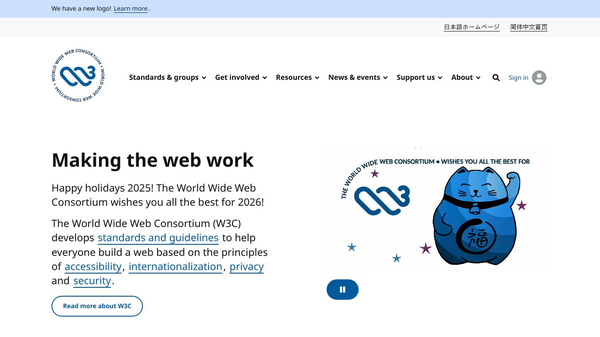
Unmarble is a tool developed by the World Wide Web Consortium (W3C) to help web developers and designers create websites and applications that are accessible, interoperable, and standards-compliant. The W3C is the main international standards organization for the World Wide Web, founded and led by Tim Berners-Lee. It is made up of member organizations that work together to develop web standards, protocols, and guidelines. As of 2021, 442 organizations, including universities, nonprofit organizations, government entities, and commercial vendors, are members of the consortium. The W3C's primary role is to ensure the long-term growth of the Web by developing specifications, guidelines, software, and tools that can be implemented on a royalty-free basis. The W3C's work is carried out through Member-only groups, Interest Groups, and Working Groups. The W3C also provides a forum for discussion and collaboration on Web-related topics through its mailing lists, blogs, and social media channels. The W3C's work is organized around several key areas, including Web Architecture, Web Design and Applications, Web of Devices, Semantic Web, Web Accessibility, and Web Education and Outreach. The W3C also maintains a number of working groups and interest groups that focus on specific aspects of the Web, such as the Web Accessibility Initiative (WAI), the Web of Things (WoT), and the WebAssembly (WASM) Community Group. The W3C's work is supported by a number of tools and resources, including the W3C Validator, the W3C CSS Validator, the W3C Link Checker, and the W3C Markup Validation Service. The W3C also provides a number of tutorials and documentation to help developers and designers create Web sites and applications that are accessible, interoperable, and standards-compliant. The W3C's work is guided by a set of principles and values, including the belief that the Web should be accessible to all, that Web standards should be developed in an open and transparent manner, and that the Web should be a platform for innovation and creativity. The W3C's work is also guided by a set of design principles, including the principle that Web standards should be simple, modular, and extensible, and that they should be designed to meet the needs of a wide range of users and devices.
This content is either user submitted or generated using AI technology (including, but not limited to, Google Gemini API, Llama, Grok, and Mistral), based on automated research and analysis of public data sources from search engines like DuckDuckGo, Google Search, and SearXNG, and directly from the tool's own website and with minimal to no human editing/review. THEJO AI is not affiliated with or endorsed by the AI tools or services mentioned. This is provided for informational and reference purposes only, is not an endorsement or official advice, and may contain inaccuracies or biases. Please verify details with original sources.
Comments
Please log in to post a comment.