Unif API
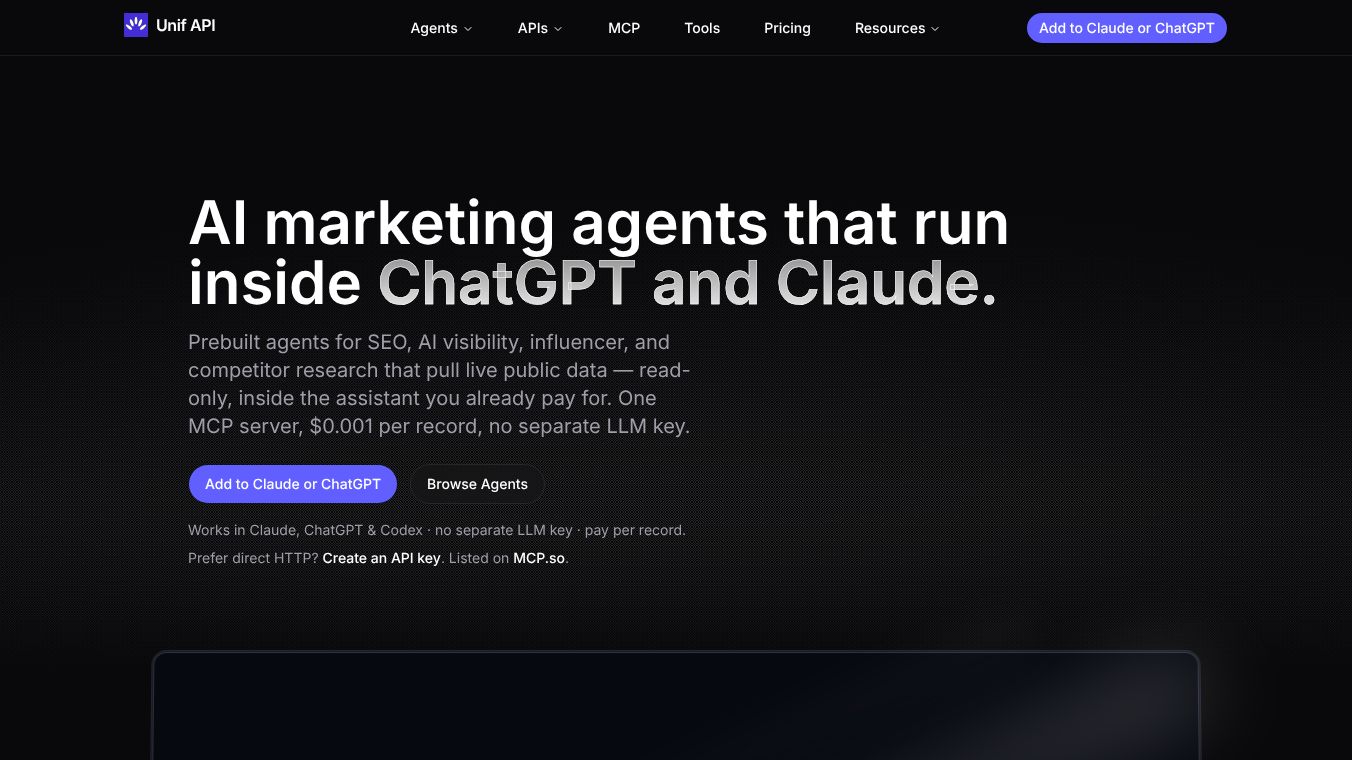





UnifAPI Public-Data Layer: A Unified Interface for Agents and Skills
Overview
The UnifAPI Public-Data layer serves as the foundational data infrastructure behind UnifAPI Agents and Skills. This layer provides access to a wide array of public platforms, ensuring that every system is callable today via both Model Context Protocol (MCP) and standard HTTP requests. A defining characteristic of this architecture is that all platforms return the same response envelope, facilitating seamless integration and data retrieval.
Core Architecture and Accessibility
Callable via MCP and HTTP
Every platform within the catalog adheres to a canonical OpenAPI contract. This standardization allows agents to discover and invoke operations directly over MCP or to access the exact same records by hitting the endpoints over HTTP. This dual-accessibility ensures flexibility for both automated agents and direct developer integration.
Unified Response Envelope
A critical feature of the UnifAPI ecosystem is the consistency of data delivery. Every live endpoint returns a shared UnifAPI response shape, which includes:- Request metadata- Normalized data- Optional pagination details- Billing information- A standardized error vocabulary
This uniformity enables agents to combine records from multiple public platforms within a single response, streamlining complex workflows.
Application in Agents and Skills
The API catalog functions as the data layer for UnifAPI Agents and their associated Skills. Various operational capabilities, such as SEO audits, AI-visibility checks, KOL pricing analysis, and competitive intelligence, leverage this layer. These skills discover available operations through MCP and execute calls to retrieve the same records that a developer would access via HTTP.
Available Data Categories
The public-data layer is organized into several distinct categories, each addressing specific workflow needs:
1. Social Platforms
This category encompasses7 APIsdesigned to handle data from major social networks. It provides access to tweets, videos, posts, comments, and creator information without the typical rate-limit constraints associated with direct platform interactions.
2. Search Engine Optimization (SEO)
Represented by1 API, this category supports SEO optimization workflows. It delivers live ranking data, target visibility metrics, rich feature information, and AI citation evidence.
3. Generative Engine Optimization (GEO)
Also covered by1 API, this category focuses on AI answer visibility. It tracks LLM brand and domain mentions across ChatGPT and AI search engines, alongside AI search volume data, specifically for generative-engine optimization workflows.
4. Browser Automation
This category includes1 APIcapable of rendering any URL in a headless browser. This service executes JavaScript and returns the result in multiple formats:- Clean Markdown- Fully rendered HTML- Screenshots- The page's link graph
This functionality is essential for agent web-reading workflows requiring dynamic content extraction.
5. Local & Maps
Comprising2 APIs, this category supports local search and lead generation workflows. It provides access to Maps and Local Finder business listings, including names, addresses, ratings, categories, and contact details.
6. Travel
Supported by1 API, this category facilitates travel and hospitality workflows. It offers hotel search and detail capabilities, including listings, class ratings, guest reviews, and nightly prices.
7. Events
This category features1 APIfor retrieving event results. It covers concerts, festivals, and local happenings, providing dates, venue information, and ticket links.
8. News
Covered by2 APIs, this category supports technology and current-events research. It provides access to Hacker News, news-search articles, top stories, and publisher data.
Conclusion
By standardizing access methods and response formats across diverse data categories—from social media and SEO to travel and news—UnifAPI's public-data layer empowers agents and skills to perform complex, multi-source data retrieval efficiently and reliably.
This content is either user submitted or generated using AI technology (including, but not limited to, Google Gemini API, Llama, Grok, and Mistral), based on automated research and analysis of public data sources from search engines like DuckDuckGo, Google Search, and SearXNG, and directly from the tool's own website and with minimal to no human editing/review. THEJO AI is not affiliated with or endorsed by the AI tools or services mentioned. This is provided for informational and reference purposes only, is not an endorsement or official advice, and may contain inaccuracies or biases. Please verify details with original sources.

Comments
Please log in to post a comment.