TurboQuant
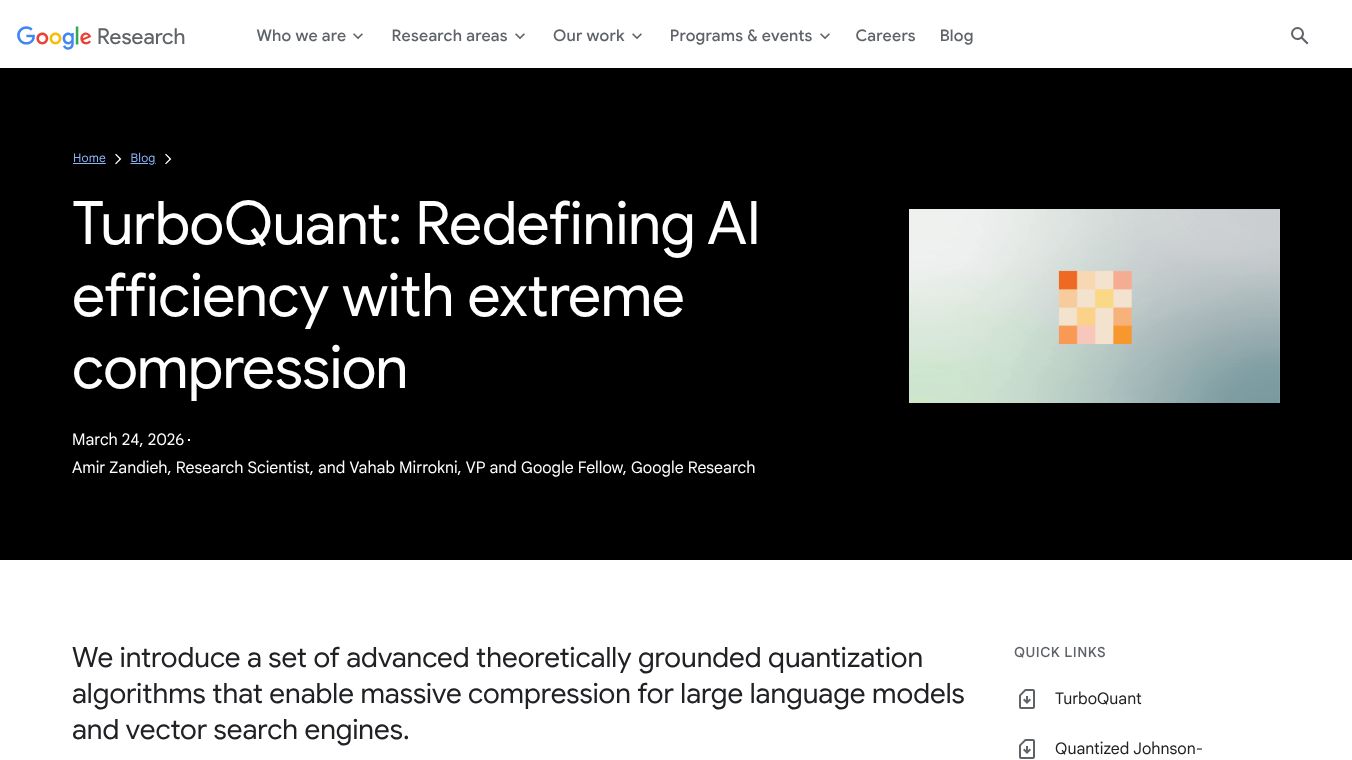





Google Research has developed TurboQuant, a set of advanced methods that greatly shrink the size of large language models and vector search engines without losing any accuracy. This makes AI more efficient and allows for many new uses.
TurboQuant works in two main steps. First, PolarQuant changes data vectors into a simpler form by using polar coordinates instead of the usual ones. This makes the data much more compact. Second, the QJL algorithm uses a very small amount of compression to fix any small errors left over. QJL also helps make attention scores more accurate.
Benefits
TurboQuant can make the key-value memory used by AI models at least 6 times smaller. It can compress this memory to just 3 bits without needing any extra training or making the model less accurate. It also makes AI models run faster, with some tasks completing up to 8 times quicker compared to uncompressed models. For vector search, TurboQuant speeds up the process of building indexes and searching through data.
Use Cases
TurboQuant is useful for large language models and vector search engines. It helps make these systems smaller and faster, which is important for many applications. It can be used in AI tasks that require understanding long pieces of text. In vector search, it helps build and search large collections of data quickly and efficiently, making semantic search faster and more effective.
Vibes
Experiments show that TurboQuant performs very well. It achieves perfect results on tasks that test understanding long texts. It also shows nearly perfect performance on other tasks. It allows nearest neighbor engines to work with the efficiency of a 3-bit system while keeping the accuracy of larger models.
Additional Information
TurboQuant, QJL, and PolarQuant are based on strong mathematical ideas and proofs, making them reliable for big systems. These techniques are important for improving search engines to better understand user intent and meaning through vector search.
This content is either user submitted or generated using AI technology (including, but not limited to, Google Gemini API, Llama, Grok, and Mistral), based on automated research and analysis of public data sources from search engines like DuckDuckGo, Google Search, and SearXNG, and directly from the tool's own website and with minimal to no human editing/review. THEJO AI is not affiliated with or endorsed by the AI tools or services mentioned. This is provided for informational and reference purposes only, is not an endorsement or official advice, and may contain inaccuracies or biases. Please verify details with original sources.

 Freemium


 No Info


Comments
Please log in to post a comment.