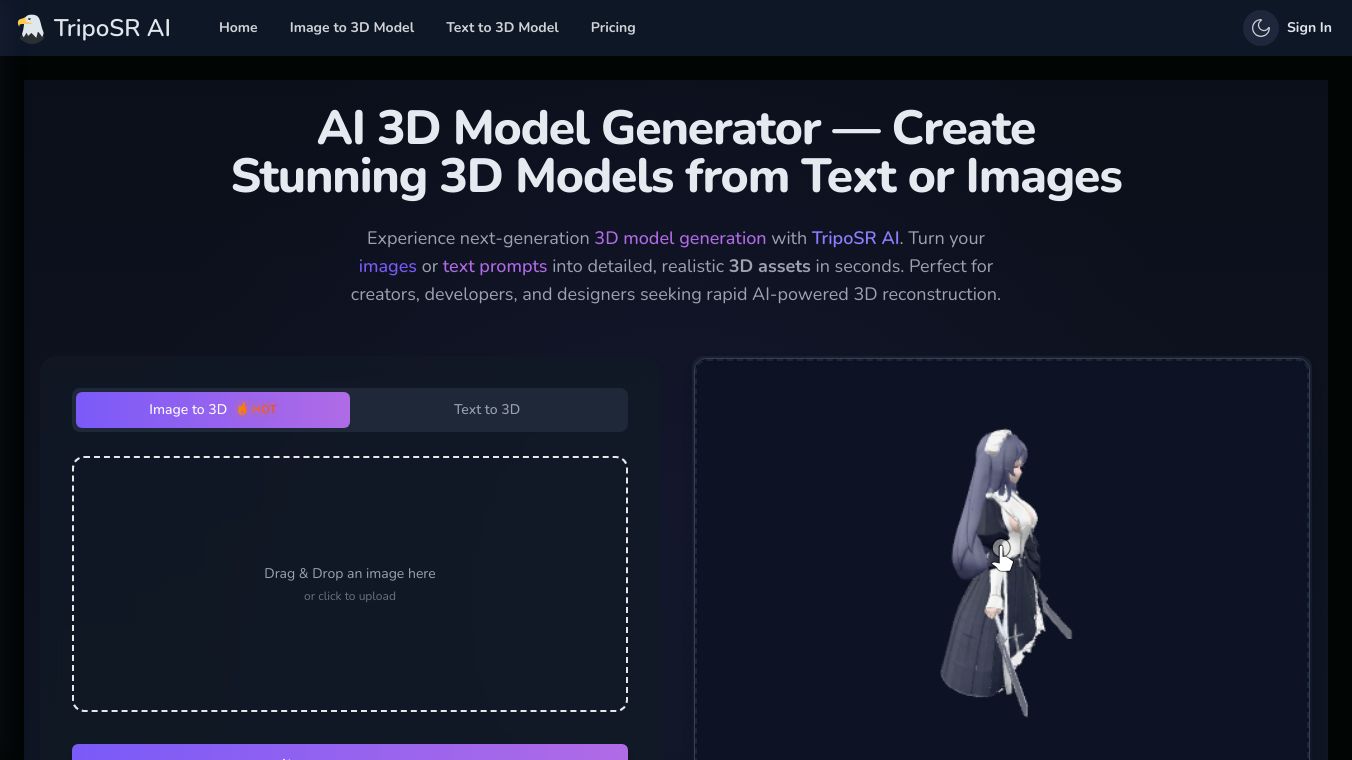





TripoSR is a tool designed to help users create 3D models from single images. It uses artificial intelligence to quickly generate these models, making the process much faster than traditional methods. The goal is to make 3D content creation more accessible and efficient for everyone.
Benefits
TripoSR offers several advantages. It significantly speeds up the creation of 3D models, allowing users to generate them in just a few seconds. This rapid generation saves a lot of time and effort. The tool is also designed to be easy to use, so people without extensive 3D modeling experience can still create impressive results. It helps turn 2D images into detailed 3D objects, opening up new possibilities for creativity and application.
Use Cases
This tool is useful for a variety of applications. Game developers can use it to quickly create assets for their games. Designers can use it to visualize products in 3D. Educators can use it to create engaging learning materials. Hobbyists and artists can also use TripoSR to bring their ideas to life in three dimensions. Essentially, anyone who needs to create 3D models from images can find value in this tool.
Vibes
Early feedback suggests that TripoSR is well received for its speed and ease of use. Users appreciate how quickly it can generate 3D models from simple pictures. Many find it a valuable tool for prototyping and creative projects, noting that it lowers the barrier to entry for 3D content creation.
This content is either user submitted or generated using AI technology (including, but not limited to, Google Gemini API, Llama, Grok, and Mistral), based on automated research and analysis of public data sources from search engines like DuckDuckGo, Google Search, and SearXNG, and directly from the tool's own website and with minimal to no human editing/review. THEJO AI is not affiliated with or endorsed by the AI tools or services mentioned. This is provided for informational and reference purposes only, is not an endorsement or official advice, and may contain inaccuracies or biases. Please verify details with original sources.



 No Info

Comments
Please log in to post a comment.