syntux
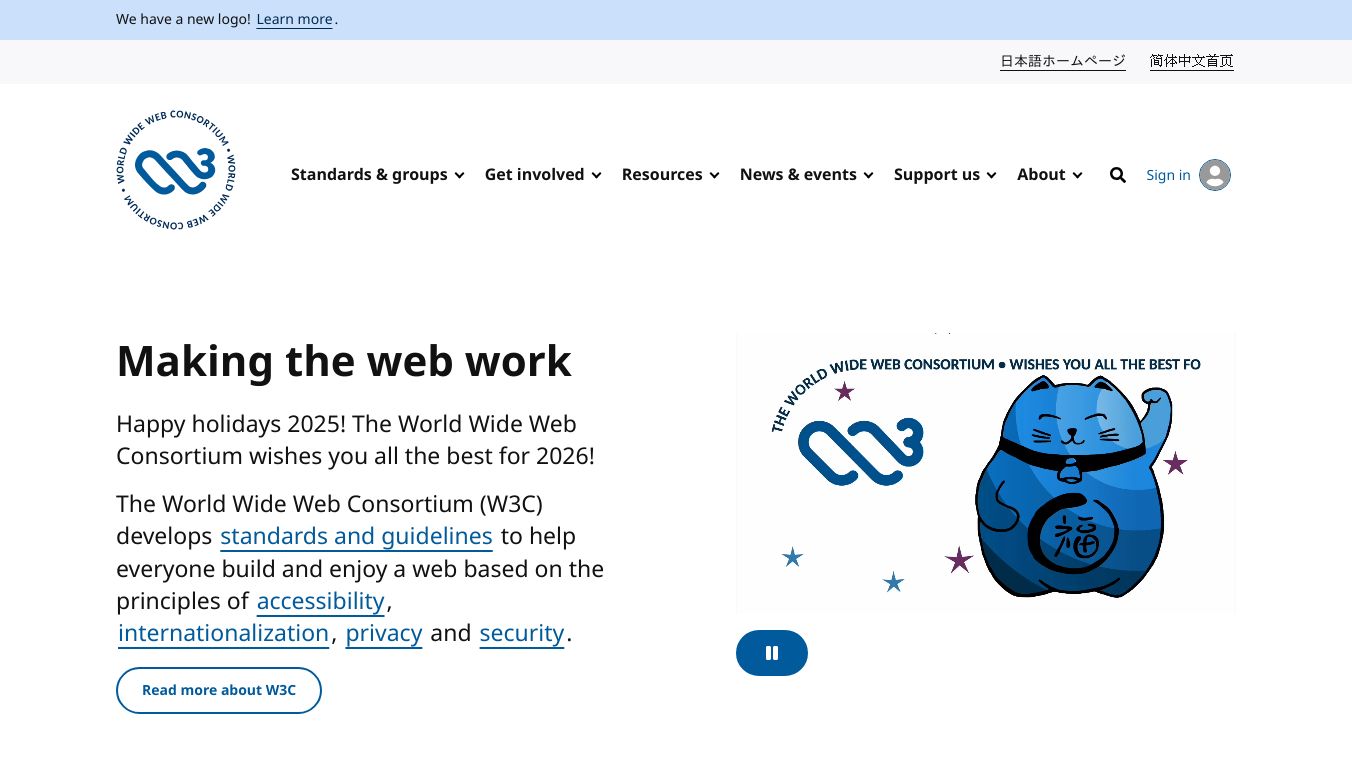





What is syntux https://www.w3.org?
The World Wide Web Consortium (W3C) is the main international standards organization for the World Wide Web. It develops protocols and guidelines that ensure the long-term growth of the Web. The W3C website, accessible at https://www.w3.org/, serves as a central hub for information on web standards and technologies.
One of the key areas of focus for the W3C is the Web Ontology Language (OWL), which can be explored at https://www.w3.org/OWL/. OWL is a language designed for creating ontologies, which are formal descriptions of concepts within a domain and the relationships between those concepts. This language allows for the creation of rich and complex knowledge models that can be processed by computers.
The W3C provides a wealth of resources, specifications, and tools related to OWL and other web standards. These resources are invaluable for developers, researchers, and organizations looking to leverage the power of semantic web technologies.
Benefits
The W3C's work on OWL and other web standards offers numerous benefits. By providing a standardized language for creating ontologies, OWL enables better data integration and interoperability. This can lead to more efficient data management and improved decision-making processes. Additionally, the W3C's resources and tools help developers create more robust and scalable web applications.
Use Cases
OWL and the resources provided by the W3C have a wide range of applications. In the field of healthcare, for example, OWL can be used to create ontologies that describe medical concepts and their relationships. This can improve data sharing and integration between different healthcare systems. In the field of e-commerce, OWL can be used to create product ontologies that enable better product search and recommendation systems.
Additional Information
The W3C is a member-driven organization, with over 400 member organizations from around the world. It is led by Tim Berners-Lee, the inventor of the World Wide Web. The W3C's work is supported by various funding sources, including membership fees, government grants, and donations. The organization also collaborates with other standards bodies and industry groups to promote the adoption of web standards.
This content is either user submitted or generated using AI technology (including, but not limited to, Google Gemini API, Llama, Grok, and Mistral), based on automated research and analysis of public data sources from search engines like DuckDuckGo, Google Search, and SearXNG, and directly from the tool's own website and with minimal to no human editing/review. THEJO AI is not affiliated with or endorsed by the AI tools or services mentioned. This is provided for informational and reference purposes only, is not an endorsement or official advice, and may contain inaccuracies or biases. Please verify details with original sources.
 No Info
Comments
Please log in to post a comment.