Synapsor Runner
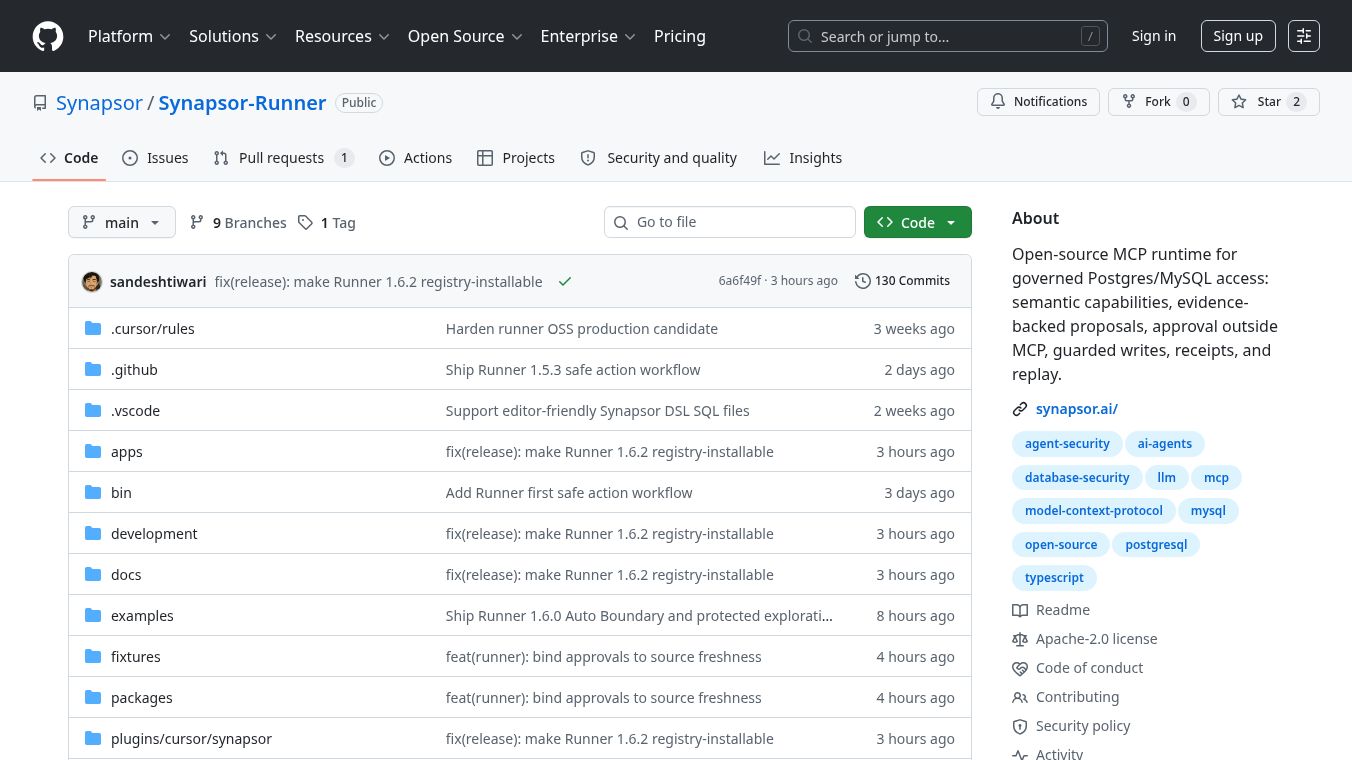





Synapsor Runner: An Open-Source MCP Runtime for Governed Database Access
Introduction
Synapsor Runner is an open-source tool designed to help AI agents safely interact with databases like Postgres and MySQL. It acts as a safety layer that allows AI to propose changes to real application data without giving the AI direct control to execute those changes. The system ensures that all business actions are reviewed by humans, recorded as detailed data proposals, and that sensitive information like passwords and approval rights stay away from the AI model. This approach helps organizations use AI for data tasks while maintaining strict control and security.
Benefits
Synapsor Runner offers several key advantages for teams working with AI and databases. First, it provides a clear safety boundary. Users can verify how the system works without needing a live database connection. The tool proves that proposed changes are safe before any action is taken. Second, it creates an audit trail. Every proposed change is recorded as a Data PR, which means there is a complete history of what was suggested, who approved it, and what the final result was. Third, it prevents accidental data loss. The system stops duplicate mutations and refuses stale proposals, ensuring that only one version of a change is applied. Finally, it integrates easily with development tools like Cursor, allowing developers to ask bounded questions about their data without risking security breaches.
Use Cases
Synapsor Runner is useful in various scenarios where AI needs to access or modify data. One common use case is auditing existing MCP servers. Teams can use the tool to scan their current setups for raw SQL usage or model-controlled authority without running the servers. Another use case is connecting staging applications. Developers can link a read-only staging database to the runner to test changes safely. The tool is also ideal for creating exact data proposals. When a business action needs to be performed, users can describe it in plain language, and the system will generate a precise TypeScript draft for human review. This is helpful for teams that want to use AI for data analysis or updates but need human oversight for every change. Additionally, it works well with Cursor IDE, where developers can ask specific questions about their data, such as identifying churned accounts, while the runner ensures the query stays within safe bounds.
Pricing
Synapsor Runner is available as open-source software under the Apache License 2.0. This means teams can use it for free without licensing fees. There is also a Synapsor Cloud option that adds features like a shared registry, approval workflows, and redacted activity logs, but specific pricing for these services is not detailed in the available information.
Vibes
As an open-source project hosted on GitHub, Synapsor Runner has not yet gathered a large number of public reviews or testimonials. The project focuses on providing a proof of concept and documentation to demonstrate its safety model. Early adopters and developers in the open-source community are likely to be the first to test and provide feedback on its capabilities. The emphasis on transparency and auditability suggests it is well-received by those concerned with AI safety and data governance.
Additional Information
Synapsor Runner is part of a larger ecosystem of packages. These include @synapsor/spec for defining contracts, @synapsor/dsl for SQL-like authoring, and @synapsor/cli for cloud administration. The system offers different isolation modes, such as embedded try for synthetic sources, applicationscope for shared roles, and tenantbound for restricted credentials. It is designed to work with various database schemas and supports integration with tools like Cursor for local authoring. The project encourages users to follow the documentation, run the proof of boundary, and report bugs or request features through the GitHub repository.
This content is either user submitted or generated using AI technology (including, but not limited to, Google Gemini API, Llama, Grok, and Mistral), based on automated research and analysis of public data sources from search engines like DuckDuckGo, Google Search, and SearXNG, and directly from the tool's own website and with minimal to no human editing/review. THEJO AI is not affiliated with or endorsed by the AI tools or services mentioned. This is provided for informational and reference purposes only, is not an endorsement or official advice, and may contain inaccuracies or biases. Please verify details with original sources.



Comments
Please log in to post a comment.