Suwu: Omarchy inspired web remote shell





Building Suwu: An Omarchy-Inspired Remote Shell with the Cheapest AI Models
Introduction
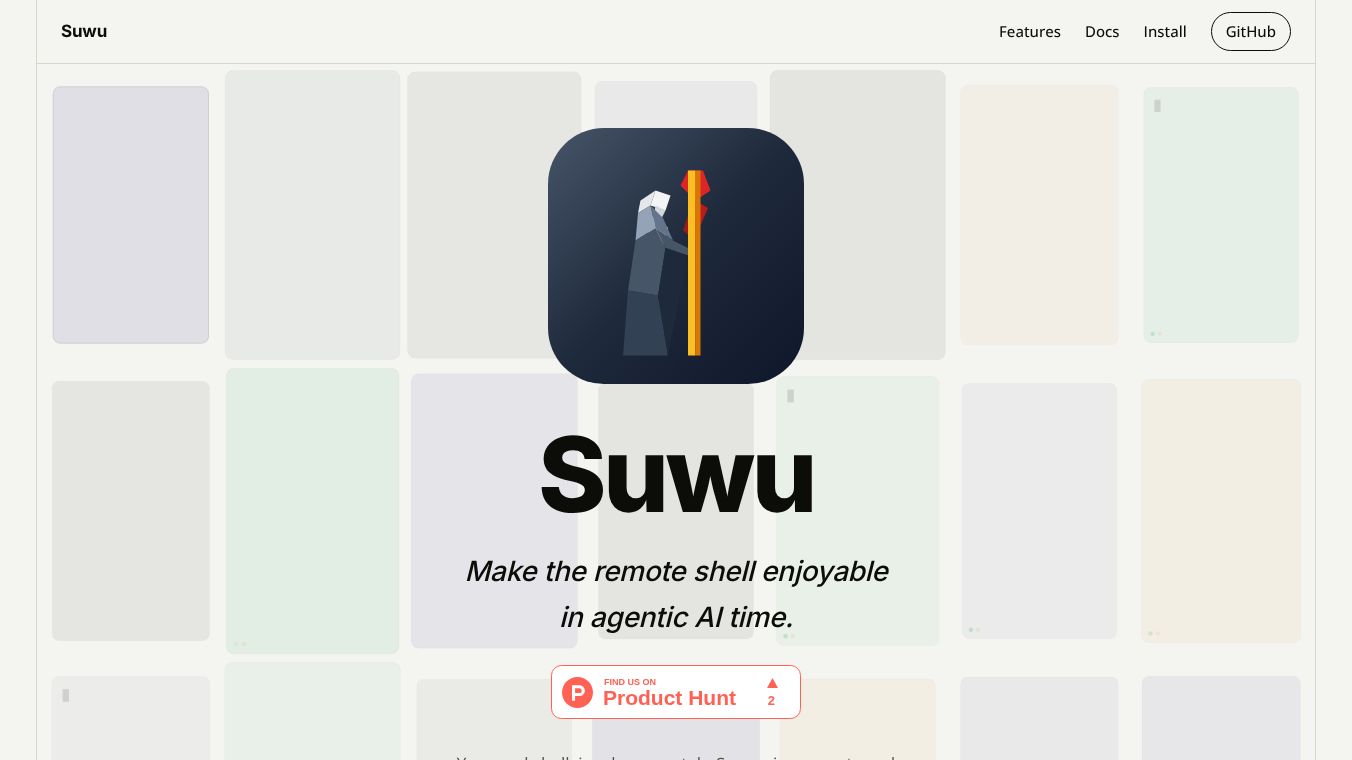
Suwu is a web-based tool that acts as a remote shell and tiling window manager. It is designed to bring the Omarchy workflow into a browser. This workflow allows developers to do all their coding and terminal work inside a web page instead of switching between different programs. The project was created to fix the problem of developers having to jump between a terminal, a web browser, and code editors like VS Code. By using Suwu, users can keep everything in one place without needing to install virtual machines or use special viewing clients.
Benefits
Suwu offers several key advantages for developers who want a smoother workflow. The main benefit is that it unifies the development process. Users can run agents, write code, and view results all within a single browser window. This eliminates the frustration of constantly switching tabs or applications. Another major benefit is cost efficiency. The project uses affordable AI models like DeepSeek V4 and Xiaomi's MiMo 2.5. This keeps the daily cost low, often around fifty cents, and the total project cost under ten dollars. The tool also solves technical problems by using a combination of xterm.js and libghostty-vt. This setup ensures that terminal sessions stay active and work well in a web environment. Finally, the tool is built with Go, which means it compiles into a single binary file. This makes it easy for users to maintain copies on their local machines.
Use Cases
Suwu is primarily designed for developers who want to streamline their coding process. It is ideal for anyone who finds themselves switching between too many tools while working on a project. For example, a developer can use Suwu to run automated coding agents directly in the browser. They can then view the code generated by these agents and make changes without leaving the page. It is also useful for teams that want a consistent remote shell experience without the overhead of setting up complex virtual machines. The tool works well for users who prefer a lightweight solution that runs entirely in their web browser. It supports standard web technologies like React, TypeScript, and Tailwind CSS, making it accessible to those familiar with modern web development.
Pricing
The project focuses on using the cheapest available AI models to keep costs down. The author tracked spending and found that the daily cost peaked at around three dollars but averaged just fifty cents. The total spending for the entire project remained under ten dollars. This approach shows that powerful developer tools do not always require expensive subscriptions to large AI providers.
Vibes
The development of Suwu highlights a successful collaboration between human developers and AI agents. The author notes that while AI is powerful, it needs human guidance to avoid mistakes like infinite loops or messy code. The human developer plays a crucial role in debugging and making high-level architectural decisions. This partnership allowed the project to move forward quickly despite technical hurdles. The final result is a tool that the author considers their most important daily utility. It proves that affordable AI models can be used to build complex and opinionated tools that rival traditional desktop environments.
Additional Information
The project was built using the Opencode Go subscription and the Pi coding agent. The author initially used DeepSeek V4 but switched to Xiaomi's MiMo 2.5 when the price of the first model increased. The development process involved overcoming significant challenges with mouse clicks and clipboard handling by pivoting back to xterm.js. The tool is compiled into a single binary thanks to the Go programming language. This design choice makes it easy to maintain and deploy. The project serves as a demonstration of how cost-effective AI assistance can accelerate the creation of high-quality developer tools.
This content is either user submitted or generated using AI technology (including, but not limited to, Google Gemini API, Llama, Grok, and Mistral), based on automated research and analysis of public data sources from search engines like DuckDuckGo, Google Search, and SearXNG, and directly from the tool's own website and with minimal to no human editing/review. THEJO AI is not affiliated with or endorsed by the AI tools or services mentioned. This is provided for informational and reference purposes only, is not an endorsement or official advice, and may contain inaccuracies or biases. Please verify details with original sources.


Comments
Please log in to post a comment.