soto
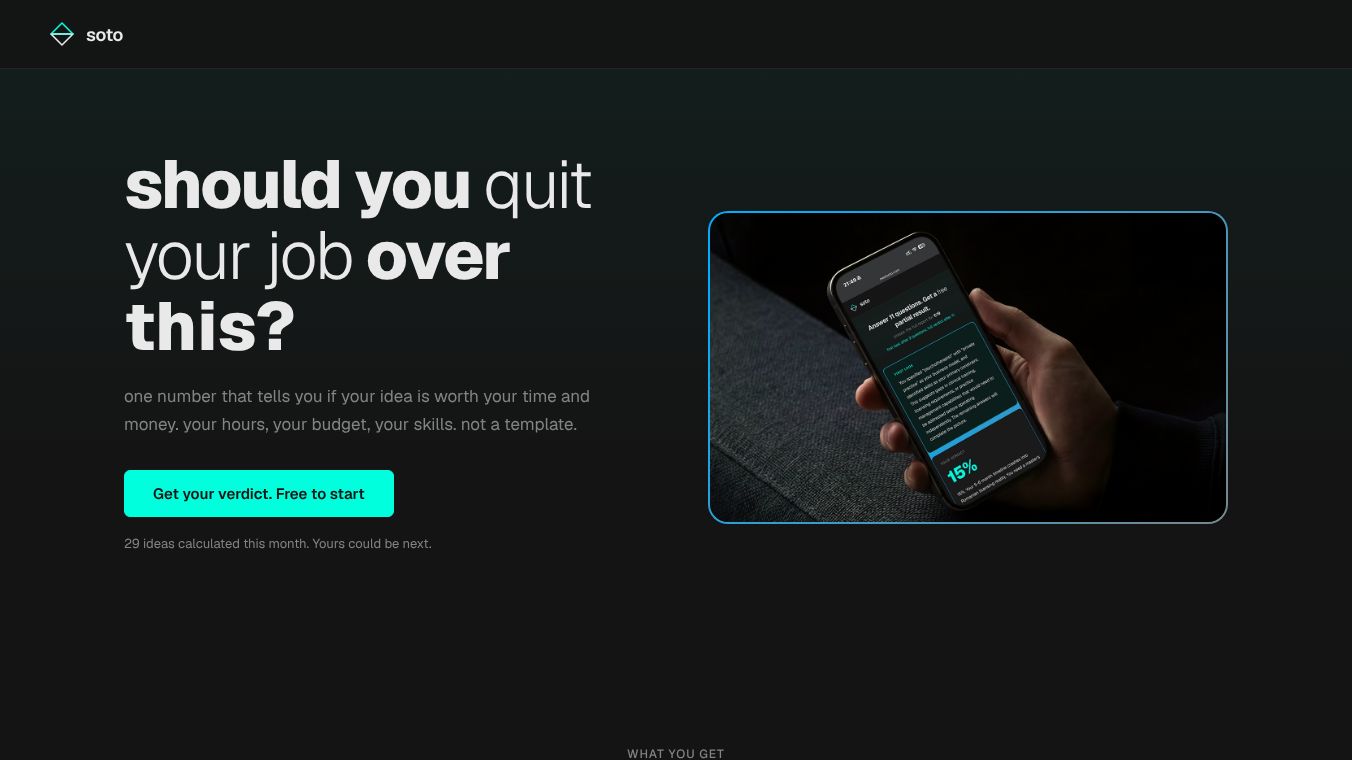





Should You Quit Your Job Over This? A Data-Driven Verdict on Your Idea
In the age of AI, many tools promise to validate your entrepreneurial dreams. However, generic advice often fails to account for the specific constraints of your reality. The solution lies in a framework that moves beyond vague possibilities to provide a concrete verdict on whether your idea is worth your time, money, and the risk of leaving your current job.
Benefits
Standard AI tools, such as ChatGPT, typically respond to business ideas with a simple yes. They offer possibilities without context. In contrast, a specialized analytical approach (exemplified by the Soto framework) operates differently. Instead of asking if an idea is good in a vacuum, it asks if the idea is viable given your specific constraints: your available hours, your budget, and your existing skills. This tool performs the math out loud, providing a position rather than just a list of options.
The core value of this approach is specificity. It does not provide a template result; every output is calculated based on your unique inputs. The deliverable includes three critical components:
- A Verdict: A specific percentage indicating the likelihood of success (e.g., 68% the idea works).
- The Biggest Risk: An identification of the primary obstacle, such as your first customer is the bottleneck or a regulatory barrier.
- Your Move This Week: A single, specific action tailored to your exact situation, rather than generic advice like it depends.
Use Cases
The utility of this framework is best illustrated by the experience of Ana, a psychology graduate in Bucharest, Romania. Ana wanted to open a private therapy practice within 5–6 months. When her idea was analyzed, the system scored it at 15% viability.
The analysis flagged a critical legal risk: in Romania, a bachelor's degree in psychology does not legally qualify someone to practice therapy; a master's degree plus supervised clinical hours (taking 2–3 years minimum) is required. While the low score was expected, the true value lay in the alternatives section. The system suggested two immediate paths Ana could pursue without waiting for accreditation:
- Life coaching.
- Psychology-informed workshops at community centers.
As Ana noted, It's nice because it gives me alternatives that I can do without accreditations. This shift from a binary yes/no to a strategic pivot point is what makes the tool effective.
The process is designed to be simple and direct:
- Answer 11 Questions: You describe your idea clearly, as if telling a friend, avoiding pitch-speak. The system analyzes your situation based on your stated constraints (hours, budget, skills).
- Receive a Free Partial Result: After answering the first two questions, you receive an initial look at the analysis.
- Unlock the Full Report: For a fee (e.g., €19), you unlock the complete report, which includes the final verdict, the specific risk, and the actionable move this week.
Why This Matters for Career Decisions
Before quitting a job to pursue an idea, you need more than optimism; you need a roadmap. This framework provides a move that changes this week, a specific action tied to your resources that can alter your trajectory immediately. It ensures that if you do decide to leave your job, you are not walking blindly but have a calculated plan based on your actual capacity and market reality.
Note: While the system is AI-powered and provides analytical scores, these are not guarantees. Users are advised to use their own judgment alongside the data provided.
This content is either user submitted or generated using AI technology (including, but not limited to, Google Gemini API, Llama, Grok, and Mistral), based on automated research and analysis of public data sources from search engines like DuckDuckGo, Google Search, and SearXNG, and directly from the tool's own website and with minimal to no human editing/review. THEJO AI is not affiliated with or endorsed by the AI tools or services mentioned. This is provided for informational and reference purposes only, is not an endorsement or official advice, and may contain inaccuracies or biases. Please verify details with original sources.


 No Info
Comments
Please log in to post a comment.