Sipp
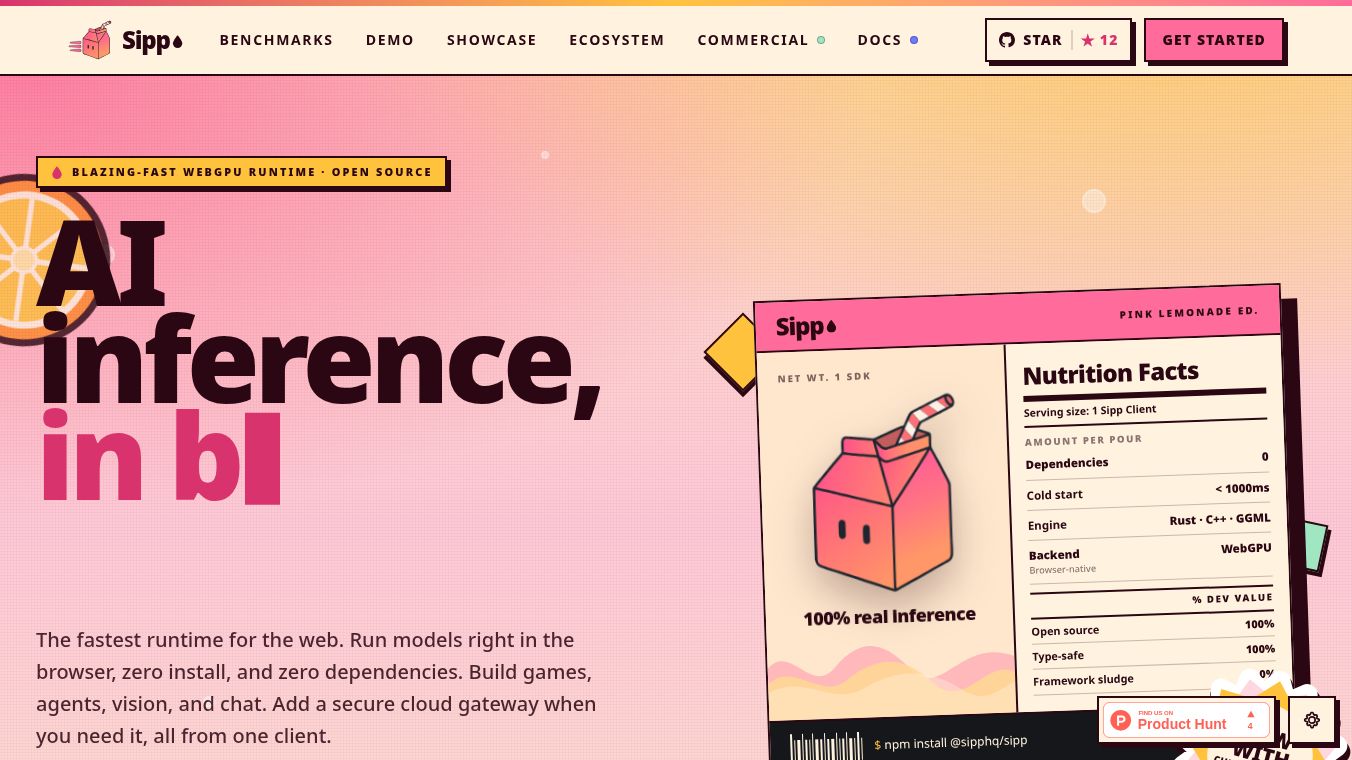





Sipp: The Fastest AI Inference Runtime for the Web
Overview
Sipp is an open-source tool that lets people run artificial intelligence models directly inside their web browsers. It is designed to be the fastest way to use AI on the web without needing to install any software or rely on cloud servers for basic tasks. Built using technologies like Rust, C++, and WebGPU, Sipp allows developers to create games, chatbots, and visual applications that work entirely within a browser window.
Benefits
Sipp offers several key advantages that make it stand out from other AI tools. First, it requires zero installation and has no external dependencies. Users can start using it immediately without downloading extra files or setting up complex environments. Second, it provides a unified API that works the same way whether the AI runs locally on the user's device or on a secure cloud server. This means developers do not need to rewrite their code if they decide to switch between local and cloud options. Third, Sipp delivers superior performance. Benchmarks show it is significantly faster than other browser-based runtimes, delivering quicker responses and smoother interactions. Finally, it is fully open-source and type-safe, which ensures a clean and efficient development experience free from unnecessary framework complications.
Use Cases
Sipp is versatile and can power a wide range of applications. It is ideal for creating games that feature dynamic spell generation or swarm-based agent battles. Developers can also build autonomous agents that reason and act in real-time. The tool supports vision applications that provide live feedback on drawings or images. It is also perfect for chat interfaces where users interact with AI-driven characters. Beyond these specific examples, Sipp enables fully offline applications where users can access AI without an internet connection. It is also suitable for real-time interactive tools like chatbots and virtual art tools. For larger projects, developers can start with browser-based inference and scale up to cloud gateways as their needs grow.
Pricing
Sipp is free to use. It is an open-source project, which means there are no licensing fees or subscription costs for developers who want to integrate it into their projects.
Vibes
As a new and emerging technology, Sipp is generating excitement within the developer community for its ability to bring high-performance AI to the web. Early benchmarks and technical reviews highlight its impressive speed, with reports noting it is much faster than existing solutions like Transformers.js and WebLLM. The community appreciates its focus on simplicity and performance, viewing it as a promising foundation for the future of AI-driven web applications. While specific user testimonials are still developing as the tool matures, the technical reception has been positive due to its robust architecture and significant performance gains.
Additional Information
Sipp is built on a strong technical foundation that includes WebGPU for GPU acceleration, WebAssembly for efficient code execution, and support for popular model formats like GGUF. The project is currently focused on desktop applications, with mobile support in active development. It is designed to be a cornerstone for future AI web applications, offering a balance of speed, flexibility, and ease of use. The tool integrates seamlessly with various environments including Node.js, Rust, and Python, making it adaptable for diverse deployment needs.
This content is either user submitted or generated using AI technology (including, but not limited to, Google Gemini API, Llama, Grok, and Mistral), based on automated research and analysis of public data sources from search engines like DuckDuckGo, Google Search, and SearXNG, and directly from the tool's own website and with minimal to no human editing/review. THEJO AI is not affiliated with or endorsed by the AI tools or services mentioned. This is provided for informational and reference purposes only, is not an endorsement or official advice, and may contain inaccuracies or biases. Please verify details with original sources.



Comments
Please log in to post a comment.