Scinaut
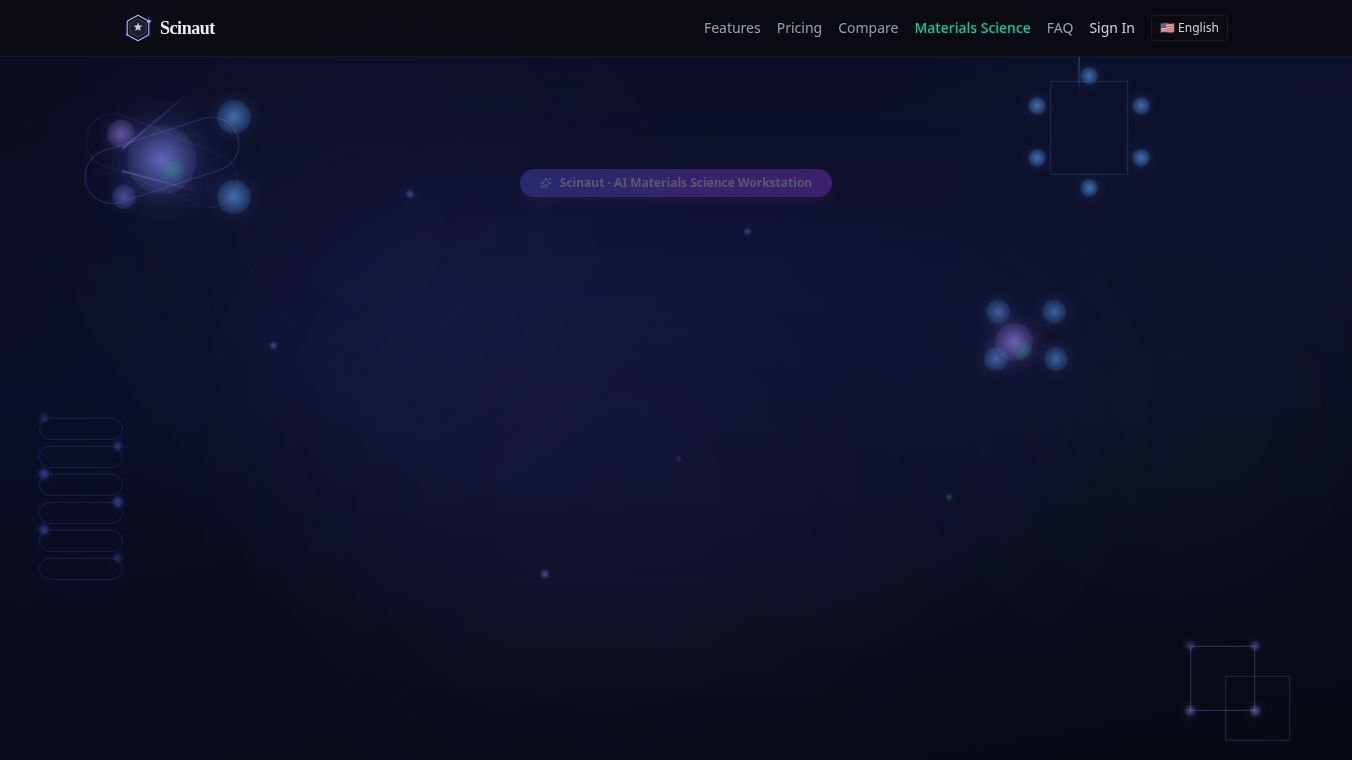





Scinaut: An AI Research Platform for Materials Science
Research Context and Background
Scinaut is a specialized AI research platform built specifically for materials science researchers. It acts as a digital lab assistant that helps scientists read papers, manage knowledge, and run calculations. The tool is designed to speed up the work of going from reading a research paper to publishing a new study. It combines general AI capabilities with deep expertise in materials science to provide accurate and useful results.
Benefits
Scinaut offers several key advantages for researchers who need to work efficiently and accurately.
First, it analyzes research papers in three different ways. Users can get a quick overview that extracts goals, methods, and results in seconds. They can also choose a deep dive mode that critically evaluates the study, checks for biases, and spots missing details like synthesis temperatures or stability data. For exam preparation, the tool can generate a set of question and answer cards based on the text.
Second, the platform provides synthesized answers instead of just search snippets. It acts like a principal scientist by giving complete responses that include citations. Users can upload paper abstracts or experiment protocols and ask follow-up questions with confidence that the answers are backed by sources.
Third, Scinaut includes a built-in materials science engine. This system is trained on 40 years of domain expertise and adapts to different material types. It gives users direct access to a database of over 100,000 materials. Users can search by chemical formula to find crystal structures, band gaps, and stability data. The tool also performs instant calculations without needing complex software installations. It can estimate battery voltage and capacity, draw phase diagrams, and calculate diffusion barriers.
Finally, the platform ensures trust and transparency. Every factual claim is followed by a clickable citation badge so users can trace the source directly. The system marks expert judgments clearly and notes any uncertainties. This approach avoids the "black box" problem where AI decisions are hard to understand.
Use Cases
Scinaut is designed for materials science researchers who need to process large amounts of data quickly.
Researchers can use the tool to speed up their literature reviews. Instead of spending hours reading papers, they can get structured summaries in about 30 seconds. This is much faster than reading manually or trying to use general chatbots with complex prompts.
The platform is useful for students and professionals preparing for exams. The review mode creates study cards that help users quickly grasp key concepts from complex papers.
Scientists can use the integrated engine to run computations that would normally take days. They can estimate battery performance, analyze failure modes in solar cells, or screen potential dopants for new materials. The tool handles tasks like parsing data from XRD or TGA instruments automatically.
The knowledge graph feature allows users to explore relationships between materials, processes, and properties. A researcher can ask natural language questions about how a specific process affects a material property, and the system will navigate through the data to find the answer.
Pricing
Pricing details for Scinaut are not available in the provided information.
Vibes
Public reception and specific user reviews are not available in the provided information.
Additional Information
Scinaut is built with privacy in mind. Documents uploaded by users are stored in their own Supabase database. The platform does not train its models on user data, which helps protect intellectual property. The tool is part of a broader effort to make AI more useful for scientific discovery by combining large language models with specialized domain knowledge.
This content is either user submitted or generated using AI technology (including, but not limited to, Google Gemini API, Llama, Grok, and Mistral), based on automated research and analysis of public data sources from search engines like DuckDuckGo, Google Search, and SearXNG, and directly from the tool's own website and with minimal to no human editing/review. THEJO AI is not affiliated with or endorsed by the AI tools or services mentioned. This is provided for informational and reference purposes only, is not an endorsement or official advice, and may contain inaccuracies or biases. Please verify details with original sources.
Comments
Please log in to post a comment.