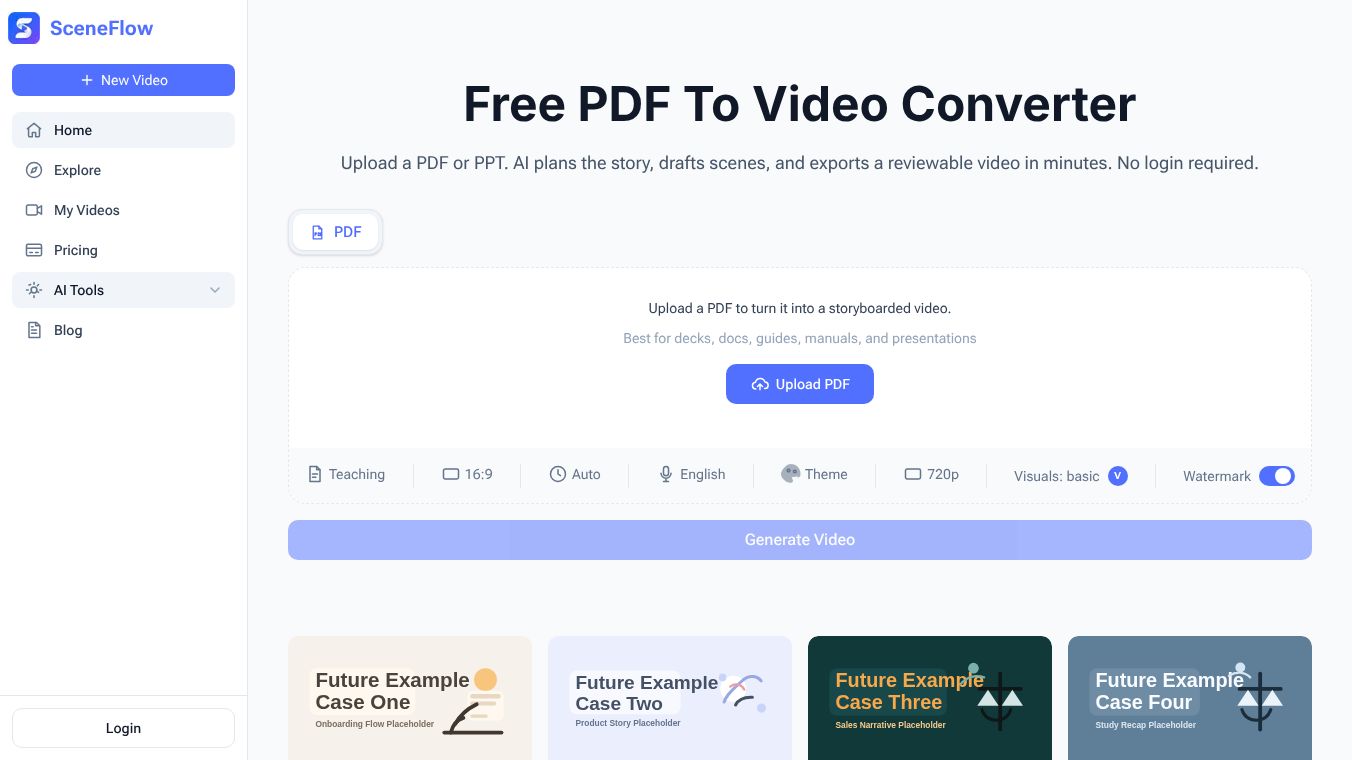





SceneFlow: A Tool for Understanding 3D Scenes
Introduction
SceneFlow is an open-source software tool designed to help researchers and developers understand how 3D scenes change over time. It focuses on estimating the movement of points in a 3D space using video data. The project was created to make this complex task easier and more accessible for the scientific community. It is available for free and is hosted on GitHub.
Benefits
The main advantage of SceneFlow is that it simplifies a difficult problem in computer vision. Many existing tools struggle with accuracy when tracking how objects move in a 3D environment. SceneFlow addresses this by using a specific method called optical flow to track points accurately. It is built to be fast and efficient, which allows it to process video data quickly. Because it is open-source, anyone can study its code, improve it, or use it as a base for their own projects. This transparency helps the community build better tools for 3D analysis.
Use Cases
SceneFlow is primarily used in academic research and development. Scientists use it to study how cameras move and how objects shift in a 3D space. It is useful for tasks like autonomous driving research, where understanding the movement of the car and its surroundings is critical. Developers working on robotics or augmented reality can also use it to improve how their systems perceive depth and motion. The tool is especially helpful when working with large video datasets where speed and accuracy are both important.
Pricing
SceneFlow is completely free to use. It is released under an open-source license, which means there are no costs for downloading, installing, or modifying the software. Users only need a computer with the necessary programming environment to run it.
Vibes
As an open-source research tool, SceneFlow does not have commercial reviews or public testimonials in the traditional sense. Its reputation is built on its use within the scientific and developer communities. Researchers often cite it in papers when they use its methods for motion estimation. The project maintains an active presence on GitHub, where users can report issues or suggest improvements. This community-driven approach suggests that the tool is valued for its utility and reliability in academic settings.
Additional Information
SceneFlow was developed by researchers from the University of Toronto and other institutions. It was first introduced in a research paper titled "Scene Flow: A Benchmark and Dataset for 3D Motion Estimation." The project is maintained on GitHub, where the source code and documentation are available. It has been recognized as a significant contribution to the field of computer vision because it provides a standard way to measure and compare 3D motion estimation algorithms.
This content is either user submitted or generated using AI technology (including, but not limited to, Google Gemini API, Llama, Grok, and Mistral), based on automated research and analysis of public data sources from search engines like DuckDuckGo, Google Search, and SearXNG, and directly from the tool's own website and with minimal to no human editing/review. THEJO AI is not affiliated with or endorsed by the AI tools or services mentioned. This is provided for informational and reference purposes only, is not an endorsement or official advice, and may contain inaccuracies or biases. Please verify details with original sources.


 No Info

Comments
Please log in to post a comment.