Reasoning First Knowledge Graph (RF-KG)





Reasoning First Knowledge Graph (RF-KG)
Introduction
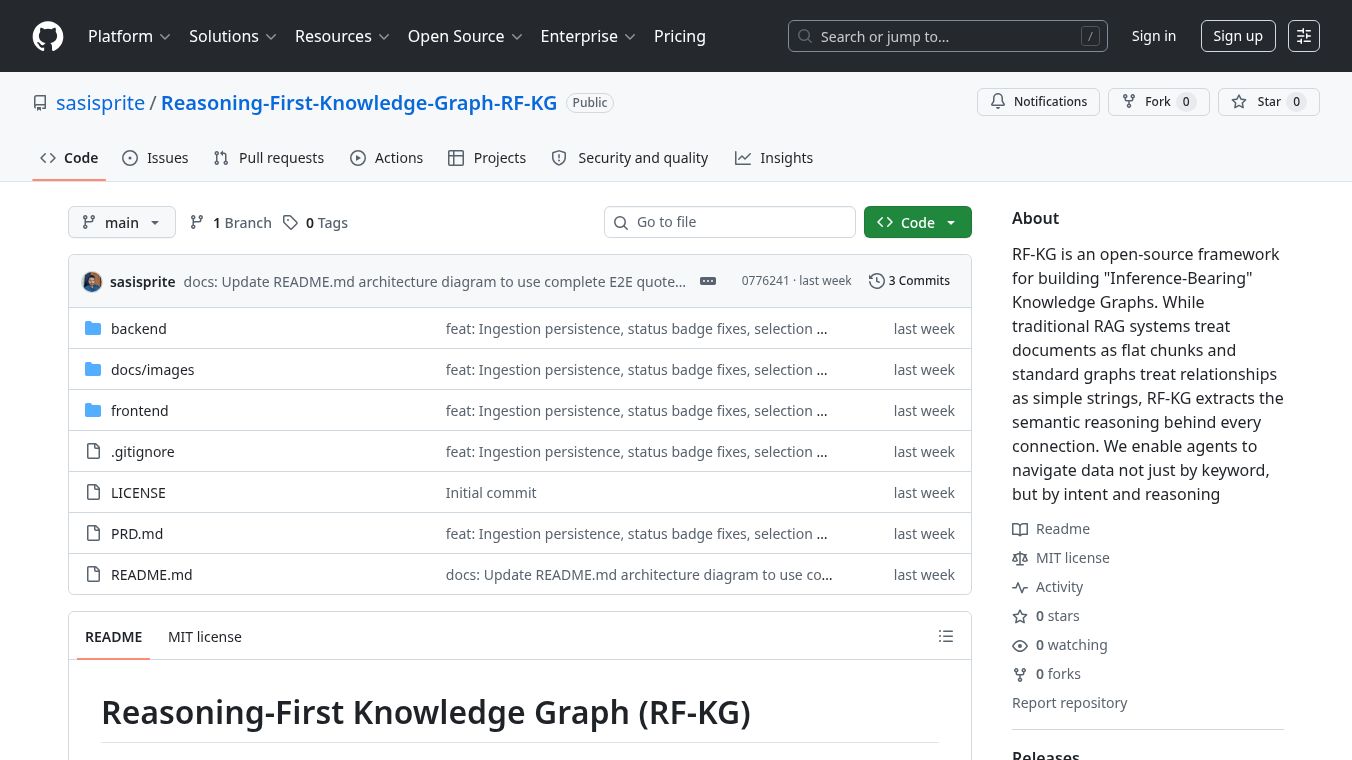
RF-KG is an open-source tool that helps build smart knowledge graphs. It is designed to fix common problems found in traditional AI systems that use documents to answer questions. Most standard systems treat text as simple blocks or connect ideas with basic labels like "related to." RF-KG goes further by storing the actual reasoning behind every connection. This means the system knows not just that two ideas are linked, but why they are linked and what evidence supports that link. The tool uses a database called Neo4j to store this detailed information, allowing AI agents to understand data with much greater depth and clarity.
Benefits
RF-KG offers several key advantages over older methods. First, it solves the problem of losing important context. Traditional systems often flatten documents, which removes the relationships between ideas. RF-KG keeps these connections intact. Second, it stores the logic behind every link. Instead of just saying two things are connected, the system saves a description of the reasoning. This makes the AI's answers more explainable and trustworthy. Third, the tool uses a flexible design where the part that adds data is separate from the part that finds answers. This allows users to connect it easily with different AI models or custom software. Finally, the system provides clear step-by-step logs so users can see exactly how an answer was formed, from finding the right entities to synthesizing the final response.
Use Cases
RF-KG is useful for anyone who needs AI to understand complex information deeply. It works well for legal teams that need to trace the logic behind case law connections. Researchers can use it to map out scientific theories and see the evidence supporting each link between concepts. Business analysts can build graphs that show not just market trends but the reasoning behind those trends. Developers can integrate the tool into their own applications to create chatbots that provide detailed, source-backed answers. The interactive interface also allows users to visualize the entire network of ideas, making it a great tool for exploring large sets of documents or training data.
Pricing
RF-KG is an open-source framework, which means it is free to download and use. Users can access the code on GitHub and set it up on their own computers or servers. However, running the tool requires users to have their own instances of a Neo4j database and to provide their own API keys for services like OpenRouter or local AI models. There are no subscription fees for the software itself, but users must cover the costs of the infrastructure and external services they choose to connect to it.
Vibes
As an open-source project, RF-KG has not yet gathered a large number of public reviews or testimonials. The community response is currently focused on the technical capabilities of the framework rather than user satisfaction scores. Developers who have tested the tool generally appreciate its ability to handle complex reasoning tasks that standard graph databases cannot manage. The project aims to set a new standard for how AI agents interact with knowledge graphs by prioritizing the "why" behind every connection.
Additional Information
RF-KG is built as a complete application with both a backend and a frontend. The backend is written in Python and uses FastAPI to handle data processing. The frontend is built with React and Vite to provide a smooth user experience. To run the system, users need Python 3.12 or higher and Node.js 18 or higher. The project is hosted on GitHub and is maintained by the developer sasisprite. It is designed to work with various large language models, including Llama 3.3, and supports both cloud-based and local AI setups. The architecture is modular, allowing developers to swap out different components like parsers or embedding models to fit their specific needs.
This content is either user submitted or generated using AI technology (including, but not limited to, Google Gemini API, Llama, Grok, and Mistral), based on automated research and analysis of public data sources from search engines like DuckDuckGo, Google Search, and SearXNG, and directly from the tool's own website and with minimal to no human editing/review. THEJO AI is not affiliated with or endorsed by the AI tools or services mentioned. This is provided for informational and reference purposes only, is not an endorsement or official advice, and may contain inaccuracies or biases. Please verify details with original sources.

Comments
Please log in to post a comment.