RAGPipe (OpenSource)
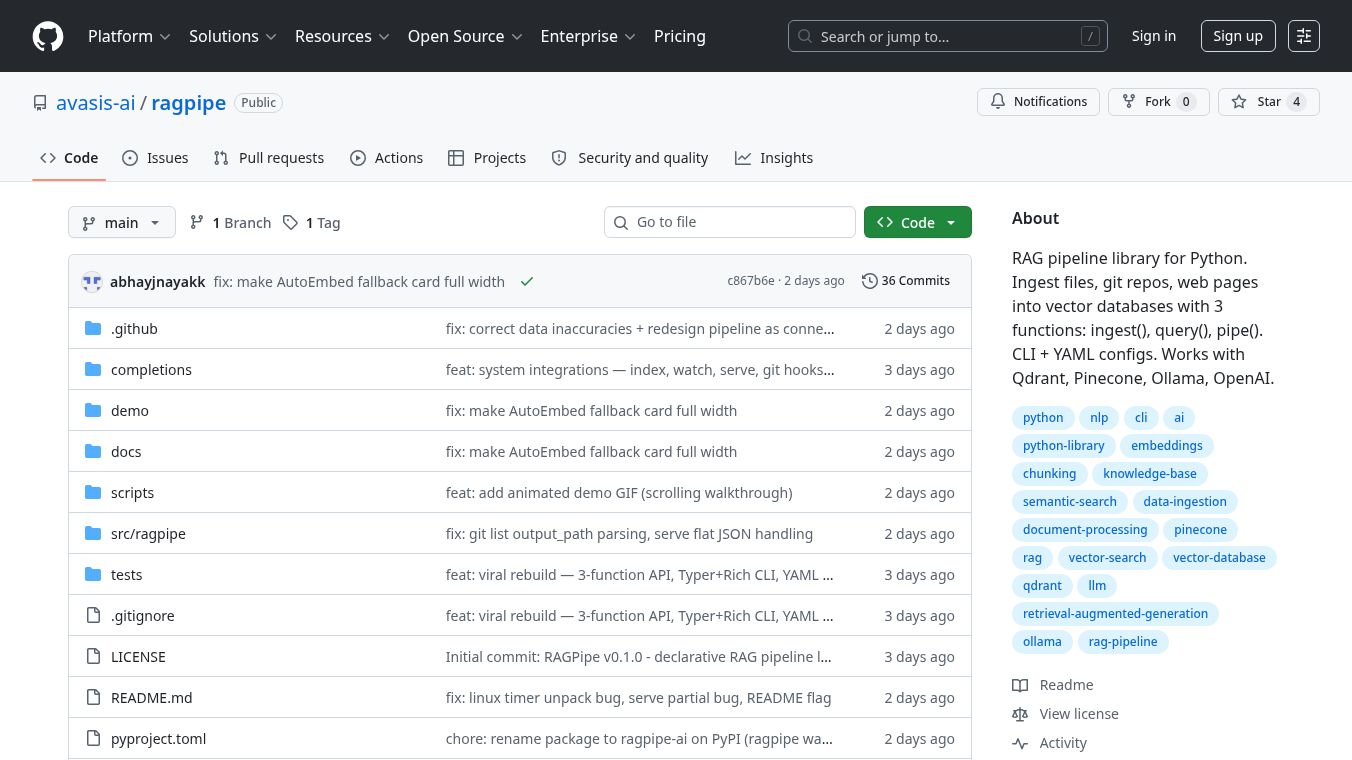





RAGPipe is an open-source Python tool that makes it easier to connect AI models with your own data. It helps AI systems find and use information from your documents, websites, or code to give more accurate and relevant answers. This process is called Retrieval-Augmented Generation or RAG.
Normally, using RAG involves several steps: getting text from different places, breaking it into smaller pieces, turning those pieces into a format the computer understands, storing them, and then searching through them to answer questions. RAGPipe combines all these steps into one simple process.
Benefits
RAGPipe simplifies the complex RAG process into a single, efficient pipeline. It requires minimal setup, allowing users to specify data sources and where to store the processed information. The tool is designed for ease of use, offering a concise three-line API in Python and a helpful command-line interface (CLI). It supports various data sources, embedding models, and vector databases, and can work with local AI models, reducing the need for external services. RAGPipe is also very fast, capable of processing thousands of data chunks per second.
Use Cases
RAGPipe can be used to ingest data from files, Git repositories, or web pages. It can then store this data in various vector databases. The tool's command-line interface allows for tasks like initializing a pipeline, ingesting data from local directories or websites, querying the stored information, and running complex workflows defined in YAML files. It also offers features for smart indexing of codebases, monitoring changes, and even starting a local API server. RAGPipe can be integrated with tools like Git hooks and VSCode, and can be set up for macOS Spotlight search or Linux systemd services.
Pricing
RAGPipe is released under the Business Source License 1.1, with non-competing use under Apache 2.0. This means it is available for use, with certain conditions.
Vibes
Compared to other tools like LangChain or LlamaIndex, RAGPipe is noted for its significantly more concise solution and ease of use. It is described as an "ops-native RAG infrastructure" that focuses on simplicity and integration. Users can expect a streamlined experience with minimal code and configuration.
Additional Information
RAGPipe is an open-source project. It supports multiple embedding backends, including local options like Ollama and sentence-transformers, as well as OpenAI and any OpenAI-compatible API. Its modular design includes various sources like files, Git, and web pages, transforms for cleaning and embedding data, and sinks for storing data in databases like JSON, Qdrant, and Pinecone.
This content is either user submitted or generated using AI technology (including, but not limited to, Google Gemini API, Llama, Grok, and Mistral), based on automated research and analysis of public data sources from search engines like DuckDuckGo, Google Search, and SearXNG, and directly from the tool's own website and with minimal to no human editing/review. THEJO AI is not affiliated with or endorsed by the AI tools or services mentioned. This is provided for informational and reference purposes only, is not an endorsement or official advice, and may contain inaccuracies or biases. Please verify details with original sources.
Other Interesting AI Tools



Comments
Please log in to post a comment.