RagLeap
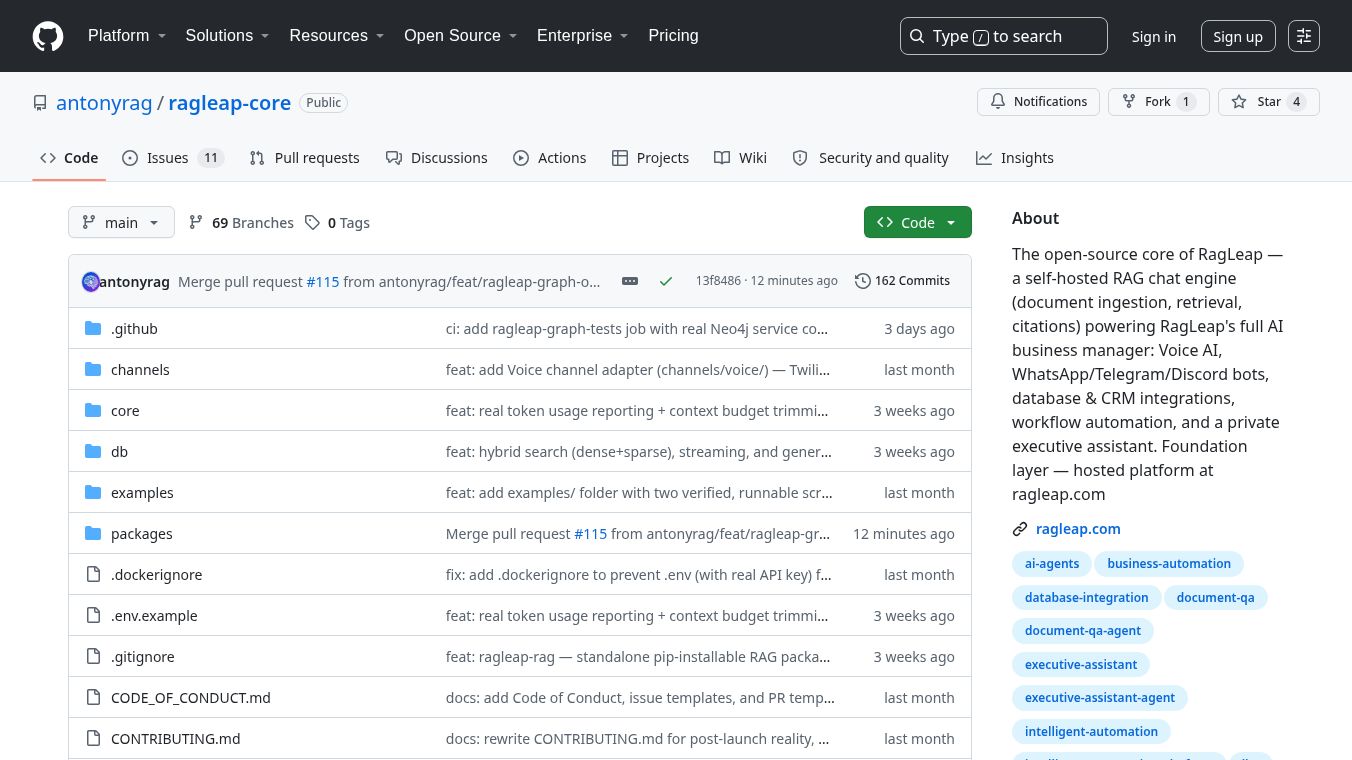





RagLeap: A Tool for Smarter AI Answers
Introduction
RagLeap is an open-source software tool designed to help artificial intelligence systems answer questions more accurately. It works by connecting an AI model to external information sources, such as documents or websites. This process, known as Retrieval-Augmented Generation, allows the AI to use real-world data to build its answers instead of relying only on what it was trained on. RagLeap makes this technology easier to use and more reliable for developers and businesses.
Benefits
RagLeap offers several key advantages for anyone working with AI. First, it improves accuracy by ensuring that answers are based on up-to-date and specific information. This reduces the chance of the AI making up facts or giving outdated responses. Second, it simplifies the setup process. Building a system that connects AI to data can be very complex, but RagLeap provides a ready-made solution that saves time and effort. Third, it supports multiple data sources. Users can connect their AI to various types of documents, making it versatile for different projects. Finally, being open-source means the code is free to use and modify, which lowers costs and encourages community improvement.
Use Cases
RagLeap is useful in many situations where accurate information is critical. One common use case is customer support. Companies can use it to create chatbots that answer questions based on their own manuals and policy documents. This ensures customers get correct answers without waiting for a human agent. Another use case is research and education. Students or researchers can upload their own papers or books and ask the AI to summarize or explain specific topics. It is also helpful for legal and medical fields where precision matters. Lawyers or doctors can query their own case files or patient records to find relevant information quickly. Any business that needs an AI assistant to work with its internal data can benefit from this tool.
Pricing
RagLeap is available as open-source software, which means it is free to download and use. There are no hidden fees or subscription costs for the basic version. Users can host the software on their own servers or use cloud platforms of their choice. This model makes it accessible for individuals, small teams, and large organizations alike.
Vibes
As an open-source project hosted on GitHub, RagLeap has received positive feedback from the developer community. Users appreciate its clear documentation and the ease with which it integrates with other tools. The project aims to solve common problems in AI development, and early adopters have found it to be a reliable foundation for building custom AI applications. While it is still growing, the focus on practical utility and transparency has built trust among its users.
Additional Information
RagLeap was created by Antony Rag and is maintained as an open-source project. It is available on GitHub under the repository name ragleap-core. The project is part of a broader movement to make advanced AI techniques accessible to everyone. By keeping the code open, the creators allow others to study, improve, and build upon their work. This collaborative approach helps the tool evolve quickly and adapt to new needs in the field of artificial intelligence.
This content is either user submitted or generated using AI technology (including, but not limited to, Google Gemini API, Llama, Grok, and Mistral), based on automated research and analysis of public data sources from search engines like DuckDuckGo, Google Search, and SearXNG, and directly from the tool's own website and with minimal to no human editing/review. THEJO AI is not affiliated with or endorsed by the AI tools or services mentioned. This is provided for informational and reference purposes only, is not an endorsement or official advice, and may contain inaccuracies or biases. Please verify details with original sources.
 No Info
Comments
Please log in to post a comment.