Qdrant
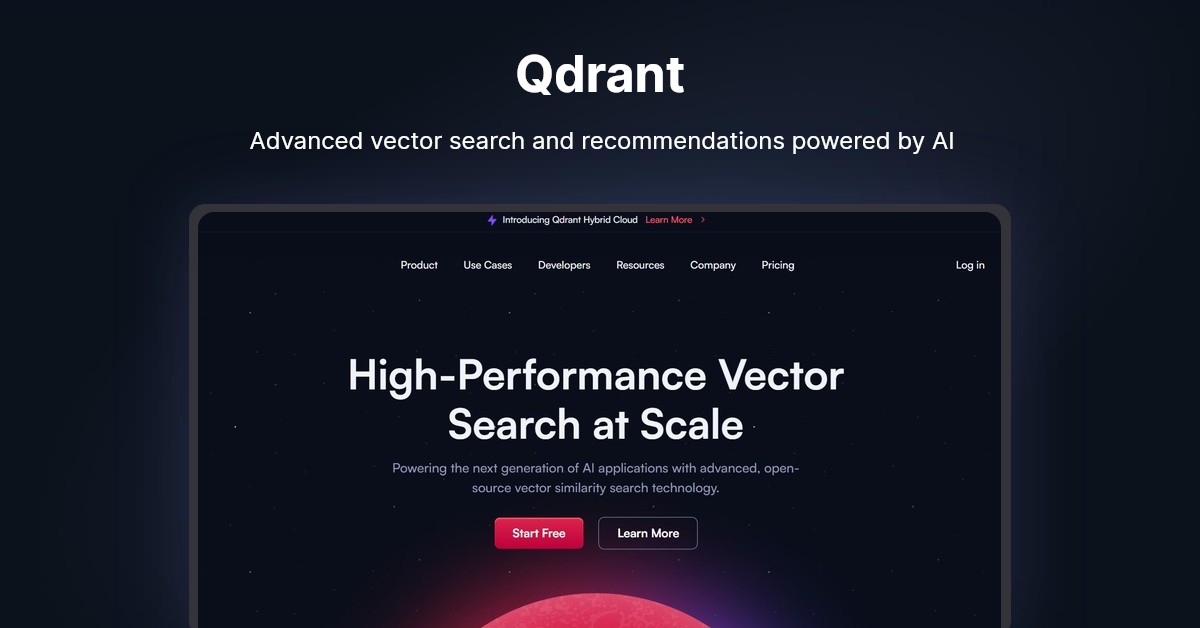





In today's fast-evolving digital landscape, the ability to efficiently manage and search through high-dimensional data is more crucial than ever. Qdrant, a leader in similarity search algorithms, has introduced version 1.3.0 with significant performance enhancements and vital fixes, aimed at elevating user experience to new heights. Its advanced vector database is designed to handle the complexities of high-dimensional data, making it an indispensable tool for developers and businesses alike.
Qdrant's core features include an asynchronous I/O interface for faster data processing, oversampling for quantization to enhance accuracy, and a grouping API lookup for optimized storage utilization. Additionally, its user-friendly Web UI and the functionality to set a temporary directory for snapshots further boost performance. Qdrant offers cloud-native scalability, high availability, ease of use, and simple deployment, making it a top choice for applications requiring similarity searches.
Highlights:
- Performance enhancements and vital fixes in version 1.3.0
- Advanced vector database for high-dimensional data management
- User-friendly Web UI for easy data management
- Cloud-native scalability and high availability
- Cost efficiency with built-in compression options
Key Features:
- Asynchronous I/O interface
- Oversampling for quantization
- Grouping API lookup
- Web UI
- Temporary directory for snapshots
Benefits:
- Empowers applications with cutting-edge search capabilities
- Offers enterprise-grade managed cloud services
- Quick deployment options with Docker and lean API
- Dramatically reduces memory usage with storage options
- Unmatched speed and reliability with Rust-powered development
Use Cases:
- Advanced search in handling multimodal data
- Creation of responsive, personalized recommendation systems
- Improvement of AI-generated content quality with efficient nearest neighbor search
- Real-time anomaly detection in complex datasets
- Enhancement of offerings with advanced search capabilities
This content is either user submitted or generated using AI technology (including, but not limited to, Google Gemini API, Llama, Grok, and Mistral), based on automated research and analysis of public data sources from search engines like DuckDuckGo, Google Search, and SearXNG, and directly from the tool's own website and with minimal to no human editing/review. THEJO AI is not affiliated with or endorsed by the AI tools or services mentioned. This is provided for informational and reference purposes only, is not an endorsement or official advice, and may contain inaccuracies or biases. Please verify details with original sources.






Comments
Please log in to post a comment.