PyMaster
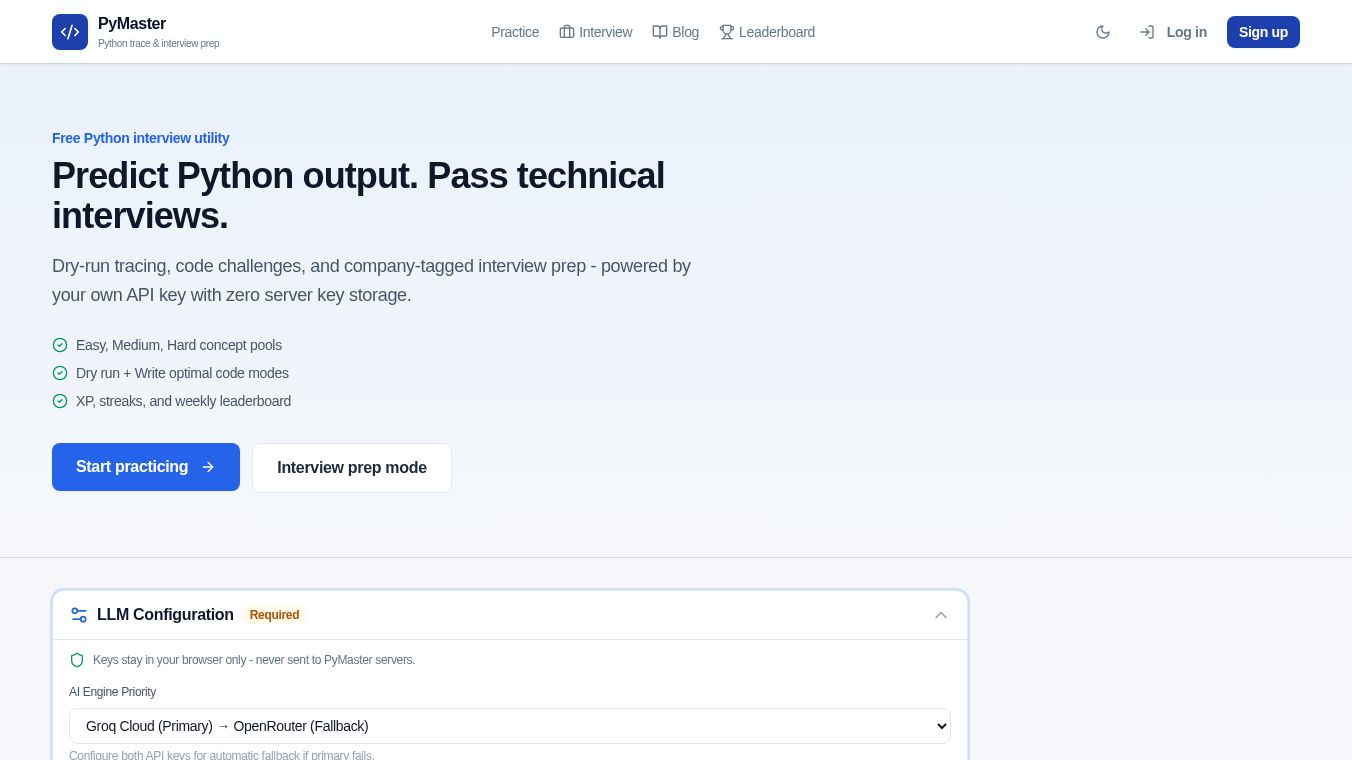





Mastering Python Technical Interviews: The Power of Trace Tables
Introduction
Technical interviews at top tech firms like Google, Meta, Amazon, and Stripe increasingly rely on dry-run questions to assess a candidate's depth of understanding. Unlike trivia or rote memorization, these questions require candidates to simulate the Python interpreter line by line. This guide outlines the systematic approach to mastering trace tables, a critical skill for predicting program output, handling edge cases, and communicating your mental model effectively during technical screens.
Benefits
A trace table is a systematic grid that records how variables, references, and control flow evolve as Python executes code. It replaces guesswork with a repeatable system consisting of line numbers, events, and new values. Unlike memorizing syntax, trace-driven practice forces you to simulate the interpreter directly, accounting for stack frames, scope resolution, mutable object aliasing, generator exhaustion, and short-circuit boolean evaluation. This method helps candidates predict program output accurately and handle complex scenarios with confidence.
Use Cases
Trace tables are essential for technical interviews at major technology companies. They are used to:* Predict program output for dry-run questions.* Handle edge cases like empty inputs or off-by-one loop bounds.* Communicate mental models clearly during technical screens.* Understand specific Python behaviors such as slicing, variable scopes, and the memory model.* Practice with unique challenges that include fresh edge cases to build muscle memory.
Pricing
Pricing information is not available for this resource.
Vibes
Pricing information is not available for this resource.
Additional Information
Pricing information is not available for this resource.
This content is either user submitted or generated using AI technology (including, but not limited to, Google Gemini API, Llama, Grok, and Mistral), based on automated research and analysis of public data sources from search engines like DuckDuckGo, Google Search, and SearXNG, and directly from the tool's own website and with minimal to no human editing/review. THEJO AI is not affiliated with or endorsed by the AI tools or services mentioned. This is provided for informational and reference purposes only, is not an endorsement or official advice, and may contain inaccuracies or biases. Please verify details with original sources.

Comments
Please log in to post a comment.