pumaDB
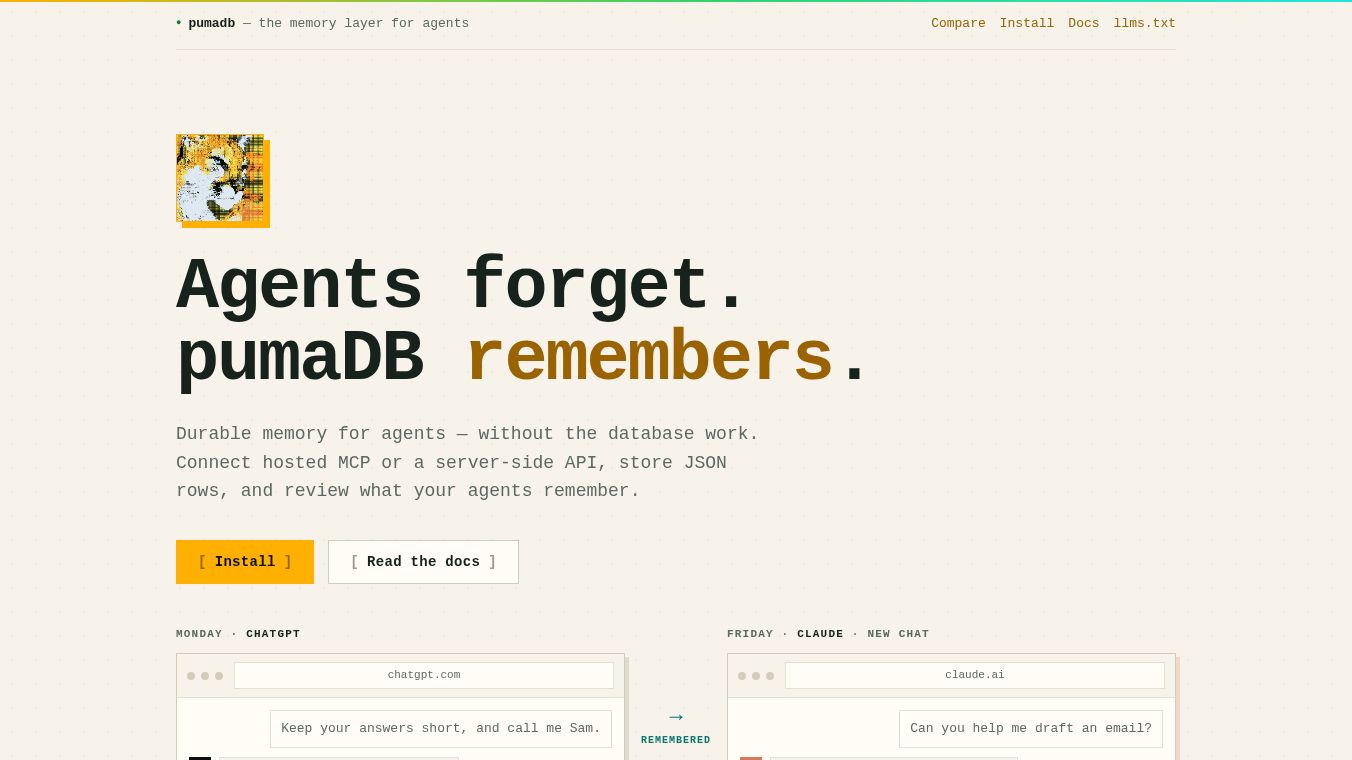





pumaDB: Durable Memory for Agents Without the Database Work
Overview
pumaDB is a lightweight memory solution designed specifically for AI agents and server-side applications. It eliminates the need for complex database projects by offering durable memory storage for JSON rows. Users can connect via a hosted Model Context Protocol (MCP) server or a server-side REST API to store, retrieve, and review what their agents remember.
Benefits
pumaDB provides a lightweight memory schema suitable for almost any small, durable JSON record an application or agent needs to retain. Key advantages include:
- Simplified Integration:It removes the overhead of traditional database administration. Developers can store facts, state, and preferences without setting up complex infrastructure.
- Flexible Connection:Users can interact with the system using a hosted Model Context Protocol (MCP) server for AI agents or a standard REST API for backend services and scripts.
- Comprehensive Memory Storage:The platform handles various types of data including skills, operating instructions, project conventions, user preferences, research clippings, and task state.
- Safety and Control:Accounts are restricted to 20 tables, 1,000 rows per table, and 25 MB of total storage. Rate limiting prevents abuse with caps of 30 writes and 60 reads per minute per key.
- Version History:Every update and delete archives the prior row content. The last 10 versions are retained for 30 days and can be restored with a single call.
- Natural Edits:Agents can convert plain-language requests into filtered updates without creating duplicate rows. Bulk updates require explicit opt-in.
Use Cases
pumaDB is designed for scenarios where applications or agents need to retain specific information over time. Common use cases include:
- Skills and Operating Instructions:Storing reusable workflows, project-specific rules, and tool notes that persist across sessions.
- Project Conventions:Keeping track of repository facts, architecture notes, branch rules, naming patterns, and architectural decisions.
- User Preferences:Saving communication styles, formatting defaults, and review expectations keyed by person or workspace.
- Research Clippings:Managing sources, summaries, links, comparison notes, and follow-up questions from ongoing investigations.
- Task State:Tracking open threads, blockers, handoff notes, pending commands, and lightweight status records for long-running work.
- Typed Safe Memory:Storing resources, code snippets, Markdown, commands, and config examples as inert records for review before use.
Pricing
Pricing details are not available in the provided information.
Vibes
Public reception, reviews, and testimonials are not available in the provided information.
Additional Information
Funding, partnerships, and notable achievements are not available in the provided information.
This content is either user submitted or generated using AI technology (including, but not limited to, Google Gemini API, Llama, Grok, and Mistral), based on automated research and analysis of public data sources from search engines like DuckDuckGo, Google Search, and SearXNG, and directly from the tool's own website and with minimal to no human editing/review. THEJO AI is not affiliated with or endorsed by the AI tools or services mentioned. This is provided for informational and reference purposes only, is not an endorsement or official advice, and may contain inaccuracies or biases. Please verify details with original sources.

Comments
Please log in to post a comment.