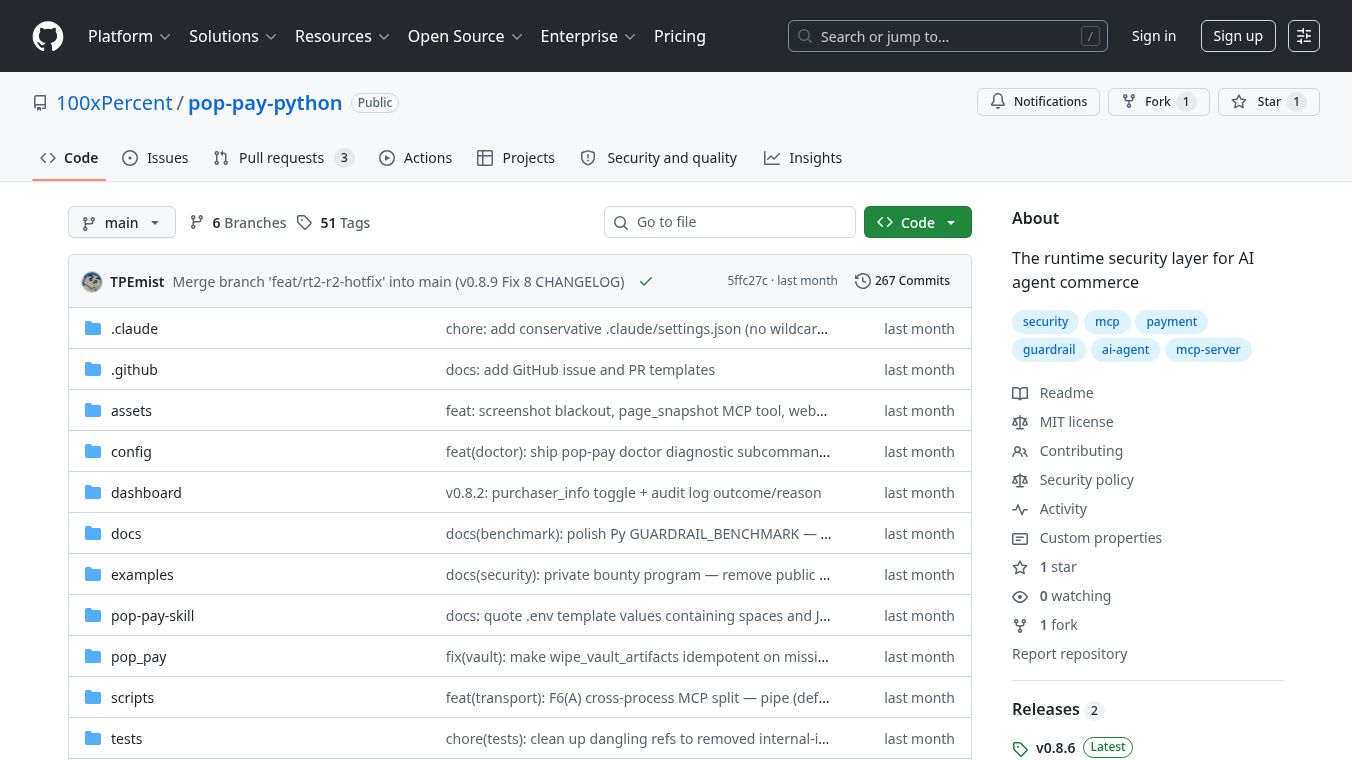





Point One Percent is a security tool designed to protect money spent by artificial intelligence agents. The project is known as pop-pay and it stops AI from accidentally spending too much money due to mistakes or lies. The main idea is that even a small amount of error from an AI can drain a large budget. This tool ensures that card details never reach the AI's memory or conversation history. Instead, the payment information is sent directly to the browser where the purchase happens. This separation keeps the money safe from the AI's potential errors.
Benefits
Point One Percent offers several key advantages for developers and businesses using AI agents. First, it prevents financial hallucinations where an AI might invent a price or spend money it should not. The tool uses a secure vault to store card credentials. These credentials are encrypted using strong AES-256-GCM encryption. The data is never shared with the AI system. Second, it provides real-time monitoring. Users can see how much money the agent has spent and check for any suspicious activity. Third, it supports flexible integration. It works with various programming languages and frameworks like Python and LangChain. Finally, it offers different security modes. Users can choose between simple keyword checks or advanced AI-based analysis depending on their needs.
Use Cases
This tool is useful for anyone building AI agents that handle payments. It is ideal for developers who want to test their AI systems without risking real money. Businesses can use it to set strict spending limits for their automated customer service bots. For example, a bot might only be allowed to spend up to one hundred dollars per transaction. It is also great for developers who want to test different payment providers like Stripe or Lithic. The tool can be used with popular AI coding assistants through a special server connection. It works well in environments where security is a top priority. Developers can run it locally on their computers or deploy it using Docker containers.
Pricing
The project is open source and released under the MIT license. This means it is free to use for both personal and commercial projects. There are no hidden fees or subscription costs mentioned in the documentation. Users can install it using standard package managers like pip or npm. The cost is limited only to the time spent setting up the environment and configuring the security rules.
Vibes
The community around this project focuses on safety and control. The slogan highlights the risk of AI spending all money due to small errors. Users appreciate the clear separation between the AI and the payment data. The tool is seen as a necessary layer of defense for modern AI commerce. Developers who use it feel more confident that their agents will not accidentally drain their wallets. The open-source nature allows the community to review the code and trust the security measures.
Additional Information
The project is built primarily in Python with some performance-critical parts written in Cython. It relies on the Chrome DevTools Protocol to inject payment data directly into the browser. The core engine and server are written in Python while the vault operations use Cython for speed. The system uses a local database to track transactions and maintain state. The team has created various extras for different features like Stripe integration or LangChain support. The project is maintained by a group of developers who are focused on runtime security for AI applications. The code is available on GitHub for anyone to inspect or contribute to.
This content is either user submitted or generated using AI technology (including, but not limited to, Google Gemini API, Llama, Grok, and Mistral), based on automated research and analysis of public data sources from search engines like DuckDuckGo, Google Search, and SearXNG, and directly from the tool's own website and with minimal to no human editing/review. THEJO AI is not affiliated with or endorsed by the AI tools or services mentioned. This is provided for informational and reference purposes only, is not an endorsement or official advice, and may contain inaccuracies or biases. Please verify details with original sources.


Comments
Please log in to post a comment.