OneMux





OneMux: A Unified, Cost-Effective Solution for Multi-Model AI Access
Overview
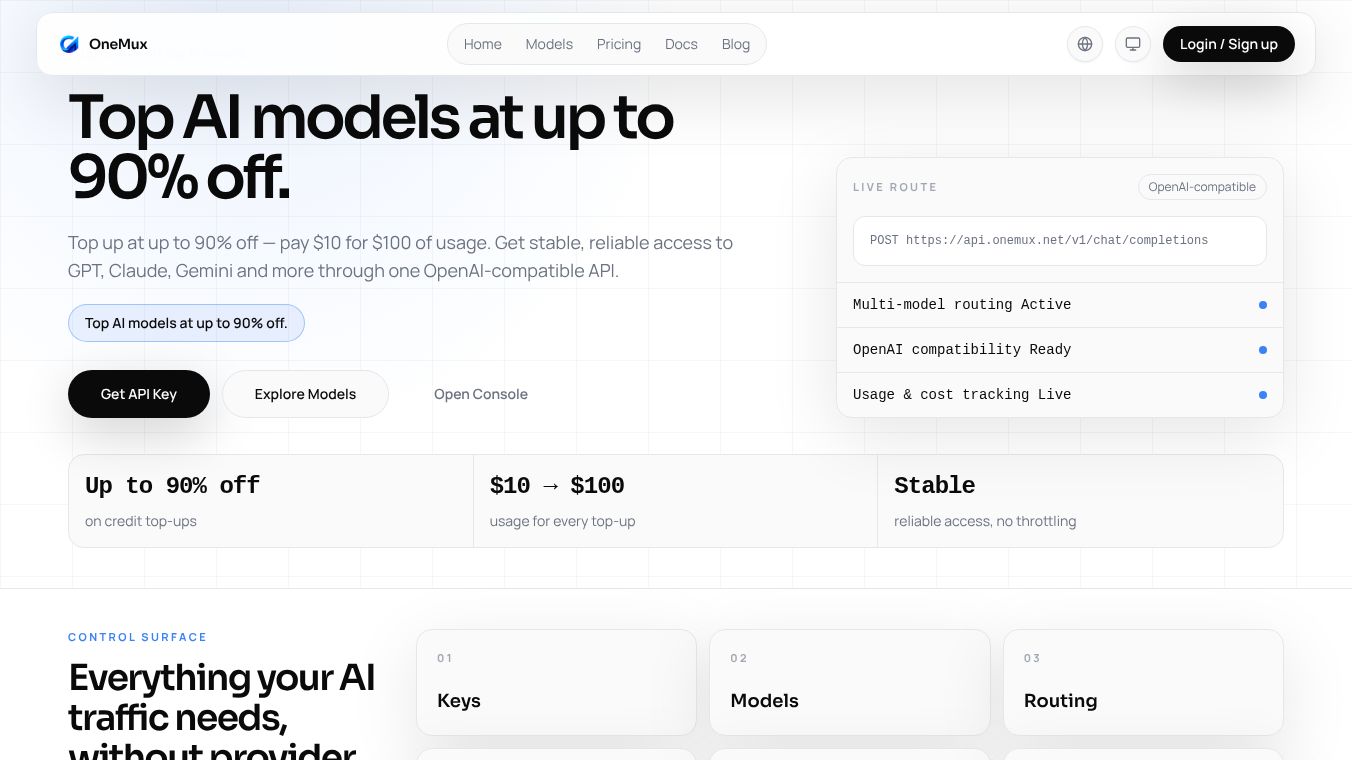
OneMux serves as a stable, reliable layer between your product and multiple AI providers, eliminating the complexity of managing separate accounts for different services. It offers a single, OpenAI-compatible API that provides access to top-tier models including GPT, Claude, Gemini, and DeepSeek. By consolidating these resources, OneMux allows developers to maintain one API surface while leveraging the best models for specific tasks such as coding, reasoning, vision, and high-volume production traffic.
Benefits
One of the primary benefits of using OneMux is the substantial reduction in costs associated with AI model usage. The platform offers discounts of up to 90% on credit top-ups. Users can pay $10 to receive $100 worth of usage credits. Furthermore, the savings scale with usage; the more credits you top up, the greater the discount you receive. This pay-as-you-go model ensures that users only pay for what they actually use, with tracking available per key.
OneMux guarantees stable and reliable access to AI models without throttling. This ensures consistent performance for applications relying on these models, making it suitable for both development and production environments. The platform acts as a robust intermediary, handling the routing and management of traffic so that developers do not need to worry about provider-specific limitations or outages.
For ease of integration, OneMux provides a drop-in OpenAI-compatible API. This means that existing applications can be adapted to use OneMux with minimal changes. The API endpoint for chat completions is available at POST https://api.onemux.net/v1/chat/completions, allowing for seamless multi-model routing.
OneMux offers a full suite of tools to manage AI traffic effectively. Users can manage access keys for different applications or users. They can also curate practical model routes tailored for specific use cases like coding, reasoning, and vision. The platform allows for automatic or manual routing of requests to the most appropriate model. Users can monitor usage and costs in real-time, tracked per key. Billing processes are simplified without the need for separate provider accounts. Detailed logs are available for auditing and debugging purposes.
Use Cases
OneMux is designed for developers who want to build applications using various AI models without the hassle of managing multiple accounts. It is ideal for scenarios requiring different types of AI capabilities. For example, a developer might use one model for coding tasks and another for reasoning tasks. The platform is also suitable for handling high-volume production traffic where stability is crucial.
By using OneMux, teams can avoid provider sprawl. They do not need to manage multiple provider accounts. Instead, they can consolidate access to top models through a single interface. This flexibility allows users to choose the right model for the job, whether it is for coding, reasoning, vision, or high-volume traffic, all through one unified API.
Pricing
OneMux offers a cost-effective pricing model with significant discounts. Users can pay $10 to receive $100 worth of usage credits. The discounts scale with usage, meaning the more credits you top up, the greater the discount you receive. This pay-as-you-go model ensures that users only pay for what they actually use. Tracking is available per key to help manage costs effectively.
Vibes
The article highlights that OneMux is designed to be user-friendly, allowing developers to focus on developing their application while OneMux handles the complexities of multi-model management and cost optimization. By leveraging OneMux, developers can achieve stable, reliable, and cost-effective access to the leading AI models in the market, streamlining their workflow and reducing operational overhead.
Additional Information
The article does not provide specific details about funding, partnerships, or notable achievements beyond the product's features and benefits.
This content is either user submitted or generated using AI technology (including, but not limited to, Google Gemini API, Llama, Grok, and Mistral), based on automated research and analysis of public data sources from search engines like DuckDuckGo, Google Search, and SearXNG, and directly from the tool's own website and with minimal to no human editing/review. THEJO AI is not affiliated with or endorsed by the AI tools or services mentioned. This is provided for informational and reference purposes only, is not an endorsement or official advice, and may contain inaccuracies or biases. Please verify details with original sources.


Comments
Please log in to post a comment.