




OMEM: The Best Open-Source AI Agent Memory for Developers in 2026
Overview
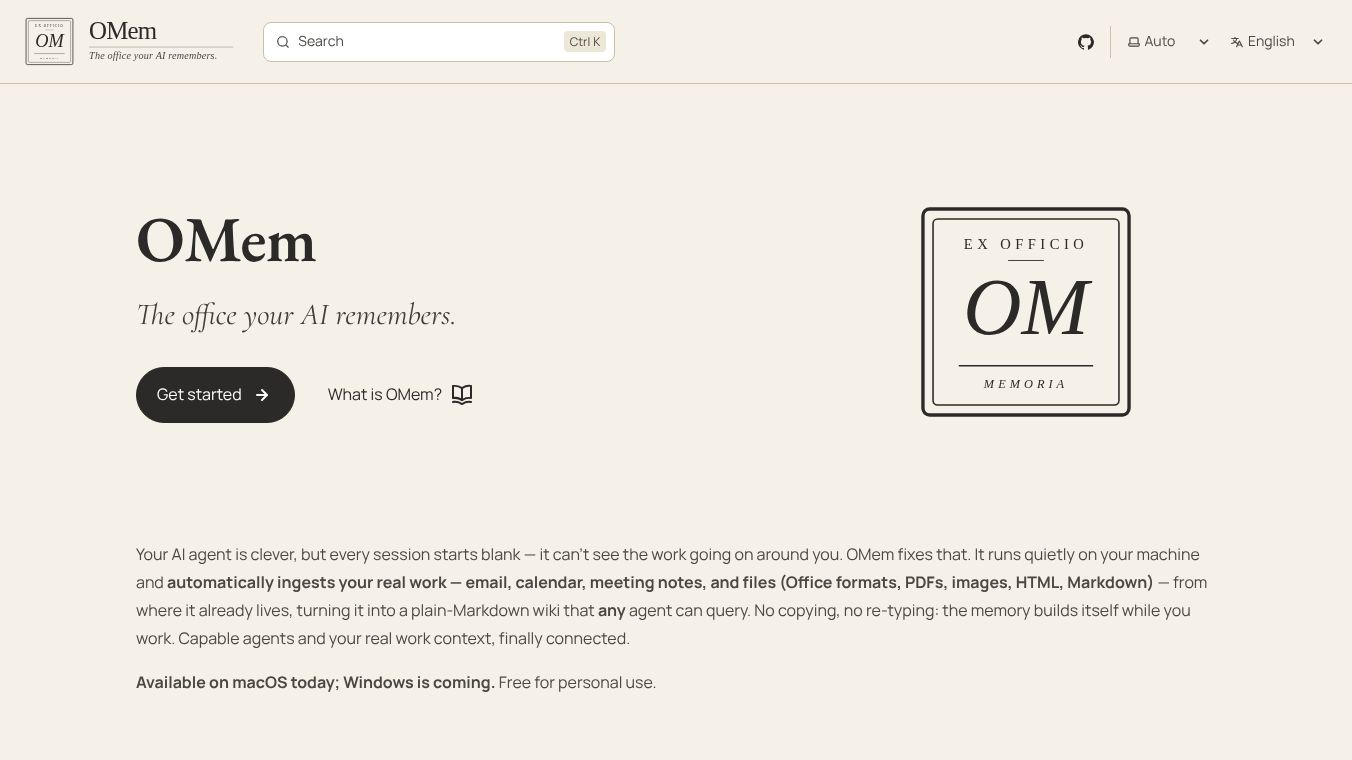
OMEM is an open-source tool built by ourmem to help AI agents remember things across different sessions. It acts as a shared storage system that solves common problems like agents forgetting past conversations or being stuck on one specific device. Built with a strong Rust-based server and Docker support, OMEM uses a three-level system for organizing data into personal, team, and organization spaces. It also tracks where every piece of information comes from. As of February 2026, the project has gained 124 stars on GitHub, and version 0.3.1 was released early in 2026. This update added features to remove duplicate memories and improve how data structures change over time.
Benefits
OMEM offers several powerful advantages for developers and teams. It supports three levels of organization, allowing individuals to share knowledge with their teams or entire organizations while keeping full track of the source. The tool uses a unique 11-stage search process that combines different methods to find the most relevant information in under 200 milliseconds. Tests show this method is 25 percent more accurate than simple search tools. It also uses a special decay model that automatically removes old, less important memories while keeping key facts safe. This prevents the storage from growing too large without needing manual cleanup. The system handles updates efficiently, reducing storage needs by 40 percent during repeated sessions. It is also very portable because it can run on many different Linux systems without extra dependencies, making it perfect for small devices like a Raspberry Pi. Finally, it works with the Claude plugin to automatically save and recall session data for coding tasks.
Use Cases
OMEM is designed for specific groups of users who need advanced memory capabilities. AI coding tool users can rely on it to remember past sessions without having to copy and paste old context manually. Teams building complex systems with multiple AI agents can use the REST API to share knowledge between different agents. Indie hackers and self-hosting enthusiasts can run the memory layer on their own servers using Docker to keep full control over their data. Solo builders working on prototypes can test persistent AI memory in their projects without getting locked into a specific vendor. However, it may not be the best fit for large enterprises that need strict security compliance or for simple chatbots that do not require remembering past conversations.
Pricing
OMEM is completely free to use because it is open-source software. Users can host it on their own servers using Docker, which eliminates any subscription fees or vendor costs. The tool is designed to be self-hosted, giving users full ownership of their data without paying for cloud services.
Vibes
The community reception for OMEM has been positive among developers who need robust memory solutions. With 124 GitHub stars, it has attracted attention as a strong open-source alternative to paid services. Users appreciate its high precision and efficient storage capabilities. The project is still in an early stage, which means the API might change before version 1.0 is released. Some users note that it lacks built-in advanced authentication beyond simple API keys and requires extra setup for OAuth. There is also no native client for JavaScript or TypeScript, so developers may need to use custom wrappers. Despite these limitations, many see it as the best choice for persistent agents when self-hosting is preferred.
Additional Information
OMEM is built using Rust and relies on Docker for deployment. It can be set up in about 60 seconds using Docker Compose. The project requires Docker version 20 or higher and git to get started. The server can handle over 1,000 requests per second on modest hardware. It uses a hybrid index that combines vector databases and full-text search to manage data. The core system includes spaces for isolation, memories stored as JSON, and retrievers for processing data. Schema evolution allows the system to update data structures without downtime. The project is maintained by ourmem and is available on GitHub at ourmem/omem.
This content is either user submitted or generated using AI technology (including, but not limited to, Google Gemini API, Llama, Grok, and Mistral), based on automated research and analysis of public data sources from search engines like DuckDuckGo, Google Search, and SearXNG, and directly from the tool's own website and with minimal to no human editing/review. THEJO AI is not affiliated with or endorsed by the AI tools or services mentioned. This is provided for informational and reference purposes only, is not an endorsement or official advice, and may contain inaccuracies or biases. Please verify details with original sources.




Comments
Please log in to post a comment.