Ollagraph





Ollagraph: A Unified Platform for Web Scraping, Crawling, and AI Agent Intelligence
Research Context and Background
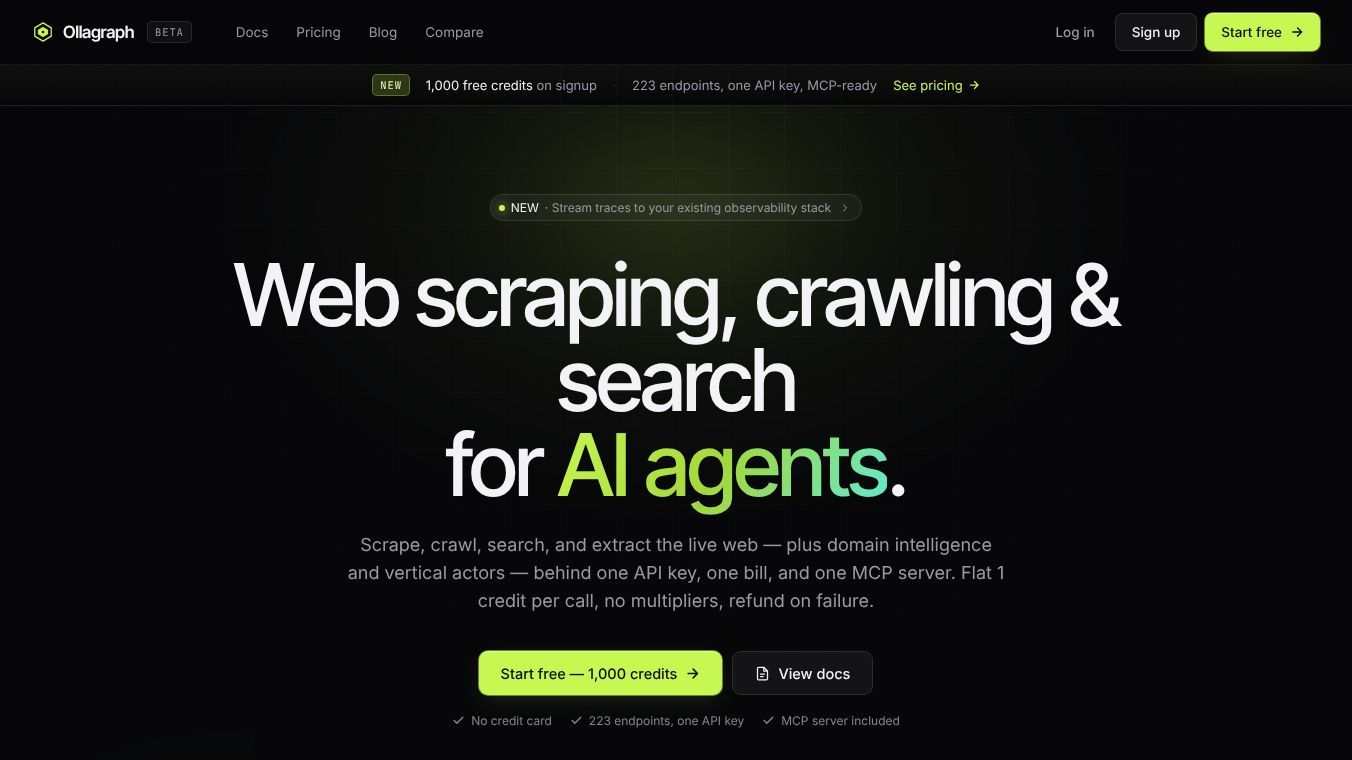
Ollagraph is a comprehensive platform designed to simplify how AI agents extract data from the web. It brings together core web-data tasks like scraping, crawling, searching, and extracting into one single system. Instead of connecting multiple different tools together, users can access everything through one API key and billing system. The platform also includes a Model Context Protocol server that allows AI tools like Claude Desktop and Cursor to use its features instantly. This unified approach helps teams handle tasks ranging from building knowledge bases to monitoring prices and enriching customer leads.
Benefits
Ollagraph offers several key advantages for developers and businesses. First, it provides access to 223 different endpoints with just one API key, which simplifies setup and management. The platform is built specifically for AI agents, making it easy to integrate with popular tools. It handles complex web pages well by using stealth technology to bypass security walls and automatically retrying requests for pages that use JavaScript. This means users do not pay extra for rendering complex sites. The system also provides clear visibility into every action taken by an AI agent, allowing teams to trace steps and fix issues quickly. Additionally, the platform supports automated background jobs that can run large tasks without constant supervision.
Use Cases
Ollagraph is designed for a variety of real-world applications. It is ideal for teams building RAG systems that need to ingest information from the live web. Businesses can use it to enrich customer leads with fresh data or to monitor competitor prices over time. It is also useful for conducting audits of AI search results to ensure accuracy. Any project that requires structured data in JSON format can benefit from its extraction tools. The platform supports standard web protocols and offers code libraries for JavaScript, Python, and TypeScript, making it accessible for developers working in different environments.
Pricing
Ollagraph uses a flat pricing model to keep costs predictable. Most features cost one credit per call, while orchestrator features cost three credits. There are no extra charges for using advanced features like rendering or extraction. Users can start paying as little as five dollars without needing a monthly subscription. If a request fails due to an error on the web side, the credit is refunded automatically, so users only pay for successful calls. New accounts receive 1,000 free credits when they sign up, and no credit card is required to start using the service.
Vibes
While specific customer testimonials are not available in the provided information, the platform has received positive attention for its approach to pricing and features. It is often compared favorably to other tools in the market for offering a broader suite of capabilities under one key. The generous free tier and the lack of hidden multipliers for rendering have been noted as significant advantages for teams testing the platform or managing large-scale workloads. The focus on data privacy, where scraped content is not stored, also resonates well with organizations concerned about compliance and security.
Additional Information
Ollagraph is positioned as a strong alternative for teams that need more than just basic markdown extraction. It distinguishes itself by offering web search, domain intelligence, and industry-specific data access all in one place. The platform includes enterprise features such as custom pricing for high-volume users, security protocols like SAML and SCIM, and audit logs that integrate with security systems. It explicitly guarantees that it does not keep copies of scraped page content, retaining only usage metadata for billing and monitoring purposes. This commitment to privacy ensures compliance for sensitive agent workloads.
This content is either user submitted or generated using AI technology (including, but not limited to, Google Gemini API, Llama, Grok, and Mistral), based on automated research and analysis of public data sources from search engines like DuckDuckGo, Google Search, and SearXNG, and directly from the tool's own website and with minimal to no human editing/review. THEJO AI is not affiliated with or endorsed by the AI tools or services mentioned. This is provided for informational and reference purposes only, is not an endorsement or official advice, and may contain inaccuracies or biases. Please verify details with original sources.
Comments
Please log in to post a comment.