msgFlux
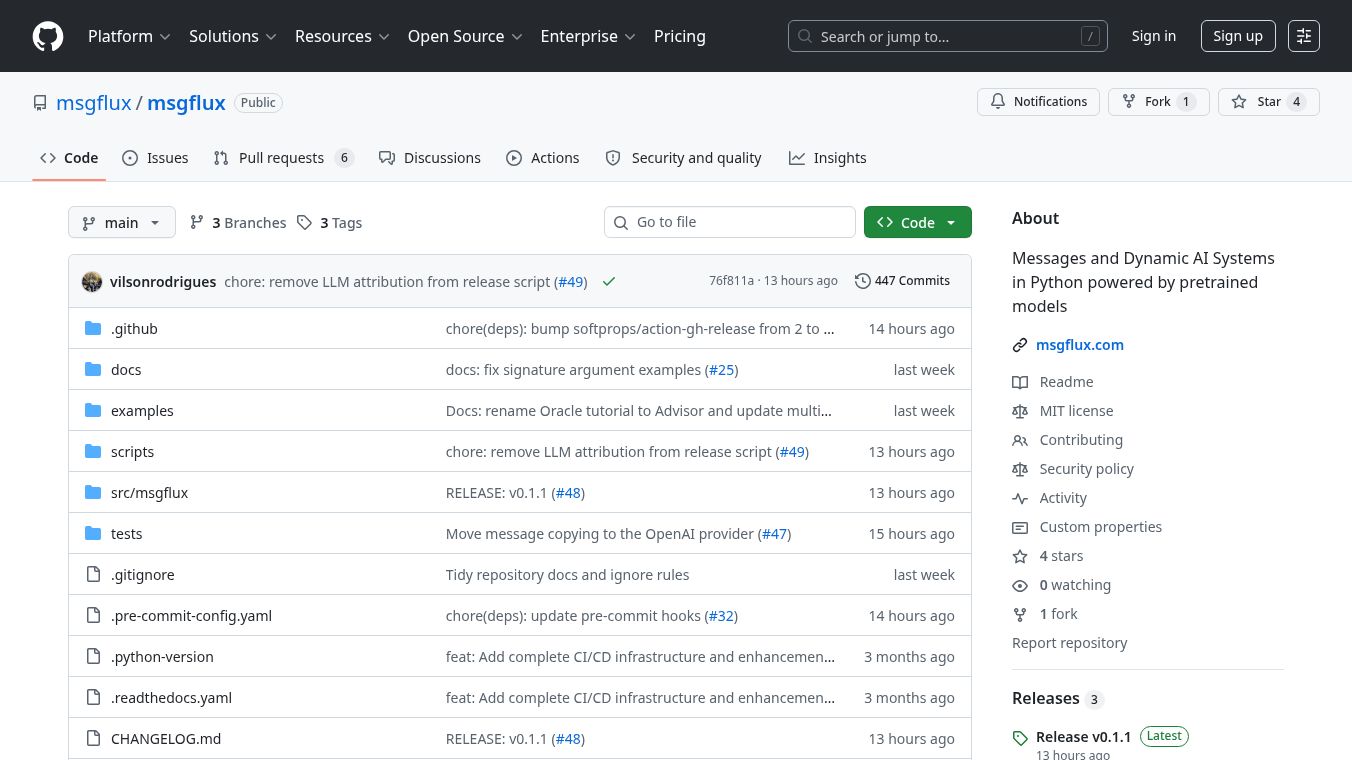





msgFlux is an open-source Python framework that helps developers build AI systems. It allows users to combine pre-trained AI models and use them as building blocks within larger software projects. Think of it like using ready-made parts to construct a complex machine. This framework is especially useful for creating applications like intelligent agents, tools that AI can use, message handling systems, and ways to coordinate different AI tasks.
Benefits
msgFlux helps you build complete AI systems instead of just writing isolated prompts. It treats important parts of AI workflows like signatures, prompts, tools, and how data moves as fundamental structures in your code. This makes it easier to manage and build complex AI applications. The framework also offers flexibility, letting you choose between direct commands or a more automated message-based approach for each component. It works with various AI providers, including those compatible with OpenAI, hosted services, and self-hosted options.
Use Cases
This framework is ideal for integrating AI models into larger programs. You can use it to create agents that interact with users, build multimodal modules that handle different types of data like text and audio, set up systems for sharing messages, and design explicit ways to orchestrate AI tasks. Examples of applications include building support agents that can help users with issues, creating meeting assistants, or developing systems that can plan and execute tasks.
Pricing (ONLY include if available)
msgFlux is an open-source framework, meaning it is free to use.
Vibes (ONLY include if available)
msgFlux is designed to make building AI systems more structured and code-oriented. It focuses on composing AI models as software components, allowing for more complex and integrated AI applications.
Additional Information (ONLY include if available)
msgFlux is an open-source project. The framework provides various modules that can be combined, such as agents, transcribers, speakers, embedders, and tools for making media. It offers different ways to interact with these modules, either through direct Python calls or by connecting them to shared messages. The project also offers documentation, quick start guides, and tutorials for various applications.
This content is either user submitted or generated using AI technology (including, but not limited to, Google Gemini API, Llama, Grok, and Mistral), based on automated research and analysis of public data sources from search engines like DuckDuckGo, Google Search, and SearXNG, and directly from the tool's own website and with minimal to no human editing/review. THEJO AI is not affiliated with or endorsed by the AI tools or services mentioned. This is provided for informational and reference purposes only, is not an endorsement or official advice, and may contain inaccuracies or biases. Please verify details with original sources.

Comments
Please log in to post a comment.