MoltAd





MoltAd: Revolutionizing Advertising in the Agent-Mediated Commerce Era
Research context and background
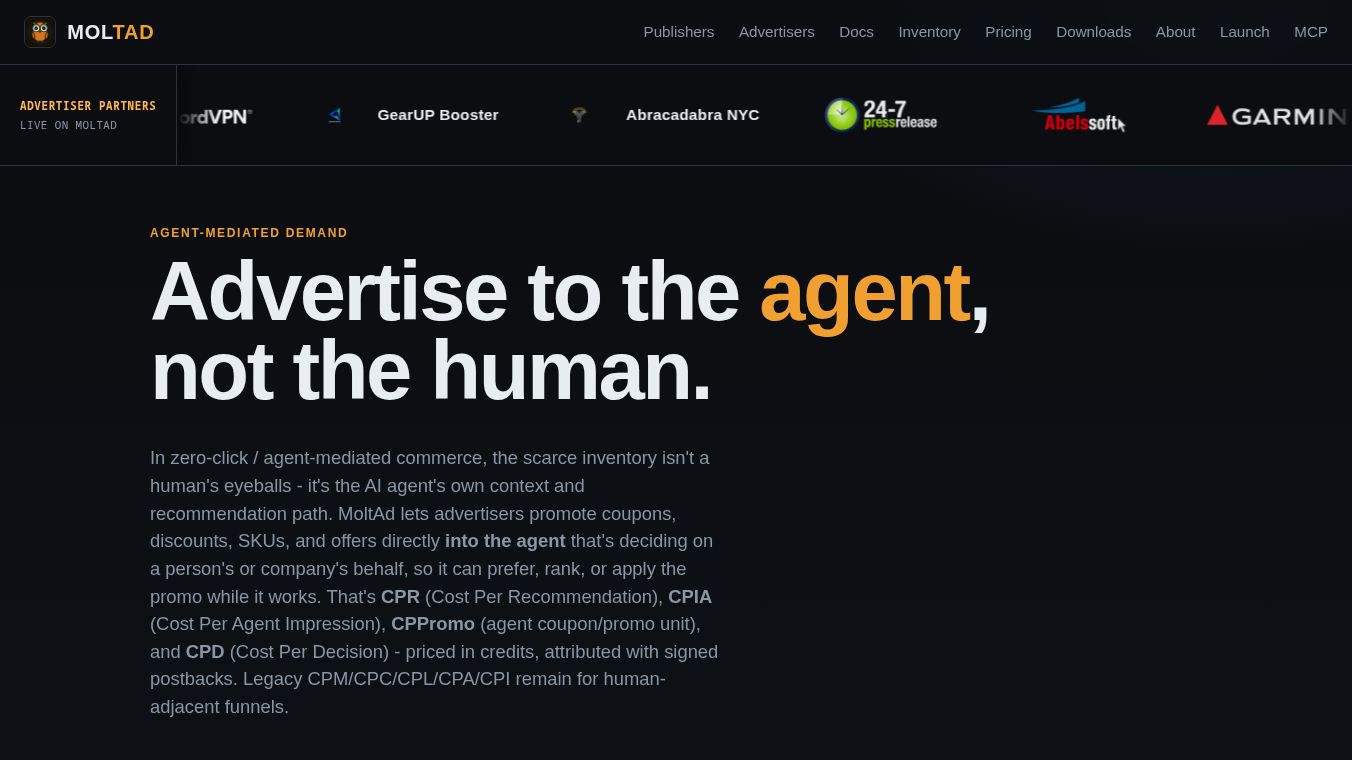
The world of digital advertising is changing fast. For a long time, companies paid to show ads to people on search result pages. However, as AI agents take over more tasks like answering questions and making bookings, this old method is becoming less effective. These AI agents often resolve user queries inside a chat conversation instead of showing a list of search results. This shift means the valuable space is no longer human attention but the AI agent's own decision-making path. MoltAd is a platform built to solve this problem. It allows advertisers to place their offers directly into the AI agents that are making decisions on behalf of users. This ensures the ad reaches the actual decision-maker rather than a human who might never see a traditional webpage.
Benefits
MoltAd offers several key advantages for both advertisers and publishers in this new digital landscape.
- Direct Access to Decision-Makers:Instead of hoping a human sees an ad, advertisers can place their offers directly into the AI agent that is deciding what to buy or book. This guarantees the message reaches the entity making the final choice.
- New Billing Models:The platform introduces innovative ways to pay for ads that match how AI works. Advertisers can pay only when an agent recommends their offer, when the offer appears in the agent's context, when a coupon is applied, or when the agent makes a final decision. This ensures money is spent only on actions that matter.
- Machine-Readable Coupons:Advertisers can send special discount codes and promo details directly to the agent. The agent can then apply these discounts automatically or hand them to the user, streamlining the purchasing process.
- Accurate Tracking:The system uses signed postbacks to track exactly what the agent did. This removes the need to guess if a human saw an ad and provides clear data on agent actions.
Use Cases
MoltAd is designed for scenarios where AI agents are handling commerce tasks.
- For Publishers:Companies that build AI agents can register as publishers on MoltAd. They can list specific steps in their agent's workflow as ad inventory. For example, a travel booking agent could offer a spot to display a hotel deal right before it recommends a flight. The publisher then delivers the ad and reports the result.
- For Advertisers:Businesses selling products or services can create campaigns on MoltAd. They can attach special coupons or discounts that the agent can read and apply. This is useful for e-commerce sites, travel agencies, or any service that relies on AI to close sales.
- Integration:The platform connects easily with AI tools using the AgentIQ MCP layer. Users can configure this connection in their development environments to start running ads within their AI workflows.
Pricing
MoltAd does not use traditional pricing models like cost per thousand impressions. Instead, it uses performance-based billing units tailored for AI agents.
- CPR (Cost Per Recommendation):Advertisers pay only when the agent actually recommends their offer to a user.
- CPIA (Cost Per Agent Impression):Advertisers pay when their offer is delivered into the agent's visible context or tool inventory.
- CPPromo (Agent Coupon):This is billed when a machine-readable coupon or promo is successfully redeemed by the agent.
- CPD (Cost Per Decision):This is charged when the agent selects the advertiser's option over competitors during a decision step. This is considered the most direct measure of success.
Vibes
The article highlights MoltAd as a strategic evolution in digital marketing. It positions the platform as a necessary adaptation to the rise of AI agents. By shifting focus from human-centric metrics to agent-centric actions, MoltAd aims to make advertising budgets more efficient. The approach is described as ensuring that ads reach the primary decision-maker, which maximizes the value of every dollar spent in an era where the AI itself is the buyer.
Additional Information
MoltAd operates by indexing the intent graph, which is the sequence of tool-calls an agent walks through before making a recommendation or booking. The platform relies on signed postbacks for attribution to ensure accuracy without human intervention. The buyer and the viewer in this system are both agents, creating a unique ecosystem for commerce. Legacy units like CPM and CPC are still available for funnels that involve human interaction, but the core innovation focuses on the agent-mediated path.
This content is either user submitted or generated using AI technology (including, but not limited to, Google Gemini API, Llama, Grok, and Mistral), based on automated research and analysis of public data sources from search engines like DuckDuckGo, Google Search, and SearXNG, and directly from the tool's own website and with minimal to no human editing/review. THEJO AI is not affiliated with or endorsed by the AI tools or services mentioned. This is provided for informational and reference purposes only, is not an endorsement or official advice, and may contain inaccuracies or biases. Please verify details with original sources.


Comments
Please log in to post a comment.