LiminalML





LiminalML: A Six-Stage Mastery Framework for Machine Learning and Software Engineering
Overview
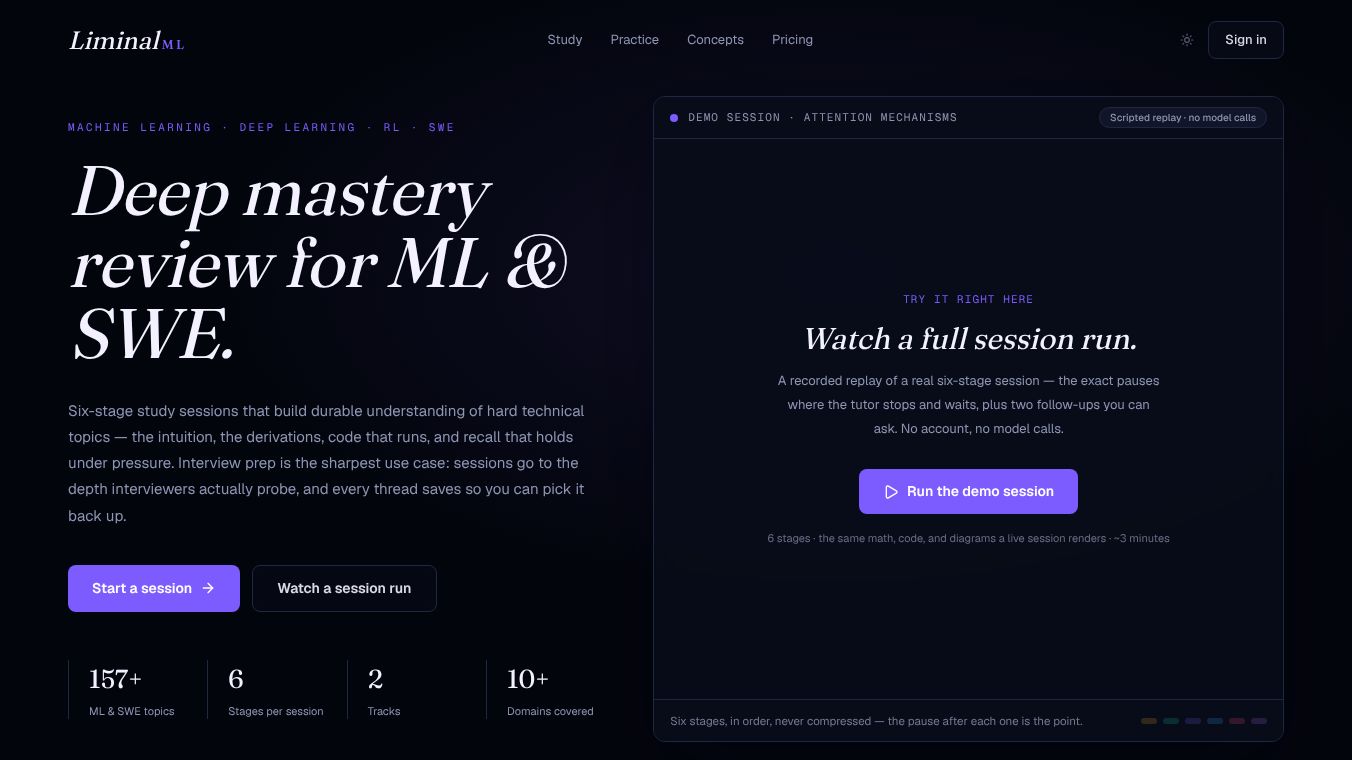
LiminalML is a specialized platform designed for deep mastery review of Machine Learning and Software Engineering topics. It addresses the challenge of retaining complex technical concepts by utilizing a structured six-stage study session format. The platform aims to build durable understanding through intuition, mathematical derivations, runnable code, and active recall, making it particularly effective for interview preparation, research refreshers, and systems reviews.
Benefits
LiminalML offers several key advantages for learners who want to move beyond surface-level knowledge. The platform uses a consistent six-stage session format that ensures comprehensive coverage of any topic. This process starts with the big picture to set the mental frame, followed by an intuitive explanation with visual diagrams. It then dives into the math with step-by-step derivations to show why each term matters. Next, it provides production-quality PyTorch code with clear comments and tests. The session includes five calibrated interview questions to test conceptual and practical understanding. Finally, a retrieval check asks the user to reproduce the concept from memory to ensure the information sticks.
The platform also supports active learning by pausing after each stage. This allows users to ask clarifying questions or request revision cards instead of passively reading a wall of text. Every session is saved so users can reload full threads later or continue from where they stopped. Users can upload their resume to ground sessions in their actual work history, generating STAR stories for interview prep. The platform also visualizes how topics connect across the landscape using knowledge graphs to help users understand the broader ecosystem.
Use Cases
LiminalML is designed for a wide range of professionals in the tech industry. It serves research engineers, machine learning engineers, research scientists, and applied scientists who need to stay current with complex algorithms. The platform covers 157+ topics across domains like classical machine learning, deep learning, reinforcement learning, and training engineering.
For software engineers, the platform covers frontend, backend, system design, and CS fundamentals. It helps users understand rendering models, distributed systems, and production deployment strategies. The tool is ideal for people preparing for high-stakes technical interviews who need to demonstrate deep knowledge of both theory and implementation. It is also useful for researchers needing a refresher on specific architectures or for engineers looking to review systems and MLOps practices like model serving and experiment tracking.
Pricing
LiminalML offers a tiered pricing model to support different levels of study needs.
The Free Tier costs $0 per month. It includes 20 sessions per month and access to all 157+ ML and SWE topics. Users get the full six-stage review format and sessions that adapt to their background. Session history, reload capabilities, and revision cards are all included. No credit card is required to start.
The Pro Tier costs $9 per month. It provides unlimited review sessions and includes all features from the Free tier. Pro users also get early access to new topics which ship to them first. A 7-day free trial is available for new users. The subscription can be cancelled anytime.
Vibes
While specific user testimonials are not detailed in the available information, the platform is designed with a rigorous and structured approach to learning. The focus on active recall, mathematical depth, and practical implementation suggests a serious tool for those aiming to deepen their technical understanding. The inclusion of features like resume injection and knowledge graphs indicates a user experience that is both personalized and comprehensive.
Additional Information
LiminalML covers two primary tracks with extensive topic lists. The ML and Research track includes 16 classical ML topics, 26 deep learning topics, 14 reinforcement learning topics, 8 training engineering topics, and 7 systems and MLOps topics. The Software Engineering track covers domains like frontend, backend, system design, and CS fundamentals with specific topics on rendering models and distributed systems. The platform aims to serve as a powerful tool for developers and researchers aiming to master complex technical subjects through a flexible and context-aware interface.
This content is either user submitted or generated using AI technology (including, but not limited to, Google Gemini API, Llama, Grok, and Mistral), based on automated research and analysis of public data sources from search engines like DuckDuckGo, Google Search, and SearXNG, and directly from the tool's own website and with minimal to no human editing/review. THEJO AI is not affiliated with or endorsed by the AI tools or services mentioned. This is provided for informational and reference purposes only, is not an endorsement or official advice, and may contain inaccuracies or biases. Please verify details with original sources.


Comments
Please log in to post a comment.