Laguna by Poolside





What is Laguna by Poolside
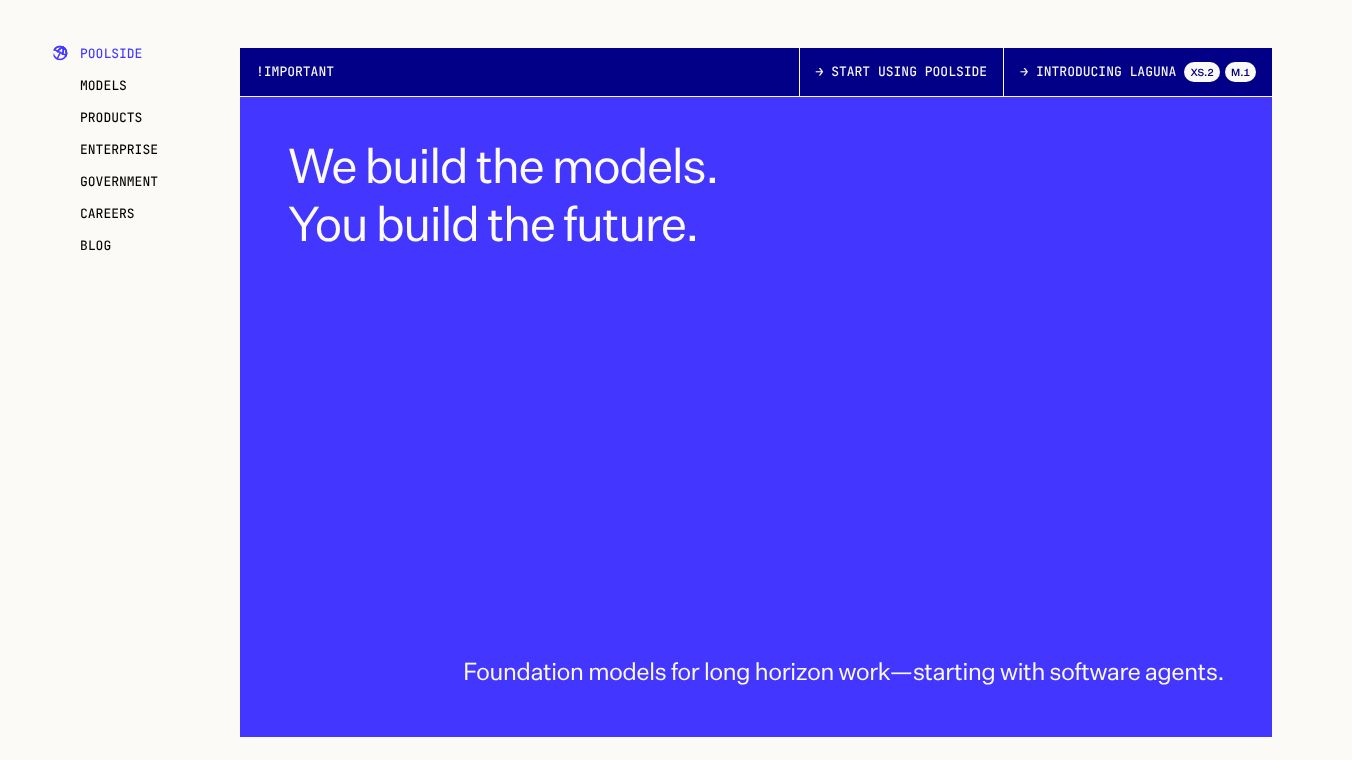
Laguna by Poolside is a new family of artificial intelligence models built specifically for agentic coding. Agentic coding means the AI can plan, execute, and complete complex software tasks on its own without constant human guidance. Poolside, a foundation model lab, recently released two versions of this technology: Laguna M.1 and Laguna XS.2. These tools are designed to help developers write code, fix bugs, and build applications more efficiently. The company is also launching new products like Pool and Shimmer to make these models easier to use in real-world projects.
Benefits
The main advantage of Laguna M.1 is its raw power. With 225 billion parameters, it is currently the most capable model Poolside has created. It excels at long-horizon work, which means it can handle projects that require many steps and deep thinking. It has shown strong results on industry benchmarks for solving real software issues in multiple languages.
Laguna XS.2 offers a different kind of benefit by focusing on efficiency. It is an open-weight model, meaning its code is available for anyone to study and use under an Apache 2.0 license. Despite being smaller than M.1, it performs very well on coding tasks. Its biggest strength is that it can run on a single graphics card. This allows developers to use the model locally on their own computers without needing expensive cloud servers. This setup also ensures that code remains private and secure.
Both models are designed to work with new tools that provide a smooth user experience. The Pool tool acts as a terminal-based agent, letting users interact with the AI directly in their command line. Shimmer provides a cloud environment where users can instantly start a virtual machine to build web apps and APIs. These features reduce the friction of setting up complex development environments.
Use Cases
Developers can use Laguna M.1 for large-scale software projects that require significant planning and execution. It is ideal for teams working on complex systems where the AI needs to understand the entire codebase and make independent decisions to fix issues or add features. Its ability to handle multilingual tasks makes it useful for global teams working in different programming languages.
Laguna XS.2 is perfect for individual developers or small teams who want to run AI tools on their own hardware. Since it runs locally, it is great for companies that are worried about data privacy. Users can install it using Ollama and start coding immediately. It is also suitable for students and researchers who want to experiment with advanced AI models without paying for cloud computing costs.
The new products expand the use cases further. Pool is useful for anyone who prefers a command-line interface and wants a powerful agent to handle their daily coding tasks. Shimmer is designed for building and testing web applications, APIs, and command-line tools. It allows users to iterate quickly on their ideas by providing an instant-on sandbox environment where the AI agent is already ready to work.
Pricing
Poolside has made Laguna M.1 available for free for a limited time through its own platform and OpenRouter. This allows users to test the model's capabilities without an upfront cost. For those who need more power, small teams, startups, universities, or institutions can contact Poolside directly to request rate limit increases or access to the weights of Laguna M.1.
Laguna XS.2 is available as open weights under an Apache 2.0 license. This means there is no direct cost to download or use the model. Users can run it locally on their own machines using free tools like Ollama. The Shimmer cloud development experience is currently in preview, and specific pricing details for that service are not yet public. However, the local deployment option ensures that the core technology remains accessible and cost-effective for most users.
Vibes
The release of Laguna M.1 and XS.2 has generated excitement in the developer community. By making Laguna XS.2 an open-weight model, Poolside aims to foster collaboration and accelerate progress in the field of agentic coding. The decision to share the weights allows the global community to build upon the technology and provide rapid feedback. This approach aligns with the belief that open ecosystems drive innovation faster than closed ones.
Early benchmarks show that both models perform well on challenging tasks. They have demonstrated the ability to resolve complex software issues and handle terminal-based operations effectively. The community response suggests that the shift toward public model distribution is a positive step. Developers appreciate the opportunity to run powerful models locally, which addresses concerns about data privacy and reduces reliance on expensive cloud services.
The introduction of new products like Pool and Shimmer adds to the positive reception. These tools are designed to maximize the utility of the models, making them easier for non-experts to use. The instant-on virtual machine sandbox in Shimmer, for example, removes the usual setup time associated with cloud development. This focus on user experience is likely to attract a wide range of users from hobbyists to enterprise teams.
Additional Information
Poolside describes itself as a foundation model lab focused entirely on agentic models. They handle every stage of the process, from pre-training to agent reinforcement learning, within their internal Model Factory. This release marks the first time Poolside is shipping models to the public, signaling a major shift in their strategy. They are moving from a private research phase to a public distribution model to accelerate development.
The company is also emphasizing the importance of an open-weight ecosystem in the West. By providing the weights and an Apache 2.0 license for Laguna XS.2, they hope to encourage others to build tools and applications on top of their work. This collaborative approach is intended to push the boundaries of what AI can do in software development. The models were benchmarked using the Laude Institute's Harbor Framework, ensuring that their performance claims are based on rigorous testing standards.
This content is either user submitted or generated using AI technology (including, but not limited to, Google Gemini API, Llama, Grok, and Mistral), based on automated research and analysis of public data sources from search engines like DuckDuckGo, Google Search, and SearXNG, and directly from the tool's own website and with minimal to no human editing/review. THEJO AI is not affiliated with or endorsed by the AI tools or services mentioned. This is provided for informational and reference purposes only, is not an endorsement or official advice, and may contain inaccuracies or biases. Please verify details with original sources.


Comments
Please log in to post a comment.