Hidream O1 Image
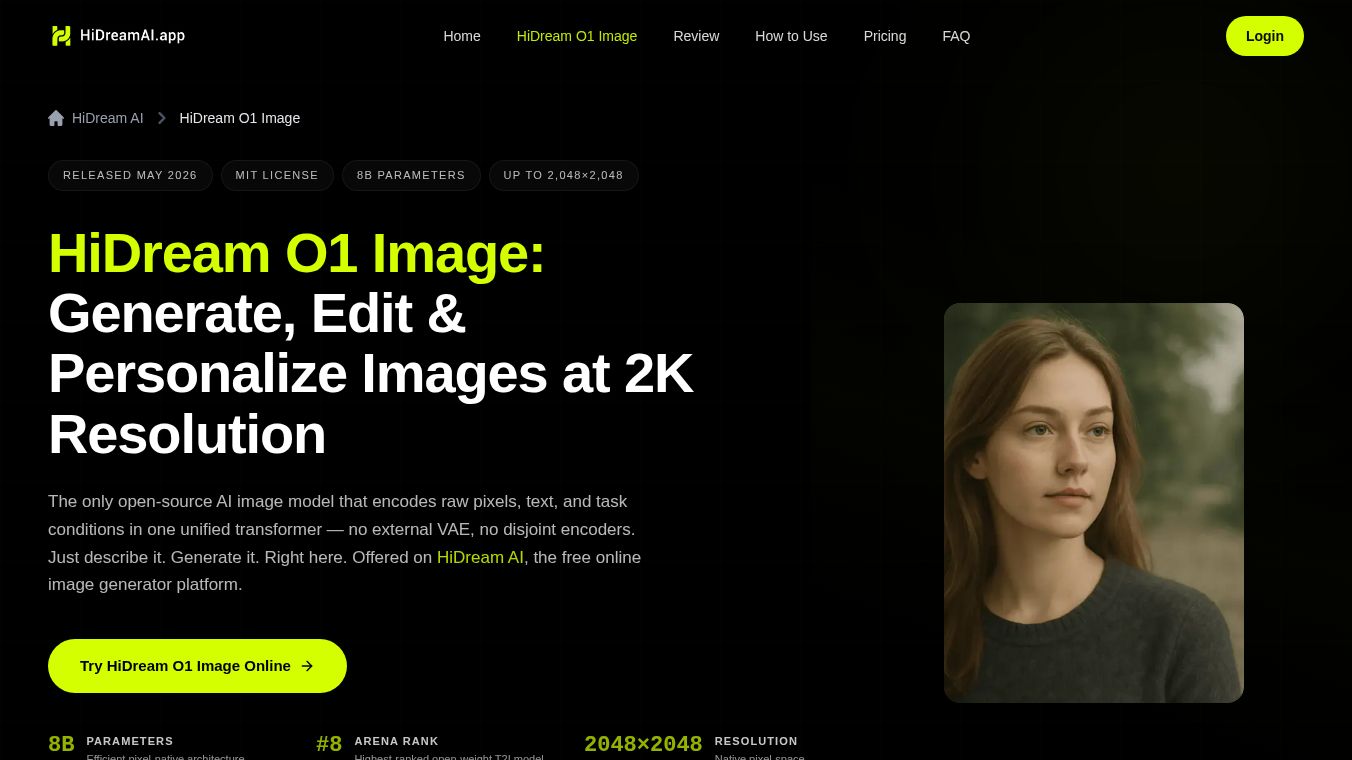





HiDream O1 Image: The Open-Source Revolution in AI Image Generation
Released in May 2026 under the MIT License, HiDream O1 Image is an 8-billion-parameter, pixel-native unified image generative model developed by HiDream-ai. It represents a significant shift in AI architecture by collapsing the traditional stack of text encoders, diffusion models, and external VAEs into a single shared token space. This unified approach allows the model to encode raw pixels, text prompts, and task-specific conditions simultaneously, enabling text-to-image generation, instruction-based editing, and subject-driven personalization at a native resolution of 2,048x2,048.
Benefits
HiDream O1 Image offers several key advantages over larger and more complex models. It is currently ranked #8 in the Artificial Analysis Text-to-Image Arena, outperforming industry giants like DALL-E 3, GPT Image 2, and FLUX.2 Dev. Despite having only 8 billion parameters, it delivers higher quality and better prompt alignment than models up to 7 times larger, offering superior quality-per-dollar for production teams.
The model features pixel-native generation, which operates directly on raw RGB pixel patches. This ensures that every detail in the 2K output is generated natively, resulting in sharper text rendering, tighter edge definition, and more faithful color reproduction. It is ideal for commercial graphics, poster work, and product photography.
Another major benefit is the integrated reasoning agent. Standard models often struggle with complex spatial logic or multi-object scenes. HiDream O1 Image includes a built-in Reasoning-Driven Prompt Agent that analyzes the raw prompt, understands implied spatial relationships and object attributes, and rewrites it into a precision-engineered directive before generation begins. This significantly reduces the need for manual prompt engineering and improves first-attempt success rates.
The model also excels at rendering text within images, achieving a score of 0.979 on LongText-Bench for English and 0.978 for Chinese. It can handle up to 5 distinct text regions within a single composition, making it suitable for creating bilingual ad banners, product labels, and localized marketing graphics without post-production retouching.
Use Cases
HiDream O1 Image is designed to handle visual workloads that previously required full production teams. It is perfect for product photography, where users can generate clean, high-resolution product shots for e-commerce listings without physical studios.
Businesses can use it for on-brand ad creatives to rapidly produce marketing assets that match specific color palettes and messaging. Creative teams can also use it for character-consistent storyboards by maintaining character consistency across story panels using multi-reference personalization.
The model supports natural language photo editing, allowing users to apply edits via simple text instructions rather than manual masking tools. For example, a user can upload a source image and provide a natural language instruction to remove an object or change a color while preserving the original composition.
Pricing
Credits power text-to-image generation and editing. Commercial usage is included in all plans.
- Starter ($9.99):400 credits ($0.025/credit). Ideal for testing and personal projects. Includes text-to-image, editing, 2K resolution, and commercial rights.
- Pro ($29.99):1,250 credits ($0.024/credit). Offers better per-credit value, priority processing, and full 2K resolution.
- Scale ($49.99):2,100 credits ($0.024/credit). Best value for teams and power users, featuring the lowest per-credit cost and faster processing.
Vibes
Users appreciate the model's efficiency and quality. It is noted for beating DALL-E 3 and GPT Image 2 on human preference scores while using significantly fewer parameters. The ability to generate legible, correctly positioned text in English and Chinese natively within the image is a major highlight for designers and marketers. The built-in reasoning agent is praised for reducing the complexity of prompt engineering, making it easier for non-experts to achieve professional results.
Additional Information
HiDream O1 Image is available for immediate use via a web interface that requires no installation or GPU setup. Free generations are watermark-free for testing, though commercial usage rights require a credit pack.
For local deployment, the model requires a CUDA-capable GPU. The FP8-quantized variant runs efficiently on GPUs with approximately 10GB of VRAM, making it accessible outside of data-center environments.
The model weights and code are released under the MIT License, which permits personal, research, and commercial use. HiDream O1 Image consolidates six major capabilities into a single model, replacing the need for stitching multiple tools together. It supports ComfyUI node integration, local LoRA loading, and OpenAI-compatible API calls for seamless workflow integration.
Both the Full Model and the Dev Variant share the same 8B parameter count and MIT license. The Full model uses 50 sampling steps for the highest photographic detail and realism, while the Dev variant uses a distilled 28-step schedule for faster convergence and rapid iteration.
This content is either user submitted or generated using AI technology (including, but not limited to, Google Gemini API, Llama, Grok, and Mistral), based on automated research and analysis of public data sources from search engines like DuckDuckGo, Google Search, and SearXNG, and directly from the tool's own website and with minimal to no human editing/review. THEJO AI is not affiliated with or endorsed by the AI tools or services mentioned. This is provided for informational and reference purposes only, is not an endorsement or official advice, and may contain inaccuracies or biases. Please verify details with original sources.

Comments
Please log in to post a comment.