HAR
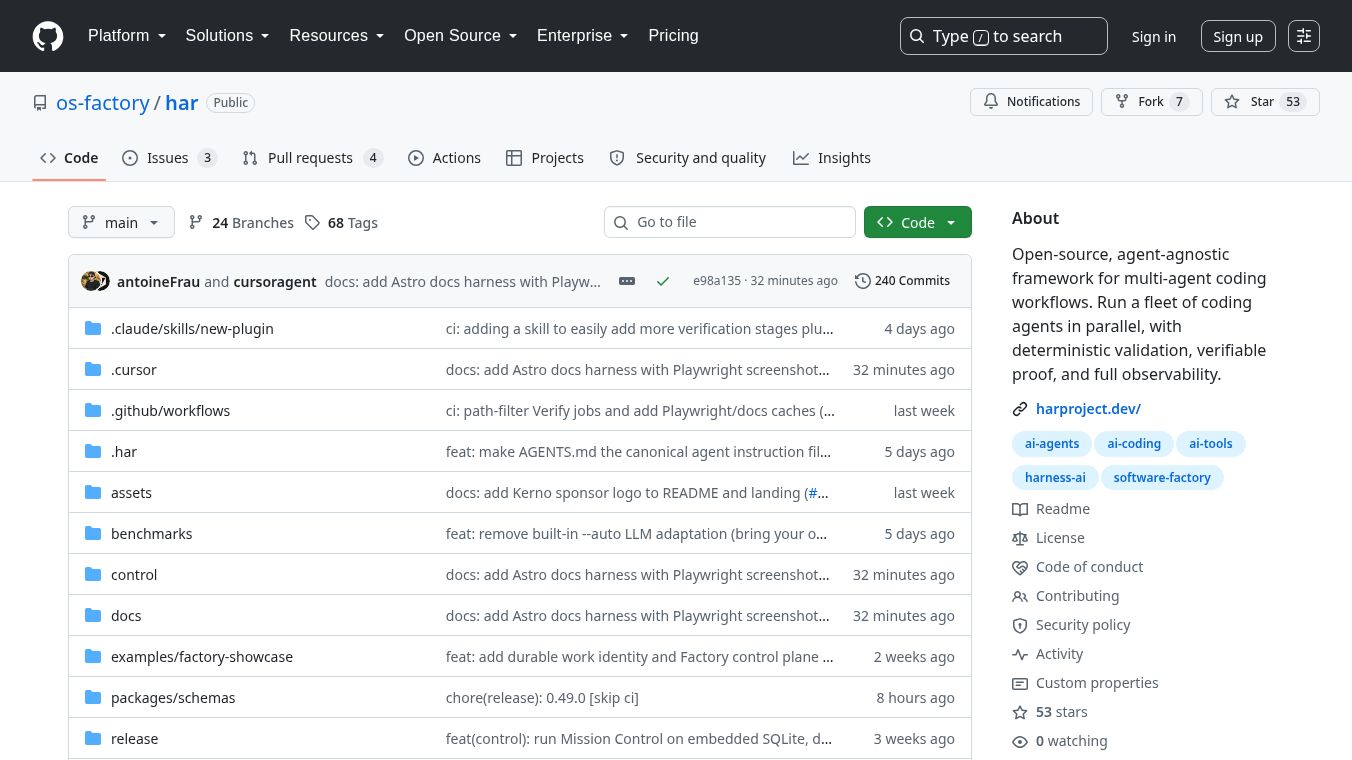





HAR: The Open Harness for Multi-Agent Coding Workflows
Research context and background
HAR is an open-source tool designed to help developers manage complex coding tasks using multiple AI agents at the same time. It acts as a central framework that allows different coding assistants to work together on a single project without causing conflicts. The tool is built to be flexible and can work with various AI coding platforms like Claude Code, Cursor, and Codex. It provides a structured way to run, check, and verify code changes made by these agents.
Benefits
HAR solves several common problems that arise when using multiple AI coding assistants. First, it prevents resource collisions. When multiple agents try to work on the same code, they often fight over shared servers, databases, or ports. HAR gives each agent its own isolated workspace, so they can work in parallel without stepping on each other’s toes. Second, it ensures trust and verification. Instead of blindly accepting code changes, HAR runs a strict check every time an agent finishes a task. This creates a clear record of what was done and whether it passed all tests. Third, it removes vendor lock-in. Because HAR uses an open standard, developers can switch between different AI coding tools without rebuilding their entire setup. Finally, it keeps scripts up to date. The tool automatically checks if verification rules have drifted from the original templates, preventing silent failures in the future.
Use Cases
HAR is ideal for teams that want to scale their use of AI coding assistants beyond a single user. It is perfect for situations where multiple agents need to work on different parts of a large codebase simultaneously. For example, a development team could use HAR to run one agent to fix bugs while another agent writes new features, all within the same project. It is also useful for environments where trust is critical. Since HAR provides a full audit trail of every action taken by an agent, it is great for projects that require strict quality control or compliance. Developers can use the included dashboard to track the progress of all agents and see the results of their verification checks in one place. The tool is also helpful for maintaining complex projects where verification scripts often become outdated. HAR’s maintenance features help keep these scripts aligned with the current technology stack.
Pricing
HAR is an open-source project, which means it is free to use. Developers can download and install it without any cost. The installation process is simple and can be done using standard command-line tools. Users can also access a growing ecosystem of free plugins to extend the tool’s functionality.
Vibes
As an open-source project, HAR is still in its early stages of adoption. There are no widespread public reviews or testimonials available yet because the tool is relatively new. However, the project has gained attention in the developer community for addressing a critical gap in multi-agent workflows. The open-source nature of the project suggests a strong commitment to community-driven development and transparency. Early feedback from developers indicates that the concept of isolated worktrees and deterministic validation is highly promising for scaling AI-assisted coding.
Additional Information
HAR is developed by the OS Factory team and is available on GitHub. The project is fully extensible, meaning developers can create their own plugins to add new features or integrate with specific tools. The framework includes a local dashboard called Mission Control, which provides a centralized view of all agent activities. This dashboard helps teams monitor runs, validations, and artifacts across multiple projects. The project emphasizes that its contract is an open standard living within the repository itself, ensuring long-term portability and compatibility across different agents and tools.
This content is either user submitted or generated using AI technology (including, but not limited to, Google Gemini API, Llama, Grok, and Mistral), based on automated research and analysis of public data sources from search engines like DuckDuckGo, Google Search, and SearXNG, and directly from the tool's own website and with minimal to no human editing/review. THEJO AI is not affiliated with or endorsed by the AI tools or services mentioned. This is provided for informational and reference purposes only, is not an endorsement or official advice, and may contain inaccuracies or biases. Please verify details with original sources.
Comments
Please log in to post a comment.