Handover
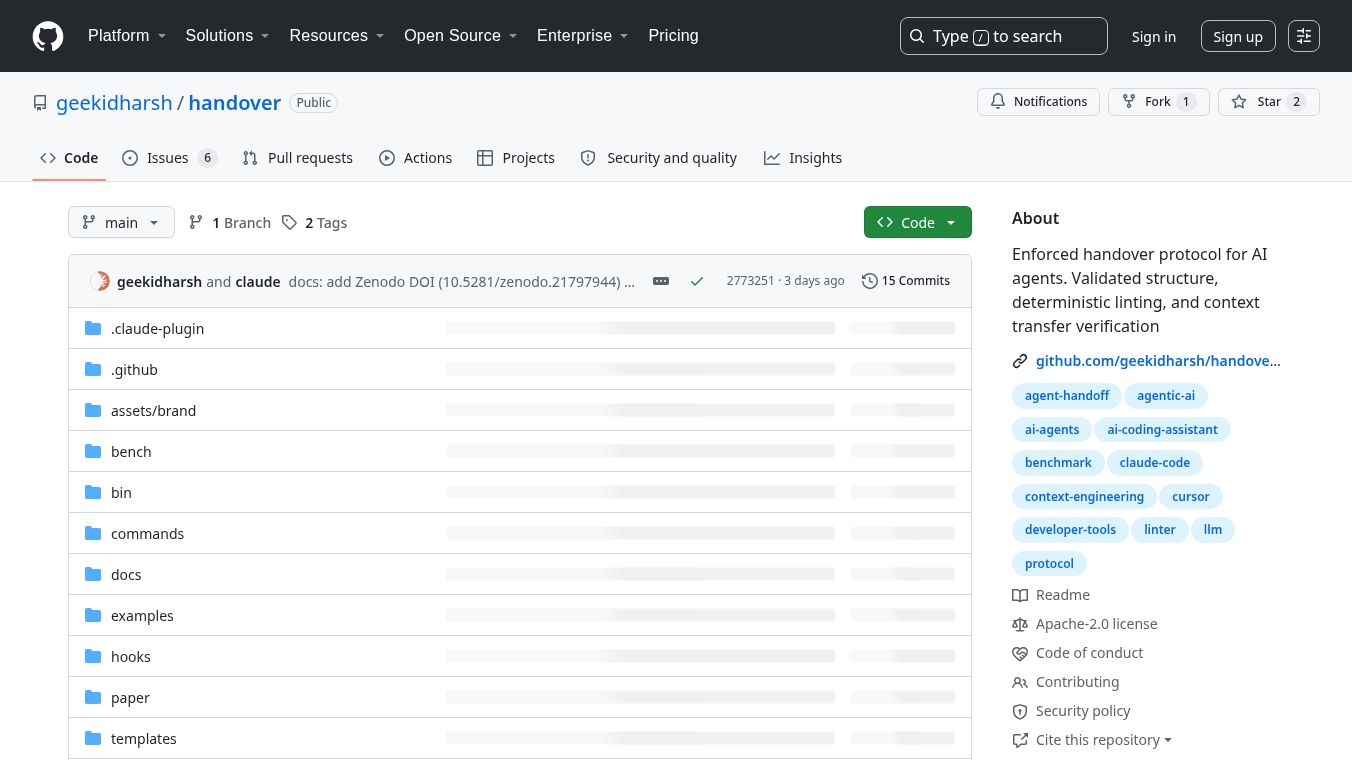





Handover: An Enforced Agent-to-Agent Handover Protocol
Introduction
Handover is a specialized tool designed to solve a critical problem in the world of artificial intelligence agents. When one AI agent finishes a task and another takes over, they often lose the context of previous work. Handover acts as a transfer document that ensures the next agent inherits a complete and verifiable state of the project. It prevents agents from forgetting past sessions or wasting time rebuilding work that was already discarded.
Benefits
Handover offers several key advantages for teams using AI agents to build software.
- Prevents Context Loss:It stops new agents from re-deriving information or rebuilding features that were intentionally cut. This saves time and reduces errors.
- Enforces Verification:The tool operates on the principle of verify, do not trust. Every claim made in the document must come with a command to verify its truth. This ensures the information is accurate before the next agent acts on it.
- Captures Negative Knowledge:Unlike standard documentation, Handover focuses on what was tried and failed. It records abandoned approaches and reverted changes so future agents do not repeat the same mistakes.
- Machine-Verified Structure:The document has a strict header that must be valid. If the header is malformed, the system blocks the entry. This ensures the document is always checkable and consistent.
- No External Dependencies:The tool runs locally using plain Node.js. It does not require network access or external services, making it secure and reliable.
Use Cases
Handover is designed for teams that rely on AI agents to manage complex software development workflows.
- Agent Handoffs:It is used when one AI agent finishes a task and passes the project to another agent. The document ensures the new agent understands exactly where the work stands.
- Git Repositories:Handover works directly within any Git repository. It can be used as a plugin for tools like Claude Code or run directly via the command line.
- Code Quality Gates:Teams can install pre-commit hooks to validate Handover documents before any code is committed. This ensures that every change includes a valid handover record.
- Audit and Linting:Developers can use the tool to score the structure of their documents and verify claims against the actual codebase. This helps maintain high standards across the project.
Pricing
Handover is an open-source project available on GitHub. It is free to use for individuals and teams. There are no subscription fees or hidden costs associated with the tool.
Vibes
As an open-source tool, Handover has not yet received widespread public reviews or testimonials. However, the project has gained attention in developer communities for its innovative approach to solving the context loss problem in AI agent workflows. The creator, geekidharsh, has built it with a focus on determinism and security, which has resonated with developers who value transparency and control over their AI interactions.
Additional Information
Handover was created by a developer known as geekidharsh. The project is hosted on GitHub under the repository geekidharsh/handover. It is built using plain Node.js and does not rely on any large language models for its enforcement logic. The tool is designed to be deterministic, meaning it uses clear rules like regex and token counts to validate documents rather than relying on AI models to make decisions. The project is currently in an active development phase, with plans to extract the behavioral gate component into a dedicated agent clearance layer in the future.
This content is either user submitted or generated using AI technology (including, but not limited to, Google Gemini API, Llama, Grok, and Mistral), based on automated research and analysis of public data sources from search engines like DuckDuckGo, Google Search, and SearXNG, and directly from the tool's own website and with minimal to no human editing/review. THEJO AI is not affiliated with or endorsed by the AI tools or services mentioned. This is provided for informational and reference purposes only, is not an endorsement or official advice, and may contain inaccuracies or biases. Please verify details with original sources.


Comments
Please log in to post a comment.