good-microcopy
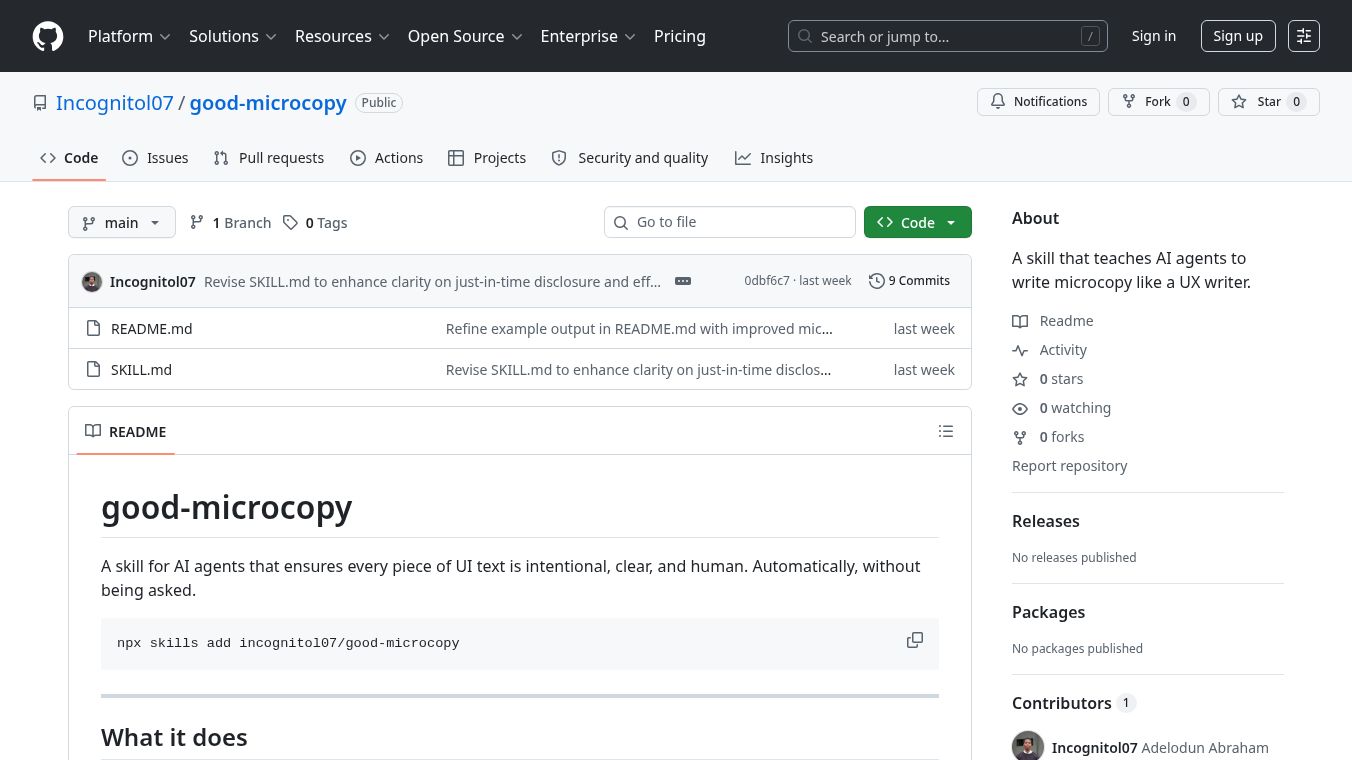





good-microcopy: A Skill for AI Agents to Write Human-Centric UI Text
Research Context and Background
The article describes good-microcopy as a specialized tool designed to help artificial intelligence agents create better user interface text. It is not a standalone software application but rather a skill that can be added to AI coding assistants. The goal of this tool is to ensure that every piece of text users see on a screen is clear, intentional, and feels like it was written by a human rather than a machine. Most AI-generated interfaces often produce text that is grammatically correct but lacks personality or helpfulness. This skill aims to fix that problem by applying ten specific principles of UX writing automatically whenever an agent builds a user-facing screen.
Benefits
The main advantage of using good-microcopy is that it transforms robotic, generic text into engaging and user-friendly content without requiring manual intervention. Instead of seeing boring labels like "Submit" or vague error messages like "Something went wrong," the tool generates specific and helpful alternatives. It sets clear expectations for users before they take an action. It provides context at the right moment so users understand what is happening. It speaks the user's language by avoiding technical jargon and using outcome-based choices. The tool also takes responsibility for errors instead of blaming the user. It reassures users during sensitive moments like payments or permission requests. It guides users toward the best path without controlling their choices. It treats empty screens as opportunities to invite action rather than dead ends. Finally, it recognizes that every small word a user reads counts as an important interaction.
Use Cases
This skill is useful for developers who use AI coding assistants to build applications. It works with popular tools like Claude Code, Cursor, Windsurf, and Cline. When a developer asks an AI to create a new feature or a user flow, the good-microcopy skill activates automatically. For example, if an AI is building a marketplace for students to sell clothes, the skill changes a simple "Submit" button to "List this item" or "Grab this fit." It improves error messages by explaining exactly what went wrong and offering a solution. It makes empty states inviting by suggesting what the user can do next. It adds personality to loading screens by describing what is happening, such as "Browsing pieces near you." This makes the entire user experience feel more polished and professional.
Pricing
Pricing information for this skill is not available in the provided article. It is distributed as an open-source skill within the skills format ecosystem.
Vibes
The public reception of this tool is positive based on the design principles it enforces. Users who rely on AI for coding often struggle with text that feels cold and impersonal. This skill addresses that pain point directly. The examples provided show a clear improvement in tone and clarity. By turning generic placeholders into specific instructions, the tool makes the software feel more responsive to human needs. The approach aligns with established best practices in user experience writing, which suggests that the output will be reliable and high-quality.
Additional Information
The principles used by good-microcopy are synthesized from established UX writing frameworks. It functions as a skill that teaches AI agents to write microcopy that is indistinguishable from that of a professional UX writer. The skill is compatible with any agent that supports the skills format. To install the skill, a user can run a specific command in their terminal using the npx package manager. The creator of the skill is Incognitol07, as indicated by the GitHub repository name.
This content is either user submitted or generated using AI technology (including, but not limited to, Google Gemini API, Llama, Grok, and Mistral), based on automated research and analysis of public data sources from search engines like DuckDuckGo, Google Search, and SearXNG, and directly from the tool's own website and with minimal to no human editing/review. THEJO AI is not affiliated with or endorsed by the AI tools or services mentioned. This is provided for informational and reference purposes only, is not an endorsement or official advice, and may contain inaccuracies or biases. Please verify details with original sources.
 No Info



Comments
Please log in to post a comment.