GLM 5
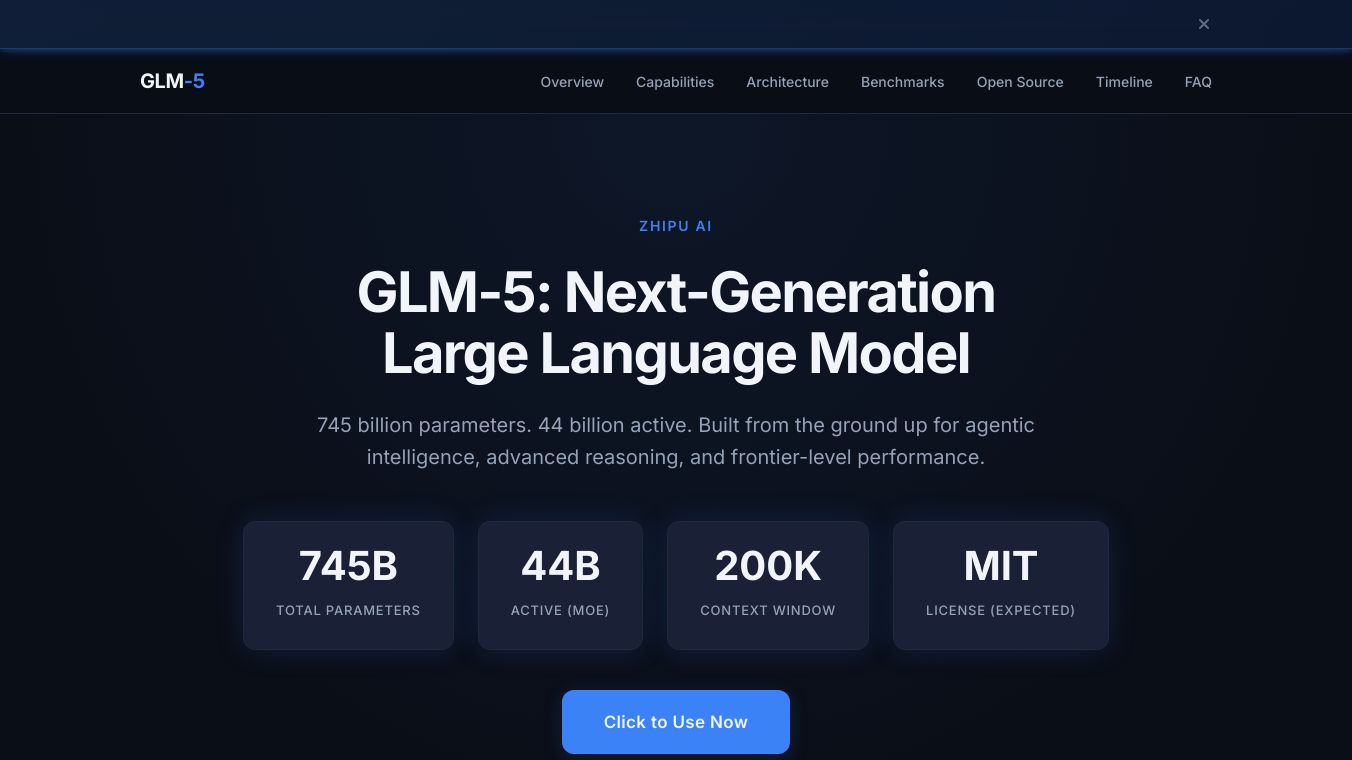





GLM-5 was trained using Huawei Ascend chips and the MindSpore software. This means it was developed without relying on hardware made in the United States. This achievement is important for China's goal of having its own AI technology and makes GLM-5 a strong competitor to other advanced AI models like GPT-5 from OpenAI and Claude from Anthropic.
Benefits
GLM-5 offers major improvements in several key areas:
- Creative Writing:It can create high-quality and varied creative content, including stories, technical guides, marketing materials, and academic writing.
- Coding:It significantly improves how well AI can write, fix, and understand code in different programming languages, acting as a helpful tool for developers.
- Advanced Reasoning:GLM-5 can perform complex, step-by-step logical thinking and solve difficult problems, which is useful for tasks like math proofs and scientific research.
- Agentic Intelligence:It has a built-in system that allows it to plan tasks, use other tools, browse the internet, and manage complex projects on its own with little help from people.
- Long-Context Processing:It can understand and work with very large amounts of information at once, such as long documents, research papers, large code projects, or video transcripts.
Use Cases
GLM-5 can be used for a wide range of tasks. Its creative writing abilities are useful for authors, marketers, and students. Developers can use its coding features to speed up their work. Researchers and scientists can benefit from its advanced reasoning capabilities for complex analysis. The agentic intelligence makes it suitable for automating workflows and managing projects. Its ability to process long texts means it can be used for summarizing lengthy reports, analyzing extensive research, or understanding complex codebases.
Pricing (ONLY include if available)
GLM-4.x API pricing is about $0.11 per million tokens, which is much cheaper than GPT-5. GLM-5 is expected to be similarly affordable or even more cost-effective.
Vibes (ONLY include if available)
GLM-5 is seen as a strong competitor to models like GPT-5 and Claude Opus, showing good performance in reasoning, coding, and agentic tasks. Its predecessor, GLM-4.7, is available on Hugging Face, and GLM-5 is expected to be released openly, similar to how LLaMA and Mistral models have impacted the market.
Additional Information (ONLY include if available)
GLM-5 became available through Z.ai's platform and the WaveSpeed API in mid-February 2026. An open version of the model is planned for release in the first quarter of 2026 under the MIT license, which allows for free commercial use and modification. Zhipu AI has also developed specialized versions like GLM-Image for creating images and GLM-4.6V/4.5V for advanced multimodal understanding. The model uses a Mixture of Experts (MoE) architecture with 256 experts, activating 8 per token, and uses DeepSeek's sparse attention mechanism to handle contexts up to 200K tokens.
This content is either user submitted or generated using AI technology (including, but not limited to, Google Gemini API, Llama, Grok, and Mistral), based on automated research and analysis of public data sources from search engines like DuckDuckGo, Google Search, and SearXNG, and directly from the tool's own website and with minimal to no human editing/review. THEJO AI is not affiliated with or endorsed by the AI tools or services mentioned. This is provided for informational and reference purposes only, is not an endorsement or official advice, and may contain inaccuracies or biases. Please verify details with original sources.




 No Info

Comments
Please log in to post a comment.