Flux 3






FLUX 3: Real-World Multimodal Flow Models for Visual Intelligence
FLUX 3 is a new type of artificial intelligence model that is currently available for early testing. It is designed to understand the world by combining different types of information like images, videos, and sound into one system. The creators believe that looking at just one type of data is not enough to fully understand reality. By learning from all these sources at the same time, FLUX 3 can build a stronger and more accurate picture of how things work. This makes it a powerful tool for visual intelligence that can work in both the physical world and digital environments.
Benefits
FLUX 3 offers several key advantages over other models currently on the market. Early tests show it is better at creating realistic videos that include natural sound. It is also very good at understanding human facial expressions and linking sounds to physical events like impacts or movements. The model supports many different languages, which makes it useful for a global audience. In comparisons with other leading tools, FLUX 3 won in a majority of cases. It was preferred over Runway Gen-4.5 in 77 percent of tests and over Luma Ray 3.2 in 93 percent of tests. It also outperformed other models like Grok Imagine Video and Kling v3 Pro in most comparisons. These results highlight its strength in creating high-quality content and understanding complex scenes.
Use Cases
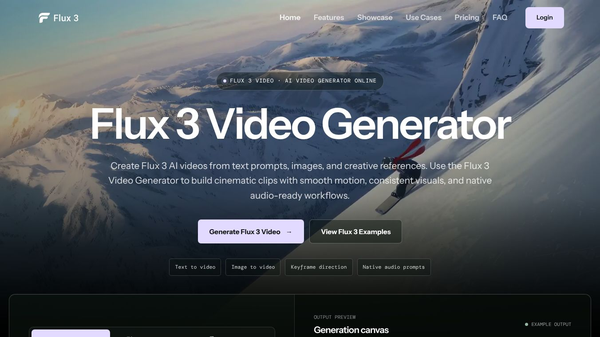
FLUX 3 can be used in many different ways depending on the needs of the user. For video creation, it can turn text descriptions into video clips or animate existing images. It can also transform old video clips to fit new scenes or extend short clips into longer stories. The model supports keyframe control, which allows users to define specific moments in a video for precise editing. It can also generate multilingual dialogue, making it useful for international projects.
For image work, FLUX 3 can create and edit photos in various styles and sizes. It is particularly good at rendering clear text in many languages, which is a common challenge for AI image generators. Beyond art and media, FLUX 3 is being used for robotics. Through a partnership with Mimic Robotics, the model helps robots learn how to move and manipulate objects. This is done by predicting actions based on visual data, which allows robots to perform tasks with limited training data. The model is also planned for future use in interactive editing, computer simulation, and broader physical AI applications.
Pricing
Pricing details for FLUX 3 are not publicly available at this time. The model is currently in an early access phase. Some features are available through APIs and private weight access for commercial partners, while others are open for research. Specific costs will likely be determined as the product moves from early access to a full release.
Vibes
Public reception for FLUX 3 has been very positive based on preliminary evaluations. The model has established itself as a new benchmark for multimodal flow models. Users and researchers are excited about its ability to unify perception, action, and language prediction in a single system. The early results suggest that FLUX 3 is a significant step forward in visual intelligence. While the team notes that results are still improving before the full release, the initial feedback indicates strong potential for both creative and industrial applications.
Additional Information
FLUX 3 is built on a unified architecture that trains on images, videos, and audio simultaneously. This approach allows the model to use mutual constraints, such as matching sound to impact or ensuring motion follows physical laws, to create a robust understanding of reality. The launch plan involves rolling out features over the coming weeks and months. This includes video and audio generation, action prediction for robotics, and image synthesis. The development team is already working on the next generation of models to expand capabilities into areas like simulation and computer use. A notable partnership exists with Mimic Robotics, which is using the model to develop specialized robot learning tools called FLUX-mimic.
This content is either user submitted or generated using AI technology (including, but not limited to, Google Gemini API, Llama, Grok, and Mistral), based on automated research and analysis of public data sources from search engines like DuckDuckGo, Google Search, and SearXNG, and directly from the tool's own website and with minimal to no human editing/review. THEJO AI is not affiliated with or endorsed by the AI tools or services mentioned. This is provided for informational and reference purposes only, is not an endorsement or official advice, and may contain inaccuracies or biases. Please verify details with original sources.


Comments
Please log in to post a comment.