Dograh
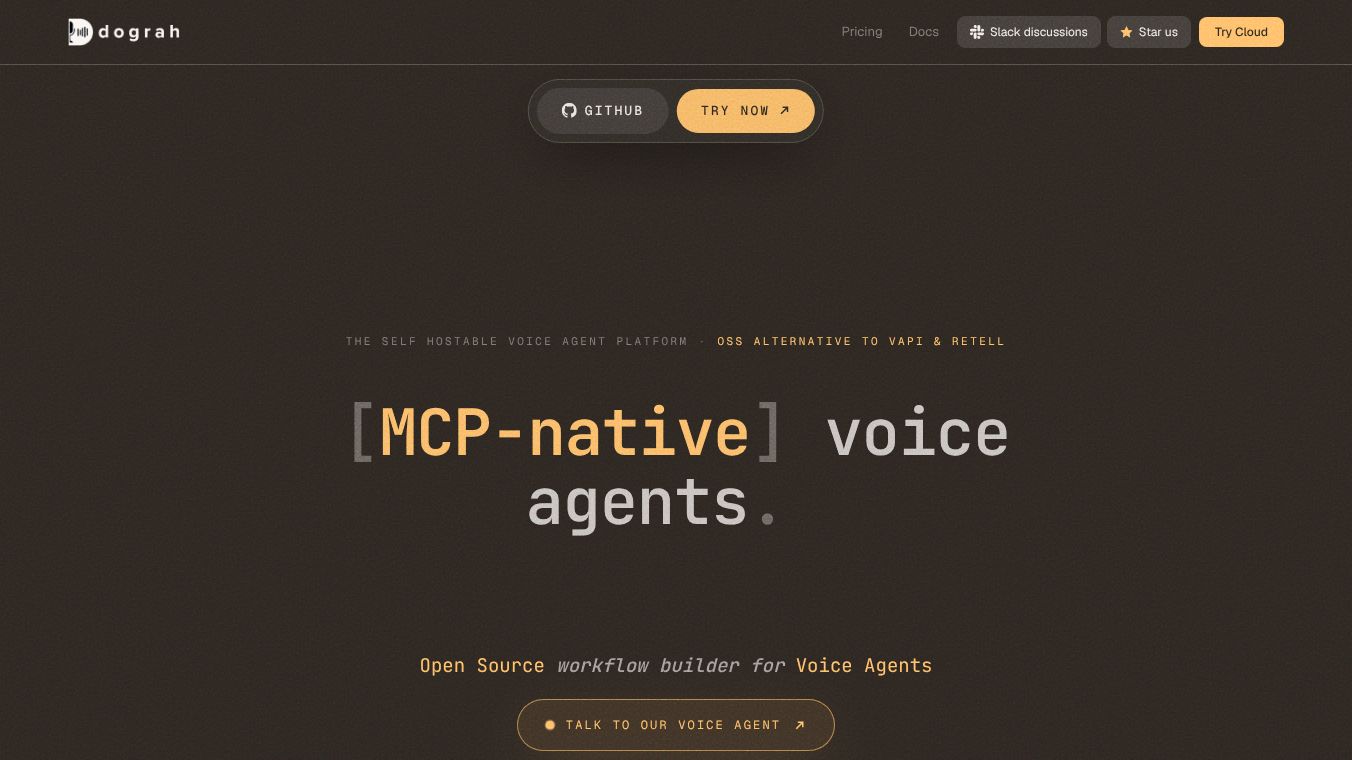





Dograh AI: Open-Source, Self-Hosted Voice AI with a Visual Workflow Builder
Dograh AI is an open-source platform that lets users build their own voice AI agents. It runs on a computer or server that the user controls, giving them full ownership of their data and costs. The tool combines a visual builder for designing conversation logic with a powerful voice engine that handles real-time audio streaming. Unlike closed systems, Dograh allows users to connect their own Large Language Models, text-to-speech services, and phone providers. This setup helps teams avoid high fees and hidden costs often found in proprietary software.
Benefits
Dograh offers several key advantages over standard voice AI solutions. First, it is self-hosted, meaning users keep all their data private and do not pay monthly platform fees. Second, the visual workflow builder makes it easy to design complex conversation paths without writing code. Users can drag and drop nodes to create logic for questions, data extraction, and call transfers. Third, the platform provides deep debugging tools. Every call generates a detailed trace that shows exactly which steps were taken, what data was extracted, and where the conversation went wrong. This visibility helps teams fix issues quickly. Finally, the model-agnostic design lets users choose the best providers for speech recognition and generation, optimizing for cost and quality.
Use Cases
This tool is ideal for businesses that need custom voice assistants but want to avoid vendor lock-in. One common use case is lead qualification. Companies can use Dograh to have AI agents answer inbound calls, ask specific questions to determine if a customer is interested, and automatically create records in a CRM system. If the lead is not qualified, the agent can transfer the call to a human representative. Another use case is customer support. Teams can build agents that handle routine inquiries, extract order details, and resolve simple issues before escalating to staff. The platform also works well for sales teams that need to practice scripts or conduct automated follow-ups. Because it runs via Docker, it can be deployed in various environments, from small offices to large enterprise data centers.
Pricing
Dograh is open-source software, so there is no upfront license fee. Users can download and install it for free. However, costs may arise from the infrastructure required to run the system. This includes expenses for servers, storage, and the third-party services used for voice processing like text-to-speech and speech-to-text. Since users bring their own providers, they can negotiate better rates or switch services as needed without paying extra to the platform.
Vibes
Users who have tried Dograh generally appreciate the balance between ease of use and control. The visual builder is praised for making it simple to create agents without needing deep programming skills. Developers value the detailed call traces and debugging tools, which make troubleshooting much faster than in other systems. The community around the project is active, with many contributors helping to improve the code and documentation. Overall, the vibe is one of empowerment, as users feel they have full control over their voice AI infrastructure without sacrificing functionality.
Additional Information
Dograh is built and maintained by the Dograh HQ team. The project is hosted on GitHub, where the source code is available for anyone to review or contribute to. Installation is straightforward and requires only Git, Docker, and Docker Compose. The entire system can be started with a single command, launching the user interface, backend API, and database automatically. The team focuses on making the platform accessible to both technical and non-technical users by providing clear documentation and guided walkthroughs for building specific agents like lead qualifiers.
This content is either user submitted or generated using AI technology (including, but not limited to, Google Gemini API, Llama, Grok, and Mistral), based on automated research and analysis of public data sources from search engines like DuckDuckGo, Google Search, and SearXNG, and directly from the tool's own website and with minimal to no human editing/review. THEJO AI is not affiliated with or endorsed by the AI tools or services mentioned. This is provided for informational and reference purposes only, is not an endorsement or official advice, and may contain inaccuracies or biases. Please verify details with original sources.


Comments
Please log in to post a comment.