Deepleex
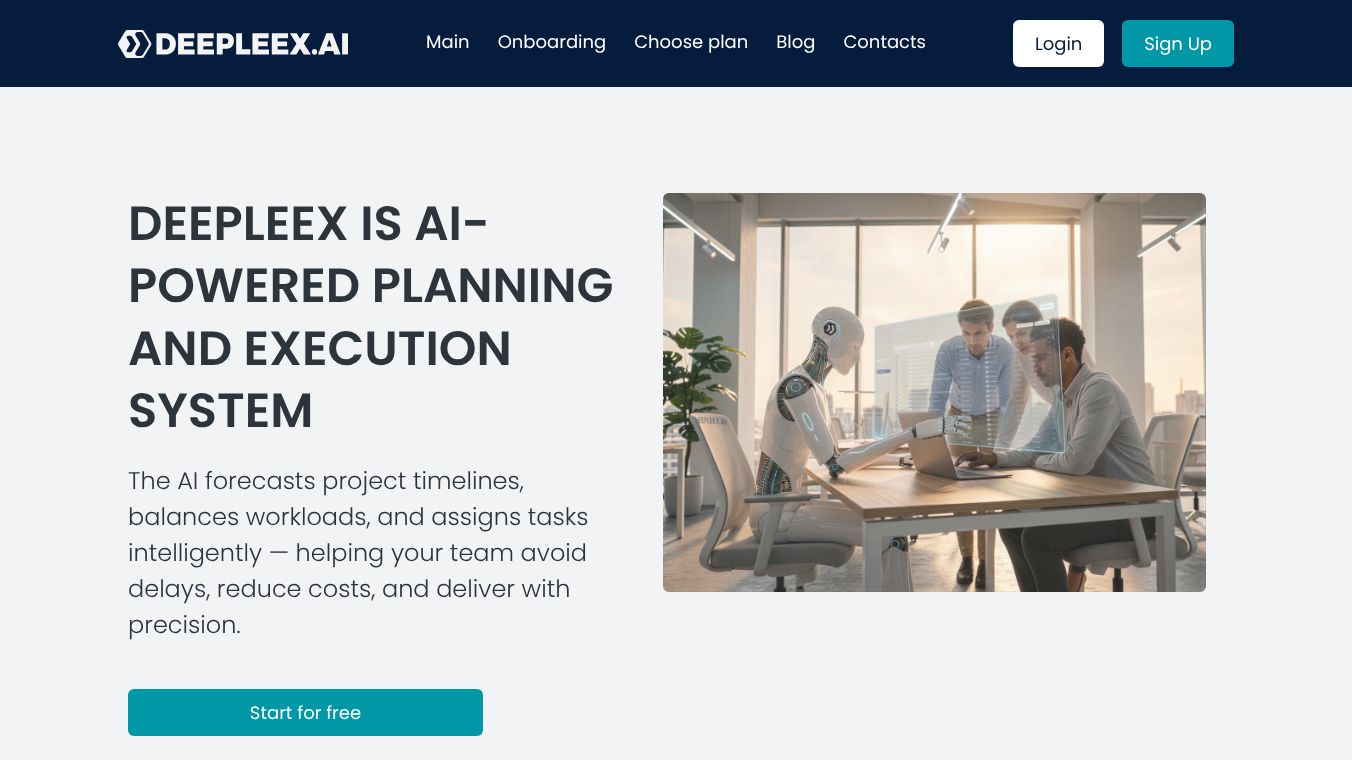





Deepleex: AI-Powered Planning and Execution System
Overview
Deepleex is an intelligent system designed for the planning and execution of tasks and projects. It functions as a comprehensive workspace that forecasts project timelines, balances workloads, and assigns tasks intelligently. By leveraging actual resource data, task composition, and performer productivity, Deepleex helps teams avoid delays, reduce costs, and deliver projects with precision. Unlike traditional task trackers that merely record statuses, Deepleex focuses on the work plan, deadlines, and resource constraints to ensure projects are actually completed on time.
Benefits
Deepleex addresses four primary challenges common in project management. First, it solves unpredictable timelines and costs. Project deadlines and budgets often deviate from plans, with real numbers becoming clear too late. Deepleex builds work plans based on actual resources and productivity, allowing managers to constantly monitor current deadlines and costs against baseline values. Second, it fixes imbalanced workloads. Manual workload balancing is time-consuming and often results in some employees burning out while others remain idle. Deepleex automatically balances workloads, evenly distributing tasks while respecting specialists' work schedules. Third, it removes subjective performance evaluation. Managers often lack quantitative metrics to assess employee effectiveness. Deepleex calculates employee productivity and costs in real-time, displaying the dynamics of these metrics over time to provide an objective view of team performance. Finally, it creates a unified workspace. When tasks, files, and plans are scattered across different tools, teams lose context and control. Deepleex unifies requirements capture, task creation, planning, communication, and progress tracking into a single transparent workspace.
Use Cases
Deepleex is suitable for teams handling a large number of tasks, dependencies, roles, and resource constraints. Ideal use cases include product and project teams, software development teams, implementation projects, operational units, and service and support teams. It is particularly well-suited for large organizations requiring strict structure, roles, permissions, and plan control. The system operates through a structured four-step process. Users first describe their team by creating a team, inviting members, assigning profiles and specific skills, defining working hours and schedules, and entering the team's productivity rate. Next, they define the work by adding project sections, entering requirements detailing what needs to be delivered, breaking requirements down into tasks and work items, distributing requirements into stages, and setting effort estimates and priorities. The third step involves AI planning and launching. Users build the plan using AI planning capabilities, review generated dates and workload distributions, and confirm and launch the plan. The final step is execution and control. Users move tasks through Kanban statuses like To Do, In Progress, Blocked, and Done. They mark progress and completion, track workload and schedule shifts, and act on needs attention alerts regarding bottlenecks or slippage. Discussions can happen directly within the system or via Telegram integration.
Pricing
Deepleex offers a trial subscription that lasts for two weeks upon first login. This trial provides Middle-level access rights limited to 50 users. During this time, teams can build project structures, import tasks, create phased plans, and test AI planning modes. After the trial, users can choose a new subscription or continue on a free plan with functional limitations to keep the project running.
Vibes
The system is designed to be a powerful assistant for calculations rather than an autonomous decision maker. The AI acts as a helper for calculations, highlighting conflicts and suggesting options, but human users retain control over priorities and parameters. This approach ensures that while the technology provides deep insights into potential issues well before deadlines become critical, the final decisions remain in human hands. The platform emphasizes proactive management, allowing teams to see potential issues early. It also supports custom integrations with internal or external systems in as little as five days using secure OAuth-based connections. For teams already using Jira, Asana, or ClickUp, Deepleex can import tasks and build execution plans from these tools while maintaining links to the original sources.
Additional Information
Deepleex includes a permission model to control who sees what and who can change what, which is essential for large organizations with multiple teams. The system organizes work hierarchically to preserve context with a structure that moves from Project to Section to Requirement to Task to Work Item. Users can create phases within a project to assign tasks and form a clear work plan. The system supports custom task and requirement states. When a task is broken down into work items, the custom state is automatically calculated based on the name of the last started work item, reflecting the real process without complex configuration. Time tracking allows users to record actual time spent and compare plan versus fact to improve future forecasting. Manager analytics provide basic and advanced reports on productivity trends, engagement, resource utilization, cost, plan deadline and budget forecasts, and risk points. A lightweight task management bot for Telegram groups called TagskBot allows task creation via CLI commands and live progress tracking within existing conversation threads.
This content is either user submitted or generated using AI technology (including, but not limited to, Google Gemini API, Llama, Grok, and Mistral), based on automated research and analysis of public data sources from search engines like DuckDuckGo, Google Search, and SearXNG, and directly from the tool's own website and with minimal to no human editing/review. THEJO AI is not affiliated with or endorsed by the AI tools or services mentioned. This is provided for informational and reference purposes only, is not an endorsement or official advice, and may contain inaccuracies or biases. Please verify details with original sources.


Comments
Please log in to post a comment.