ContextLane





ContextLane: A Self-Hosted AI Gateway for Model Routing and LLM Cost Control
Overview
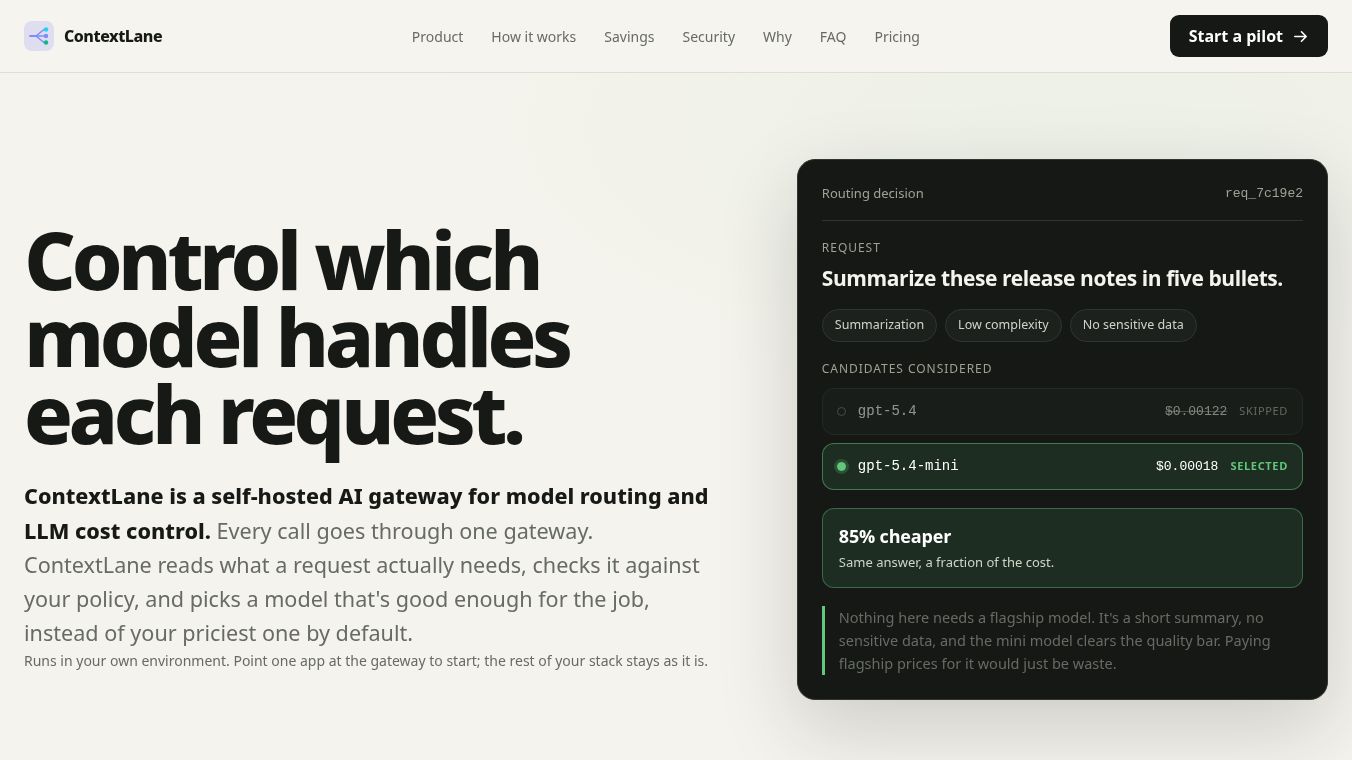
ContextLane is a self-hosted AI gateway designed to optimize model routing and control Large Language Model (LLM) costs. It operates as a central layer in your infrastructure, intercepting every request to analyze its requirements, apply organizational policies, and select the most appropriate model from your approved providers. Instead of defaulting to the most expensive flagship models for every task, ContextLane routes requests to the least expensive model that meets the quality and complexity thresholds, significantly reducing operational expenses.
Benefits
ContextLane offers several key advantages for organizations managing AI infrastructure. Its primary value lies in cost reduction through intelligent downgrading. The system calculates savings by comparing the baseline cost of using a premium model against the actual cost of the selected model. For example, a simple task might cost $0.012 with a flagship model but only $0.002 with a smaller model, resulting in an 83% reduction. This approach ensures that expensive resources are reserved for complex tasks while simple queries use cheaper alternatives.
The platform also provides comprehensive visibility and control. Administrators can configure rules for provider allowlists, pinned models, and sensitivity filters. The system records metadata for every request, creating detailed audit trails for finance and operations teams. This allows organizations to attribute model spend by team, application, or feature. Additionally, ContextLane supports fallback management, ensuring that if a selected model fails, the system can automatically switch to another approved option based on policy.
Security is a major benefit as ContextLane is self-hosted. The servers never enter the request path directly; instead, they act as a gateway that reaches out to chosen providers. This means that API keys, prompts, audit logs, and database data remain under the customer's control within their own environment.
Use Cases
ContextLane is designed for teams that need centralized control over their AI infrastructure. It serves as a control plane for platform engineering, product teams, and finance departments. The tool integrates seamlessly with existing model providers such as OpenAI, Anthropic, Google Gemini, Qwen, Kimi, Z.AI, DeepSeek, and Grok.
The platform offers three distinct interfaces to suit different needs. The API mode is best for products, internal services, agents, and CI/CD workflows that require repeatable controls. The Chat mode provides a shared workbench for teams, offering session continuity and visible model or cost metadata. The CLI mode allows developers to make repository-aware asks directly from their terminal while adhering to the same policies and routing rules.
Organizations can deploy ContextLane in their own environment using Kubernetes or VMs. This setup requires replacing the application endpoint and credentials with the ContextLane gateway values. The rest of the application stack remains unchanged, making the integration process straightforward for teams already using these providers.
Pricing
ContextLane offers two commercial models to align with different procurement strategies. The first is a predictable subscription plan. This is a fixed monthly fee ideal for teams that require stable budget planning and predictable spend regardless of the volume of savings generated. The second model is savings-aligned. This performance-based option ties pricing directly to verified savings. It is best for teams that want their costs to scale with their impact and prefer a lower fixed commitment.
Vibes
The article does not include specific customer reviews, testimonials, or public reception data regarding ContextLane.
Additional Information
The article does not provide details about specific funding rounds, partnerships, or notable achievements beyond its core functionality and business models.
This content is either user submitted or generated using AI technology (including, but not limited to, Google Gemini API, Llama, Grok, and Mistral), based on automated research and analysis of public data sources from search engines like DuckDuckGo, Google Search, and SearXNG, and directly from the tool's own website and with minimal to no human editing/review. THEJO AI is not affiliated with or endorsed by the AI tools or services mentioned. This is provided for informational and reference purposes only, is not an endorsement or official advice, and may contain inaccuracies or biases. Please verify details with original sources.



Comments
Please log in to post a comment.