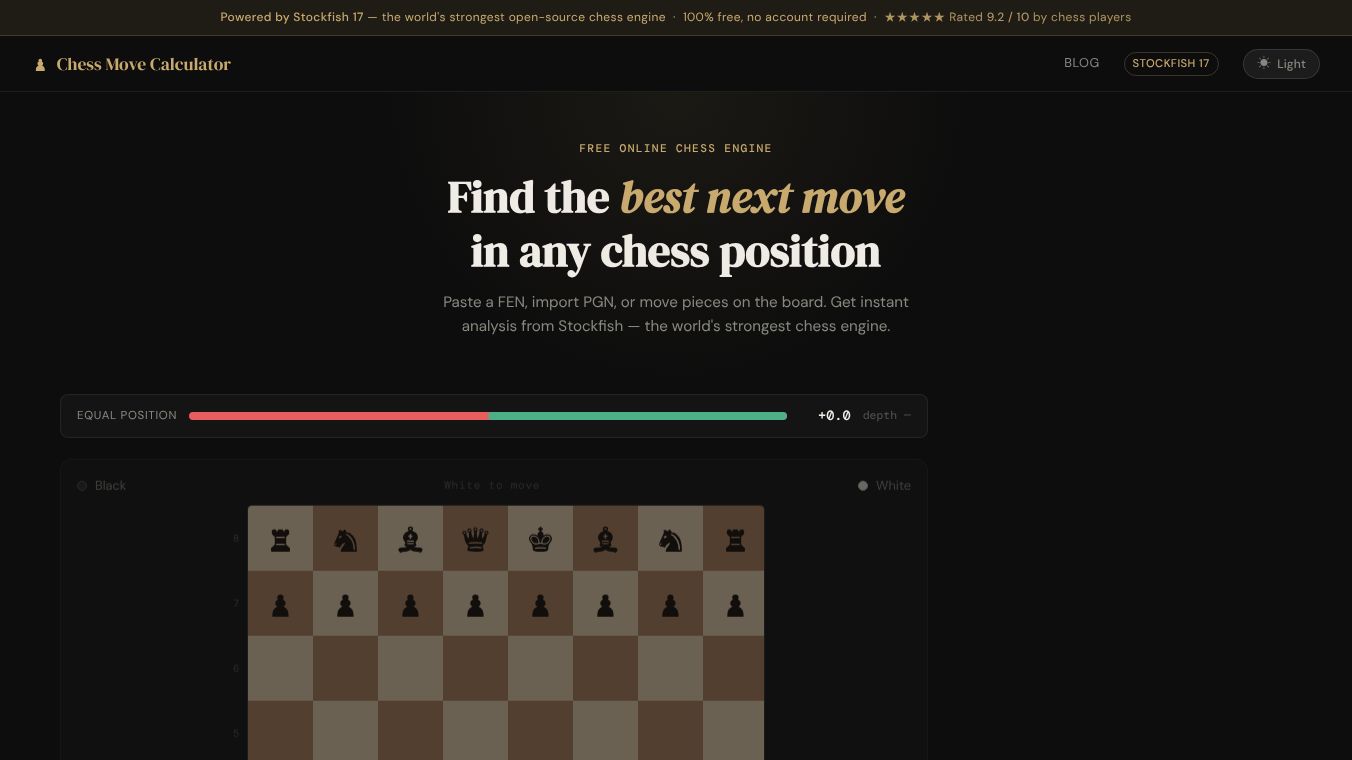





The Chess Move Calculator is a digital tool designed to help chess players analyze their games. It allows users to input a sequence of moves and calculates the resulting position on the board. This tool is useful for studying past games, practicing new openings, or reviewing mistakes made during a match.
Benefits
The main advantage of using this tool is its ability to visualize complex game scenarios quickly. Players can see exactly how a specific move affects the board without needing to set up a physical board. It helps in understanding tactical patterns and strategic decisions by showing the outcome of different move sequences. The tool supports both standard chess rules and variations, making it versatile for different skill levels.
Use Cases
This tool is ideal for chess enthusiasts who want to improve their game. Beginners can use it to learn basic opening principles by seeing how moves unfold. Intermediate players can analyze their own games to identify errors or missed opportunities. Advanced players might use it to test theoretical lines or prepare for upcoming tournaments. It can also be used in casual settings where friends want to discuss a specific game without the need for physical pieces.
Pricing
Pricing details are not available for this product.
Vibes
Public reception and specific reviews are not available for this product.
Additional Information
Funding, partnerships, or notable achievements are not available for this product.
This content is either user submitted or generated using AI technology (including, but not limited to, Google Gemini API, Llama, Grok, and Mistral), based on automated research and analysis of public data sources from search engines like DuckDuckGo, Google Search, and SearXNG, and directly from the tool's own website and with minimal to no human editing/review. THEJO AI is not affiliated with or endorsed by the AI tools or services mentioned. This is provided for informational and reference purposes only, is not an endorsement or official advice, and may contain inaccuracies or biases. Please verify details with original sources.





Comments
Please log in to post a comment.