Chat with Web Pages: AI Knowledge Base





Chat with Web Pages: Transforming the Web into a Personal AI Knowledge Vault
Overview
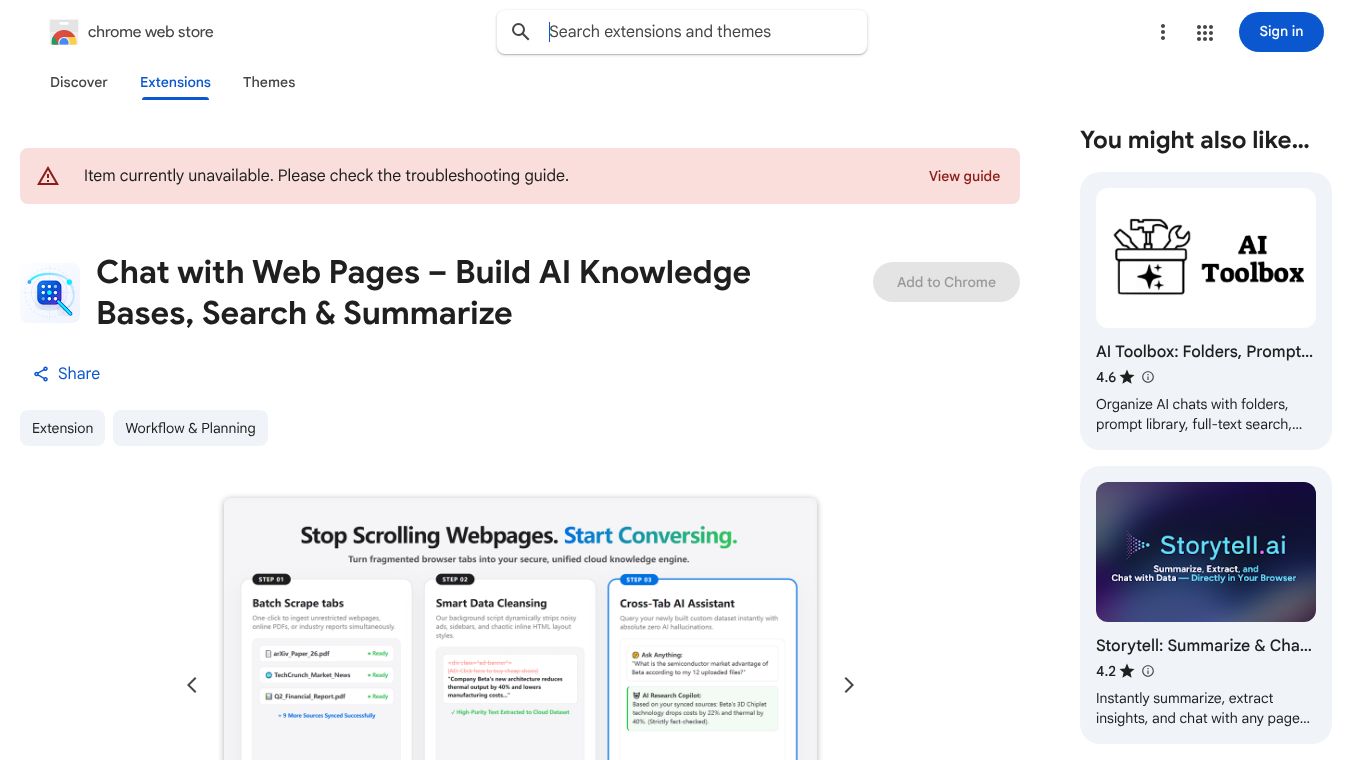
Chat with Web Pages is a Chrome extension designed to turn scattered webpages, PDFs, and documents into a private, queryable AI knowledge base. It functions as a personal research assistant and second brain, allowing users to organize research, auto-summarize content, and generate insights grounded strictly in their collected data. By transforming chaotic browser tabs into a structured, searchable archive, the tool helps users avoid the limitations of generic AI chatbots that may provide hallucinated or irrelevant information.
Benefits
This tool offers several key advantages for anyone who deals with large amounts of information. First, it provides structured knowledge tags that let users organize their research into infinite, custom project categories. This ensures data remains clean and easy to find later. Second, the extension uses asset-first aggregation to extract clean, ad-free text from webpages and reports. This removes the noise of advertisements and formatting issues so users only see the important content. Third, it delivers grounded AI insights. Users can chat with their saved content to get answers that are strictly based on the data they have collected. This minimizes AI hallucinations and ensures every insight is supported by the user's own notes. Finally, the tool automates productivity by instantly generating structured summaries, outlines, and actionable reports from stored knowledge. It also allows cross-document intelligence, meaning users can query their entire research history across multiple pages within a specific tag.
Use Cases
Chat with Web Pages is ideal for a variety of professionals and students. Researchers and students can use it to manage literature reviews and complex papers without losing track of their sources. Analysts and professionals can aggregate industry reports and web data into structured knowledge bases to aid in decision-making. Power users can turn the entire web into a private, queryable research archive. For example, a student studying climate change could save hundreds of articles and reports, tag them by topic, and then ask the AI specific questions about the data without having to read every single document again. A business analyst could upload market reports and ask for a summary of trends, receiving answers that are strictly based on the uploaded files.
Pricing
Pricing details are not available in the provided information.
Vibes
Public reception and specific reviews are not available in the provided information.
Additional Information
The extension is developed by Ian Silas and can be contacted at devkhayo@web-library.net. The current version is 1.6.1, and it was last updated on July 28, 2026. The file size is 54.13 KiB, and it supports the English language. It is important to note that the tool is currently unavailable, and users are advised to check the troubleshooting guide for more details. The developer has declared that user data is not being sold to third parties, not being used for purposes unrelated to the item's core functionality, and not being used to determine creditworthiness or for lending purposes. Data is indexed and stored locally within a secure knowledge vault to ensure research remains confidential and under the user's control.
This content is either user submitted or generated using AI technology (including, but not limited to, Google Gemini API, Llama, Grok, and Mistral), based on automated research and analysis of public data sources from search engines like DuckDuckGo, Google Search, and SearXNG, and directly from the tool's own website and with minimal to no human editing/review. THEJO AI is not affiliated with or endorsed by the AI tools or services mentioned. This is provided for informational and reference purposes only, is not an endorsement or official advice, and may contain inaccuracies or biases. Please verify details with original sources.

Comments
Please log in to post a comment.