browser-memory
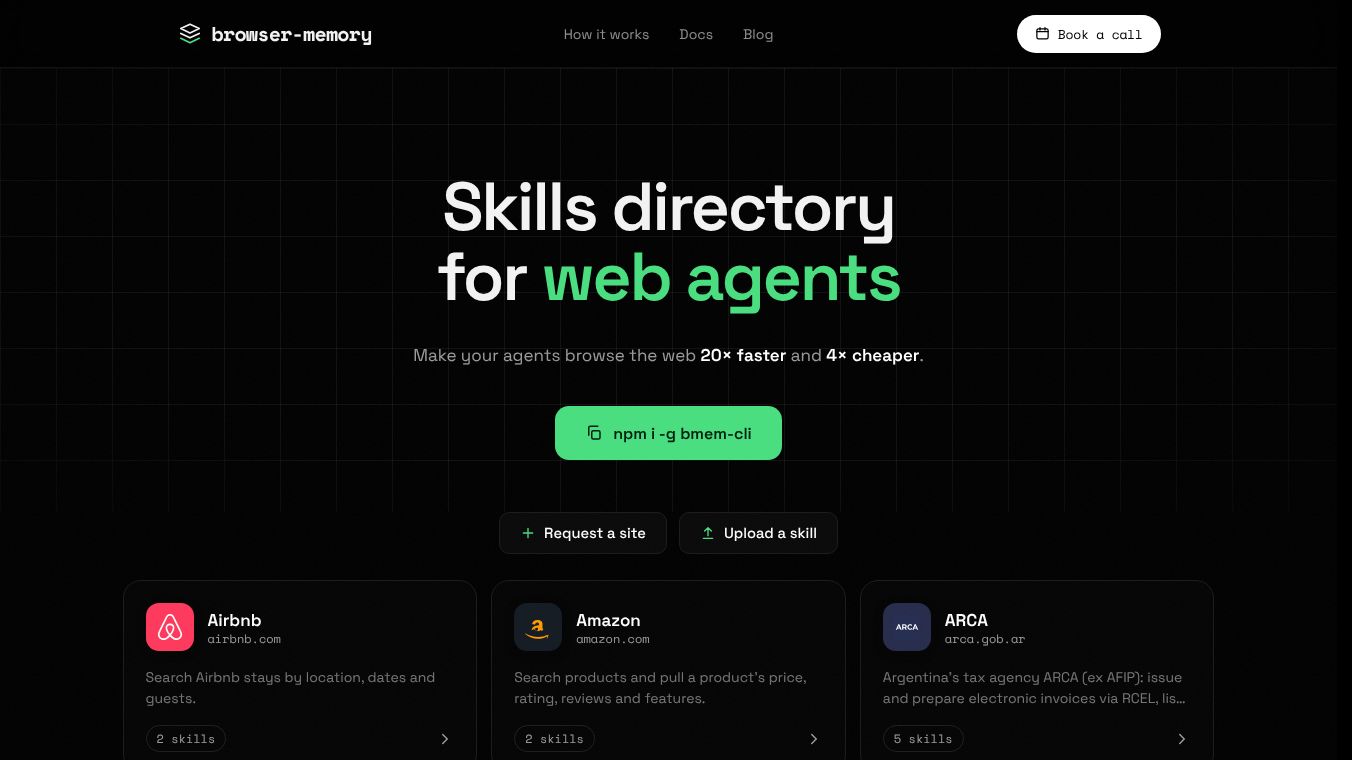





How Browser-Memory Works: Accelerating AI Agents with a Shared Web Ecosystem
The Challenge of Repeated Browsing
AI agents and automation tools frequently face the inefficiency of re-learning how to navigate websites with every single visit. Traditional methods require an agent to repeatedly locate the Document Object Model (DOM), identify interactive elements, and understand data exchange protocols (XHR) for every task. This process is not only slow but highly fragile; as websites update their markup or APIs, these tools break overnight, forcing agents to re-learn the site from scratch.
The Browser-Memory Solution
Browser-Memory is a system designed to eliminate this redundancy by creating a persistent, shared memory of the web. It allows agents to stop re-learning the same pages on every visit, significantly increasing efficiency and reliability.
1. A Shared Memory Ecosystem
The core innovation of Browser-Memory is a universal, shared catalog accessible by all agents. Because website structures and APIs change constantly, any single agent's tool can break. However, in a shared ecosystem, the first agent to encounter a broken tool or a new site feature repairs or builds it once. This fix is then immediately available to every other agent in the network.
This collaborative approach ensures that the ecosystem continuously improves. As more agents utilize the system, the collective knowledge base grows, making the entire network more robust and efficient.
2. Prebuilt DOM and XHR Tools
Browser-Memory automatically converts a website's DOM selectors and XHR requests into ready-to-use tools. Instead of an agent manually parsing the page structure, it can call specific, pre-built functions.
- Dynamic Updates:These tools are kept current as website markup and APIs shift. This ensures that agents always call a working tool rather than attempting to reverse-engineer the page layout.
- Universal Coverage:The system currently supports a vast array of major platforms, including:
- Walmart (92 tools)
- Amazon (100 tools)
- Booking.com (78 tools)
- Airbnb (64 tools)
- eBay (86 tools)
- AliExpress (71 tools)
3. On-Demand Tool Generation
When an agent requires a tool that is not yet in the shared catalog, or encounters a broken one, Browser-Memory deploys a subagent to build it in real-time.
- Process:The subagent builds and tests the tool directly within the browser environment.
- Validation:Once the tool passes the Browser-Memory test suite (e.g., successfully capturing DOM and XHR data and executing logic), it is saved to the shared memory ecosystem.
- Result:The newly created tool becomes instantly available for all agents, ensuring seamless operation without manual intervention.
Impact on Performance
By leveraging a reusable memory of the web, Browser-Memory enables browsing agents to operate approximately 20 times faster than traditional methods. With a single command, an agent gains access to a comprehensive, up-to-date repository of web interactions, allowing for complex tasks such as shopping, tracking orders, or booking travel to be executed with minimal latency and maximum reliability.
Example Workflow
Consider an agent tasked with purchasing items online:1.Traditional Approach:The agent must locate the product pages, add items to the cart, and find the checkout button by parsing the HTML every time.2.Browser-Memory Approach:The agent calls pre-built functions like supermarket.buy(milk), supermarket.buy(bread), and supermarket.checkout(). These functions are already optimized and verified, allowing the agent to complete the transaction instantly.
Conclusion
Browser-Memory transforms the way AI agents interact with the web by shifting from a reactive, repetitive model to a proactive, collaborative one. By maintaining a shared, self-healing catalog of web tools, it ensures that agents remain fast, accurate, and resilient against the constant evolution of the internet.
This content is either user submitted or generated using AI technology (including, but not limited to, Google Gemini API, Llama, Grok, and Mistral), based on automated research and analysis of public data sources from search engines like DuckDuckGo, Google Search, and SearXNG, and directly from the tool's own website and with minimal to no human editing/review. THEJO AI is not affiliated with or endorsed by the AI tools or services mentioned. This is provided for informational and reference purposes only, is not an endorsement or official advice, and may contain inaccuracies or biases. Please verify details with original sources.


Comments
Please log in to post a comment.