Audar-TTS-V1
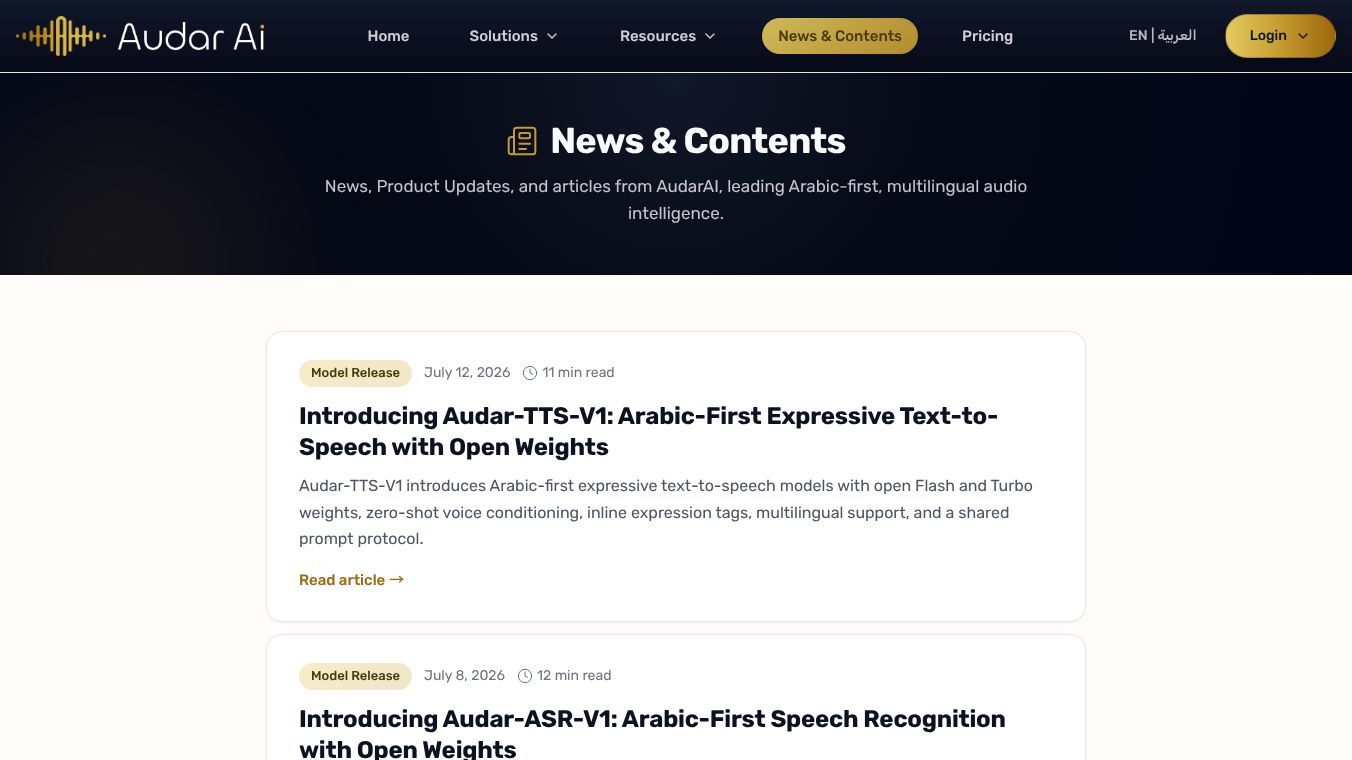





Audar-TTS-V1-Flash: Open, Arabic-First, Expressive Zero-Shot Text-to-Speech
Research Context and Background
Audar-TTS-V1-Flash is the smallest and fastest member of the Audar-TTS family. It is a compact, open-weights speech model designed for real-time performance. With approximately 553 million parameters, it converts text into natural, expressive speech. The model is optimized for Arabic-first use cases but also supports English and code-switching between the two languages. It is built to run efficiently on various devices, from powerful GPUs to simple CPUs and edge devices.
Benefits
Audar-TTS-V1-Flash offers several key advantages for developers and users. First, it supports zero-shot voice cloning, meaning users can create a new voice using only a 5 to 15 second audio clip without needing to fine-tune the model for each speaker. Second, it is fully bilingual and handles Arabic-English code-switching smoothly. Third, the model includes expressive control features. Users can add tags like [laughs], [whispers], or [excited] to shape the delivery of the speech. Finally, the model is open-source and released under a license that allows commercial use without revenue caps or royalties. It also comes in different quantization sizes to fit different hardware needs.
Use Cases
This tool is designed for a wide range of applications. It is ideal for building voice assistants and virtual agents. It works well for narration tools and accessibility software that helps people listen to text. It is also suitable for IVR and telephony systems that need to handle customer calls. Any application that requires synthesizing Arabic and English speech in the cloud, on-premises, or offline can benefit from this model. The ability to run on edge devices makes it perfect for scenarios where internet connectivity is limited or expensive.
Pricing
Audar-TTS-V1-Flash is free to use. The model is released under the AudarAI Open License v1.0. This license allows commercial use without any revenue caps, user limits, or royalties. Users are free to redistribute and modify the model, including fine-tuning and quantization, as long as they include the license with their distributions.
Vibes
As an open-source model, there are no traditional user reviews or testimonials available yet. However, the project has gained attention for its focus on Arabic-first technology. The developers emphasize responsible use, stating that zero-shot cloning should only be used for voices that have given consent. The community is encouraged to use the model to build tools that help people communicate across languages and cultures rather than to deceive or impersonate others.
Additional Information
Audar-TTS-V1-Flash is part of a larger family of models that includes the Turbo and Pro variants. The Flash version is the most compact, while the Pro version is expected to offer maximum expressiveness and fidelity in the future. The model is hosted on Hugging Face and can be accessed via llama.cpp for local deployment. It uses a neural codec specifically fine-tuned for Arabic to ensure high-quality audio output at 24 kHz. The project is led by AudarAI, a company focused on building advanced speech technology for Arabic and global multilingual markets.
This content is either user submitted or generated using AI technology (including, but not limited to, Google Gemini API, Llama, Grok, and Mistral), based on automated research and analysis of public data sources from search engines like DuckDuckGo, Google Search, and SearXNG, and directly from the tool's own website and with minimal to no human editing/review. THEJO AI is not affiliated with or endorsed by the AI tools or services mentioned. This is provided for informational and reference purposes only, is not an endorsement or official advice, and may contain inaccuracies or biases. Please verify details with original sources.
Comments
Please log in to post a comment.